
The Debate on reading books is better than watching TV remains one of the most common school debate topics for a reason. It looks simple at first, but once you start preparing, the real challenge appears: you need more than catchy lines. You need a clear definition of the motion, strong supporting points, fair counterarguments, and smart rebuttals that sound convincing in a classroom or competition setting.
This topic also matters beyond debate hall language. Reading is tied to literacy, school performance, and long-term opportunity, while screen-based media increasingly shapes how students spend their time. UNESCO notes that literacy expands capabilities and improves life chances, and the World Bank frames weak reading ability as a core education problem because children who cannot read with understanding struggle across the rest of school.
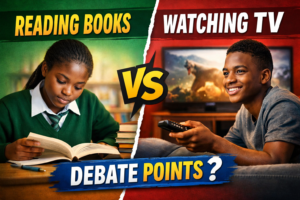
Understanding the motion: what the debate is really asking
When a debate says reading books is better than watching TV, it is not claiming that every book is automatically useful or that every television program is useless. The motion compares the two as habits. In other words, which one contributes more to learning, thinking, language growth, and personal development?
That distinction matters. A weak speaker attacks TV as if it has no value at all. A stronger speaker admits that television can educate, entertain, and inform, then shows why reading still offers deeper and more lasting benefits. That balanced approach is usually more persuasive because it sounds thoughtful rather than extreme.
Why this topic matters for students in Nigeria
For Nigerian students, this debate connects directly to a real education issue. In a 2022 foundational learning brief, UNICEF Nigeria reported that 70 percent of children in Nigeria could not read with meaning or solve simple math problems. The World Bank also explains “learning poverty” as being unable to read and understand a simple text by age 10, which shows how central reading is to education quality.
That is why this is not just a moral argument about “good habits.” It is a practical one. In a country where literacy and comprehension are still major education priorities, reading is not merely a hobby. It is a foundation. This is one reason a proposition speaker can defend the motion strongly without pretending that television has no place in modern learning.
You can also strengthen the article naturally with authority references such as UNESCO’s literacy overview and UNICEF Nigeria’s foundational literacy brief. Those links support the wider point that reading ability is not a side issue in education; it is central to it.
Debate on reading books is better than watching TV: the strongest arguments for the motion
Reading is active while TV is mostly passive
The first strong argument is that reading demands mental effort. A reader must follow ideas, interpret words, connect sentences, imagine scenes, and make meaning from the page. Television usually gives the images, sounds, expressions, and pacing to the viewer all at once. That makes watching easier, but ease is not always the same as better learning.
This matters because effort strengthens thinking. Research on reading consistently links comprehension to language knowledge and working memory, showing that reading is an active cognitive process rather than simple exposure to information. When students read, they are not just receiving content; they are processing it.
A clean debate line here is this: TV shows you; books make you think. That sentence is simple, memorable, and easy to defend.
Reading builds vocabulary, comprehension, and expression
One of the biggest advantages of reading books is language development. Students meet unfamiliar words in context, learn sentence patterns, and absorb how ideas are organized. Over time, that improves speaking, writing, and exam performance.
Research supports that connection. Studies in the reading literature show that vocabulary is closely tied to later reading achievement, and repeated exposure to new words through reading helps children grow and retain word knowledge. In plain terms, books do not just entertain; they quietly expand the language tools students need in class and beyond.
This is a powerful debate point because television can introduce words, but books force direct contact with language itself. A student who reads regularly is usually better prepared to write essays, explain ideas clearly, and follow complex questions.
Reading improves concentration and self-discipline
Reading asks for attention over time. You cannot skim a novel or textbook the same way you glance at a moving screen in the corner of a room. To read well, a student must slow down, stay present, and follow a sequence of ideas. That habit builds patience.
That matters academically because comprehension is tied to working memory and sustained processing. Research shows working memory is a well-established predictor of reading comprehension, which helps explain why regular reading supports disciplined thinking.
For a debate, this point is especially useful because it speaks to a hidden concern many teachers already see: some students struggle to sit with one idea for long. Reading trains the mind to stay with an argument. Television often trains the mind to wait for the next image.
Reading develops imagination and critical thinking
When students read, they construct the scene in their minds. They imagine characters, settings, tone, and motive. That process develops imagination in a way television rarely demands because the visuals are already supplied.
Reading also encourages judgment. A reader pauses, re-reads, questions the writer, and compares one idea with another. This deep engagement fits with UNESCO’s broader view of literacy as part of empowerment and critical participation in society, not just the mechanical act of recognizing words.
This is one of the most persuasive parts of the motion. Students are not only arguing that books give information. They are arguing that books help shape the kind of mind that can question information.
Books are easier to revisit, annotate, and study from
A television program moves at its own speed. Even when you can pause or replay, the experience is still built around a stream of pictures and sound. Books are different. A reader can underline, take notes, return to a paragraph, compare chapters, and quote exact lines more easily.
That makes books more useful for serious study. Reading fits exam preparation, note-making, revision, and independent learning. For many school tasks, especially subjects that require exact definitions, careful comparison, or written analysis, books are simply more practical tools.
This point works well in class debates because it is concrete. It moves the argument away from vague claims about intelligence and focuses on what students actually do with material when they study.
Reading supports stronger long-term academic habits
Books reward consistency. The habit of reading daily spills into other habits: checking meaning, following arguments, writing better answers, and spending time with ideas rather than only with stimulation. UNESCO links literacy to participation, health, work, and development, which shows that reading is not just a school skill but a life skill.
This is where the motion becomes bigger than “books versus TV.” It becomes a question of what kind of learner a student is becoming. A person who reads regularly is practicing independence. They do not have to wait for information to be packaged dramatically before they can absorb it.
A fair view of the opposing side: when watching TV has value
A good article or speech should not pretend the opposing side has no argument. Television does have value. In fact, denying that makes your position weaker.
Educational TV can teach facts and simplify complex ideas
Documentaries, news features, language programs, science shows, and classroom videos can explain difficult ideas quickly. Visual demonstration is useful for experiments, geography, history, and current affairs. The American Academy of Pediatrics also notes that high-quality media can support learning when carefully chosen and used with adults, especially for younger children.
This means the smart proposition speaker should not say, “TV teaches nothing.” That would be easy to attack. A better claim is: TV can teach, but reading usually teaches more deeply and more independently.
Visual learning helps some students understand faster
Some learners grasp ideas more quickly when they can see actions, diagrams, maps, or demonstrations. Television and video can reduce confusion where pure text feels abstract.
That is true. But quick understanding is not always the same as lasting understanding. Reading slows the learner down enough to interact with the material, question it, and revisit it. So even when TV helps introduce a topic, books often do the heavier work of mastery.
TV can widen exposure to culture, science, and current affairs
Television can expose students to places, accents, events, and professions they may never see directly. In that sense, TV can broaden awareness.
Still, awareness is only the first step. Deep knowledge usually requires reading beyond the program. A student may watch a documentary about climate change, a court case, or a historical event, but serious understanding often depends on reading texts, evidence, and analysis afterward.
Best rebuttals to use in the debate
If the opposition says, “TV is better because it is easier to understand,” your rebuttal should be that easier is not always better. A thing can be easier and still be less effective for building deep comprehension, vocabulary, and independent thought.
If they say, “TV is more interesting than books,” answer that interest alone is not the measure of educational value. Many useful things require effort. Reading trains the mind to work through complexity instead of expecting every idea to arrive as entertainment.
If they say, “Educational TV teaches students,” agree partly, then turn the point: yes, it can introduce knowledge, but books remain better for detail, revision, note-taking, language growth, and careful analysis.
If they say, “Modern life is digital, so TV and screens are the future,” respond that the future still depends on literacy. In fact, strong reading ability helps students navigate digital information, judge sources, and understand what they see online. UNESCO has explicitly linked literacy to critical thinking and navigating complex information environments.
For younger children, health guidance also leans toward reading and storytelling over passive screen use. The World Health Organization encourages reading and storytelling when children are sedentary and recommends tight limits on screen-based sedentary activities in early childhood. See WHO screen-time guidance. The American Academy of Pediatrics media guidance makes a similar point about choosing quality media and using it intentionally.
How to present your argument confidently in class or competition
A strong debate delivery does three things well.
First, define the motion clearly. Say that the comparison is about overall value to learning and development, not whether every TV program is bad.
Second, group your points. Instead of giving ten scattered lines, build three or four strong themes:
- reading develops language
- reading improves concentration
- reading strengthens imagination and critical thinking
- books support better study habits
Third, use contrast. Contrast is memorable. For example:
- TV gives images; books build images.
- TV can inform; books train the mind.
- TV is often consumed; books are worked through.
That kind of structure makes your speech easier to follow and easier to remember.
Common mistakes students make in this debate
The first mistake is exaggeration. Saying “TV is useless” or “books are always perfect” weakens your credibility. Balanced arguments win more often because they sound honest.
The second mistake is repeating the same point in different words. Vocabulary, communication, and writing are related, but they are not identical. Separate them clearly.
The third mistake is forgetting the real standard of comparison. The motion is not asking what people enjoy more on a Friday evening. It is asking which habit is better overall for learning, growth, and development.
The fourth mistake is using moral language instead of practical reasoning. Saying reading is “good” and TV is “bad” is too shallow. Explain what reading actually does for the mind, for school performance, and for independent learning.
Final practical takeaway before speaking or writing
The safest, strongest position is this: television has educational uses, but reading books is better because it develops language more directly, builds concentration, encourages imagination, supports deeper understanding, and strengthens long-term academic habits.
That position is hard to attack because it is not extreme. It gives credit to educational media while still defending the motion with confidence. For school debates, that balance usually sounds smarter than a one-sided attack on technology.
FAQ Section
1. Why is reading books better than watching TV in a debate?
Reading books is easier to defend in a debate because it promotes vocabulary growth, reading comprehension, concentration, imagination, and independent thinking more directly than TV. Television can inform, but reading usually requires deeper mental engagement.
2. Can watching TV ever be educational?
Yes. High-quality documentaries, news programs, and learning videos can teach useful information. The stronger argument is not that TV is worthless, but that books usually produce deeper language and study benefits.
3. What are the best points for students supporting the motion?
The strongest points are that reading builds vocabulary, improves concentration, develops imagination, supports note-taking and revision, and encourages critical thinking. Those points are broad enough for speeches and specific enough for rebuttals.
4. Is this topic relevant for Nigerian students?
Very much. Reading is central to foundational learning, and Nigeria still faces serious literacy challenges. That makes the debate practical, not just theoretical.
5. What is a good rebuttal if the opposition says TV is easier to understand?
A strong rebuttal is that ease is not the same as depth. TV may explain something quickly, but reading helps students process, revisit, and truly master ideas.
6. Should I say TV is bad in my debate?
No. That is usually too extreme. A better strategy is to admit that TV can educate and entertain, then show why books are still better for language development, deeper learning, and academic growth.
7. How should I end a debate on reading books and television?
End by returning to the standard of comparison: which habit better develops the learner. Then restate that books do more for comprehension, language, imagination, and disciplined study, even if television has some value.
Conclusion
The best version of the Debate on reading books is better than watching TV is not built on exaggeration. It is built on clarity. Reading asks more from the mind, and because it asks more, it often gives more back: stronger vocabulary, better comprehension, sharper concentration, richer imagination, and better study habits. Television can still be useful, especially when it is educational and carefully chosen, but books remain the stronger tool for deep learning and intellectual growth. For students in Nigeria and beyond, that is the argument worth making.