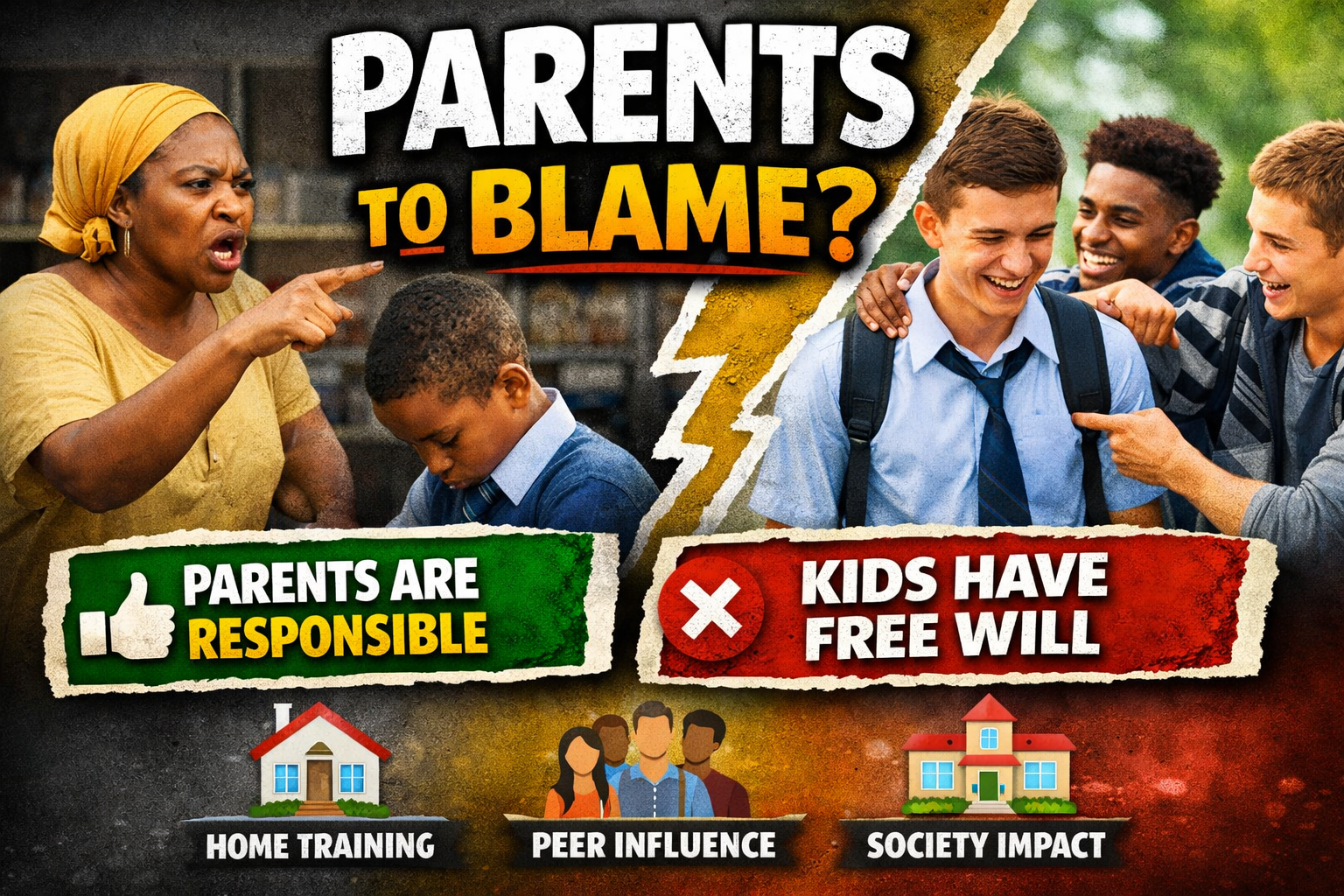
Debate Points on Parents Are to be Blamed for the Misconduct of Their Children: Arguments, Rebuttals, and Conclusion
In many school debates, the first speaker jumps up and says, “Charity begins at home,” then assumes the case is already won. That line is memorable, but it is not enough. If you want strong debate points on Parents Are to be Blamed for the Misconduct of Their Children, you need more than slogans. You need a clear argument, fair balance, and a conclusion that shows maturity. The strongest position is this: parents usually carry major responsibility for shaping children, but blaming them for every act of misconduct is too simplistic. International child-rights principles also recognize that parents have the primary responsibility for a child’s upbringing, while states and institutions are expected to support that role.
First, understand what the motion is really saying
This topic is not asking whether parents influence children. That part is easy. Of course they do. The real question is whether parents should be blamed when children behave badly.
That wording matters. Influence is not the same as total control. A parent can shape a child’s values, habits, discipline, and early worldview. But a child also grows into contact with friends, teachers, neighbors, media, and wider society. Even the strongest family does not raise a child in a vacuum. Research-based public-health guidance on youth violence and harmful behavior points to individual, relationship, community, and societal factors, not just one cause.
So a smart debater does not treat the issue as black and white. A smart debater asks: How far does parental responsibility go, and where does it stop?
The case for the motion: why parents can be blamed
1. The home is the first training ground of character
Before a child meets a teacher, a principal, or a police officer, the child has already been shaped by the home. That is where language, manners, respect, self-control, and early ideas of right and wrong begin. UNICEF describes parenting as the work of providing nurturing care throughout childhood and preparing children to live in society, form relationships, learn, work, and thrive. That is why many people argue that when misconduct becomes obvious, the first place to look is the home.
In a debate, this is one of the strongest opening points: children do not suddenly become well-behaved or badly behaved in public; the foundation is often laid in private.
2. Parents are the first role models
Children copy before they reason. They watch how adults speak, fight, apologize, lie, greet people, obey rules, and handle anger. Pediatric guidance from the American Academy of Pediatrics recommends positive discipline and specifically tells parents to model the behavior they want to see in their children. That matters because example often teaches faster than instruction.
A parent who shouts constantly but demands politeness is sending two different messages. A parent who cheats, insults others, or treats rules as optional should not be shocked when the child repeats the same pattern. In debate language, the point is simple: misconduct is often learned behavior.
3. Lack of supervision gives misconduct room to grow
Many forms of misconduct do not begin with evil intention. They begin with opportunity. Truancy, theft, lying, bullying, drug use, and reckless behavior often grow where children are left without proper monitoring, correction, or emotional attention.
This is not just a moral argument. In Nigeria’s Child’s Rights Act, parents and others responsible for children are given a duty to provide guidance, discipline, education, and training that help the child develop properly. The same Act also places a duty on every parent or guardian to ensure a child attends and completes basic schooling. That legal language reflects a broader social belief: raising a child is not a passive assignment.
In debate, this becomes a powerful line: where parents abandon supervision, misconduct often enters through the open door.
4. Wrong values at home often show up as bad behavior outside
A child who is taught entitlement may become rude. A child who grows up around violence may solve every disagreement with aggression. A child who sees dishonesty rewarded may not see cheating as wrong.
The point here is not that every badly behaved child came from a bad home. That would be careless. The stronger argument is that parents set the moral climate in which the child first develops. When that climate is careless, inconsistent, or corrupt, misconduct becomes easier to justify.
This is why proposition speakers often say that parents should be blamed not only for what they teach directly, but also for what they normalize. Silence can also train a child. When a child lies and no correction follows, the lesson has already been taught.
5. Some parents actively excuse or defend bad behavior
There is a difference between a struggling parent and an enabling parent. Some parents correct misconduct early. Others defend it, cover it up, blame teachers, or attack anyone who disciplines the child. That response does serious harm because it teaches the child that consequences can be escaped.
Once a child believes, “My parents will always justify me,” bad conduct hardens into character. At that point, blame does not rest on the child alone. It also rests on the adults who protected the behavior instead of confronting it.
6. Society rightly expects parents to take primary responsibility
This argument is stronger when it is framed carefully. The Convention on the Rights of the Child says both parents share responsibilities for upbringing and development, and that parents or legal guardians have the primary responsibility for that upbringing. That does not mean parents control everything. It means society recognizes them as the first and main custodians of child development.
So if the motion says parents are to be blamed, the proposition can argue that this is not cruelty. It is accountability. If parents hold the first responsibility, they cannot escape the first scrutiny.
The case against the motion: why blaming parents alone is too broad
1. Children have minds, choices, and agency of their own
At some point, every child becomes more than a reflection of home. Children think, choose, resist, imitate friends, hide behavior, and test boundaries. Two children raised in the same house can behave very differently. That fact alone should make any serious debater cautious.
If one child is respectful and the other is defiant, can we blame the same parents equally for both outcomes? Not automatically. Personality, temperament, and individual decision-making also matter.
This is where the opposition makes an important distinction: parents influence conduct, but they do not mechanically control every decision a child makes.
2. Peer pressure and environment shape behavior powerfully
Public-health evidence does not treat youth misconduct as a one-parent problem. The CDC identifies protective and risk factors across relationships, schools, and communities. It notes that connectedness to family and the ability to discuss problems with parents are protective, but it also points to school climate, supervision, community violence, unemployment, instability, and lack of youth activities as wider factors that shape harmful behavior.
That matters in a debate because it weakens any extreme claim. A child may come from a decent home and still be pulled by gangs, destructive friendships, violent neighborhoods, online influence, or school cultures that reward aggression. If those forces are real, then total blame on parents becomes unfair.
3. Some parents do everything right and still face serious challenges
Not every case of misconduct proves parental failure. Some parents teach values, supervise well, communicate openly, and still face rebellion, trauma, addiction, or hidden behavior. Children sometimes behave one way at home and another way outside it.
A good opposition speaker uses this point with restraint. The aim is not to remove parents from responsibility. The aim is to show that cause and blame are not always identical. A difficult child is not always evidence of a careless parent.
4. Blaming parents alone can hide the failure of schools and society
When a child misbehaves repeatedly, schools, communities, faith institutions, youth programs, and government systems also come into the picture. The Convention on the Rights of the Child does not only speak about parents; it also says states must support parents and protect children’s well-being through appropriate measures and services.
That means the burden is shared. If a society produces unsafe schools, glorifies bad behavior in media, weakens social support, and leaves young people without guidance structures, it cannot place all blame at the feet of parents.
A debate sounds more intelligent when it recognizes this: family is central, but family is not the whole system.
The strongest position in this debate
If you want the most convincing overall argument, avoid both extremes.
Do not say parents are never to blame. That sounds naïve.
Do not say parents are always to blame. That sounds careless.
The strongest position is this:
Parents deserve major blame when children’s misconduct clearly grows from poor upbringing, bad example, negligence, lack of discipline, or active encouragement of wrong behavior. But parents should not receive total blame in every case, because children are also shaped by personal choice, peers, schools, media, and society.
That position is more realistic, more defensible, and harder to defeat.
Debate-ready points for the proposition
Use these when speaking for the motion:
- Parents are the first teachers of the child.
- Character begins at home before it appears in society.
- Children often copy what they see, not what they are told.
- Lack of supervision allows misconduct to develop.
- Parents are responsible for discipline and moral training.
- Excusing a child’s wrongdoing encourages repeated misconduct.
- Society gives parents primary responsibility for upbringing.
Debate-ready points for the opposition
Use these when speaking against the motion:
- Children are not robots controlled entirely by parents.
- Peer pressure can overpower home training.
- School culture and community conditions influence conduct.
- Media and social trends shape behavior outside the home.
- Some children hide misconduct from responsible parents.
- Blaming parents alone ignores social and institutional failure.
- Human behavior is multi-causal, not one-dimensional.
Sharp rebuttals you can use in class
If you support the motion and the opposition says, “Peers are responsible”
You can reply:
Peers may influence behavior, but parents choose the values and discipline that prepare a child to resist bad influence. A child with strong home training is less likely to collapse under pressure.
That rebuttal works because the CDC’s protective factors include family connectedness, frequent shared activities, strong parental expectations, and the ability to discuss problems with parents.
If you oppose the motion and the proposition says, “Charity begins at home”
You can reply:
Yes, charity begins at home, but it does not end there. A child also grows in school, in the street, online, and among peers. If many forces shape behavior, then blaming parents alone is too narrow.
If you support the motion and they say, “Children make their own choices”
You can reply:
Children make choices, but parents shape the conscience behind those choices. The first moral training still comes from home.
If you oppose the motion and they say, “Parents have primary responsibility”
You can reply:
Primary responsibility is not the same as exclusive responsibility. Even child-rights frameworks place duties on society and the state to support children and families.
A short judgment for exams and speeches
If you are asked to take a final stand, this is a strong one:
Parents should be blamed to a large extent, because they are the first trainers, first role models, and first disciplinarians of the child. When they fail in supervision, value formation, and correction, misconduct often follows. Yet it would be unfair to hold that parents are always and completely responsible, because children are also shaped by peers, school, community, and personal choice. Therefore, parents deserve the greatest share of blame in many cases, but not absolute blame in every case.
FAQ Section
What is the strongest argument in favor of the motion?
The strongest argument is that parents are the first teachers and role models, so misconduct often reflects what a child has learned, seen, or been allowed to practice at home. That argument is strengthened by child-rights frameworks and parenting guidance that place primary upbringing responsibility on parents.
What is the strongest argument against the motion?
The strongest argument against the motion is that children are influenced by many forces beyond the home, including peers, schools, neighborhoods, and wider social conditions. Public-health guidance treats harmful youth behavior as multi-factor, not parent-only.
Should I argue fully for the motion or take a balanced position?
For a school debate, a strong balanced position is often more persuasive unless the format requires a strictly one-sided speech. It shows critical thinking and makes your argument harder to dismiss.
Can I use Nigerian examples in this debate?
Yes. That usually makes the speech stronger for a Nigerian audience. You can refer to absentee parenting, lack of supervision, defending children against rightful correction, exam malpractice support, or bad peer influence in schools. Keep examples realistic and respectful.
Is “blame” the same as “responsibility”?
Not exactly. Responsibility means having a duty. Blame suggests fault when something goes wrong. In this topic, that distinction helps you sound smarter because you can argue that parents have primary responsibility, but blame depends on the specific case.
Conclusion
The best way to handle debate points on Parents Are to be Blamed for the Misconduct of Their Children is not with noise, but with balance. Parents matter enormously. They shape the child’s earliest values, model behavior, and carry a serious duty to guide, discipline, and educate. For that reason, they can rightly be blamed when misconduct grows from neglect, poor example, weak supervision, or deliberate encouragement of wrong behavior. Still, children do not grow up inside the home alone. Friends, schools, media, neighborhoods, and personal choices also shape conduct. So the strongest conclusion is this: parents are often the first people to examine when a child goes wrong, but they should not be treated as the only cause in every case. That is the most defensible, intelligent, and debate-worthy position.