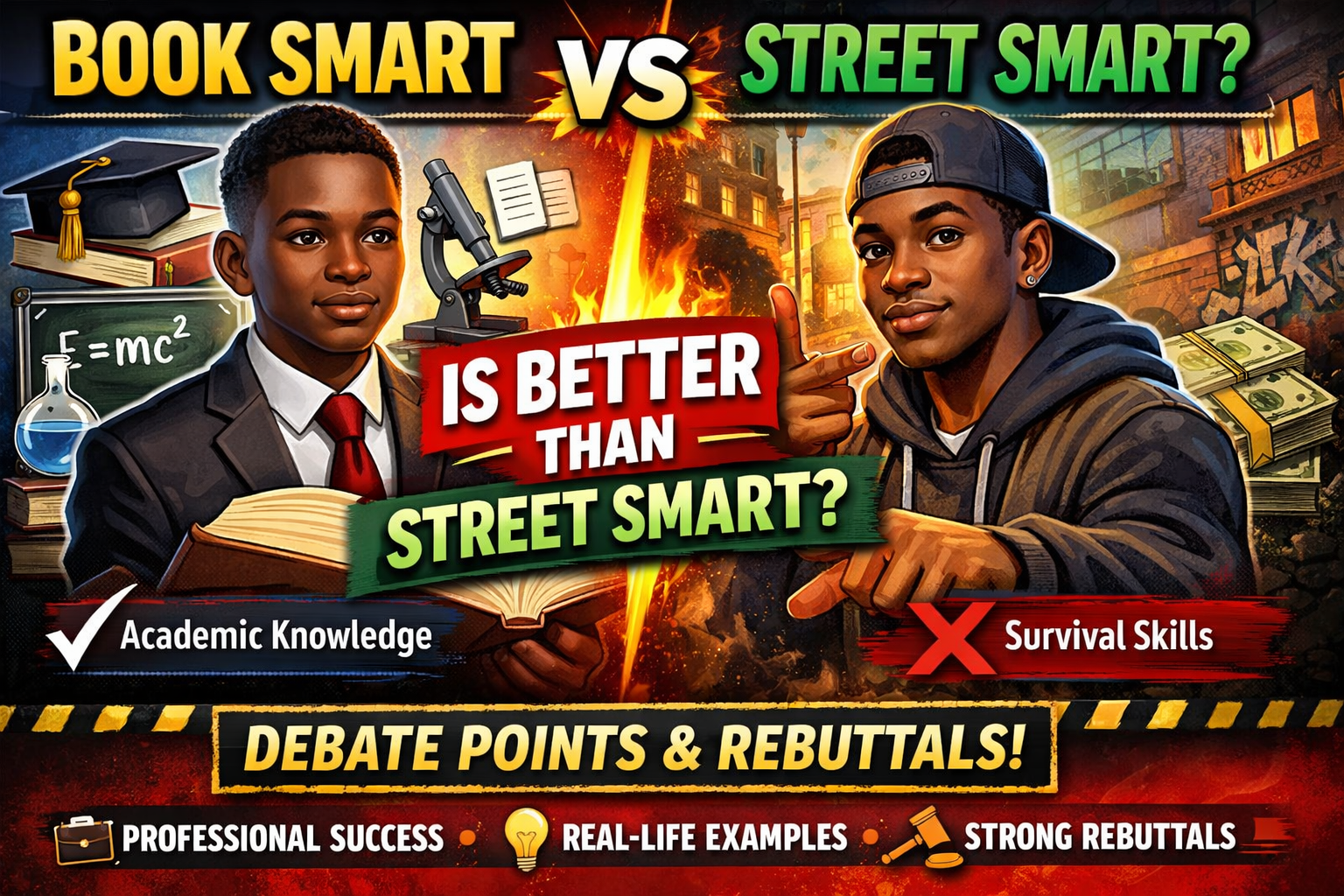
Book Smart Is Better Than Street Smart Debate Points: Strong Arguments, Examples, and Rebuttals
If you searched for book smart is better than street smart debate points, you probably do not need empty motivation or recycled quotes. You need arguments you can understand, remember, and defend in front of a class, a panel, or an audience.
This debate comes up often because both kinds of intelligence matter in real life. One helps people succeed in formal learning and professional environments. The other helps people read situations, avoid danger, and deal with everyday realities. That is exactly why the topic can confuse students. If both are useful, how do you argue that one is better?
The cleanest answer is this: street smart is valuable, but book smart provides a stronger, more reliable foundation for personal growth, professional competence, and long-term impact. In most structured societies, education-based intelligence opens more doors, sharpens reasoning, and creates knowledge that can improve not just one life, but many lives.
That is the side this article will help you defend.
First, define the terms properly
Before giving points, you need to define the motion clearly. Many weak debates fail because the speakers never explain what they mean.
Book smart refers to knowledge gained through study, reading, schooling, research, and formal learning. A book-smart person understands concepts, theories, systems, and facts. They often do well in academics and can explain ideas with logic and evidence.
Street smart refers to practical wisdom gained from life experience, observation, social awareness, and survival in everyday situations. A street-smart person can read people, avoid trouble, make quick judgments, and handle unpredictable situations.
This distinction matters because the debate is not about whether one side is useless. It is about which one is better. In debate terms, “better” usually means more dependable, more beneficial, more transferable, and more important in building success.
What this debate is really asking
Many students treat this motion as if it asks whether experience matters. That is too shallow.
The real question is this: Which form of intelligence gives a person a stronger advantage in life, especially in education, work, leadership, innovation, and long-term decision-making?
Once you frame it that way, the affirmative side becomes easier to defend.
Street smart can help a person survive a moment.
Book smart can help a person build a future.
That contrast is powerful because it shifts the debate from immediate convenience to lasting value.
The strongest debate points for the motion
1. Book smart gives people dependable knowledge, not just situational guesses
One major advantage of being book smart is that it is built on studied knowledge. It is not based only on instinct or scattered experience. It gives people tested information, principles, and methods they can use with confidence.
A student who studies mathematics understands formulas and how to apply them. A medical student learns anatomy, diagnosis, and treatment from years of structured learning. An engineer does not design a bridge by “reading the streets.” They rely on training, calculations, and scientific knowledge.
That matters because society depends on accuracy. In serious fields, guessing is dangerous.
Debate angle: Street smart may help a person react, but book smart helps a person know.
2. Book smart is essential for professional success in modern society
Most respected professions depend first on formal knowledge. Doctors, lawyers, pharmacists, accountants, architects, teachers, and scientists all need education. Even where confidence and practical ability matter, the starting point is still learning.
A street-smart person may negotiate well or spot danger quickly, but that alone cannot perform surgery, defend a constitutional case, or teach advanced chemistry. These roles require study, discipline, and certified competence.
This is one of the strongest affirmative arguments because it links intelligence to real-world responsibility. In modern life, the more complex the task, the more book smart matters.
Strong line for debate: You can admire street sense, but you cannot replace expertise with instinct.
3. Book smart improves critical thinking and sound reasoning
A common mistake is to assume book smart simply means memorizing facts. That is too narrow. Real academic intelligence teaches people how to reason, compare evidence, test ideas, and draw logical conclusions.
That skill goes beyond passing exams. It helps people detect false claims, understand consequences, and make informed choices. A book-smart person is trained to ask: What is the evidence? What is the cause? What is the alternative? What are the long-term effects?
Street smart often depends on experience in specific environments. Book smart trains the mind itself.
That is a deeper advantage.
4. Book smart opens doors to long-term opportunity
Street smart can help someone manage present challenges, but book smart often creates lasting opportunities. It leads to admission, scholarships, certifications, careers, promotions, and intellectual growth.
In many parts of the world, including Nigeria, education remains one of the strongest ladders for social mobility. A student from a modest background can change their life through academic success. Book smart ability is not just about classroom praise. It can create access.
That makes it more than personal intelligence. It becomes a tool for transformation.
Debate framing: Street smart may help you navigate your current environment. Book smart can help you rise beyond it.
5. Book smart drives invention, research, and societal progress
Societies move forward because people study, test, discover, and improve systems. Vaccines, legal systems, software, machines, educational reforms, and scientific breakthroughs do not emerge from raw instinct. They come from disciplined thinking and accumulated knowledge.
This point is especially effective because it lifts the debate above the individual level. Street smart may help a person survive a difficult market, avoid manipulation, or handle conflict. Those are useful skills. But book smart produces innovations that change communities, industries, and entire nations.
Without book-smart minds, there would be less progress in medicine, technology, engineering, and education.
That gives the affirmative side moral weight.
6. Book smart is more transferable across places and situations
Street smart can be highly local. What works in one street, one city, or one social circle may fail in another. Social cues differ. Risk patterns differ. Informal rules differ.
Book smart knowledge is often more portable. Mathematics works in Lagos and London. Medical science does not stop being valid because you crossed a border. A well-trained writer, analyst, teacher, or programmer can often apply their skills in many settings.
This makes book smart more universal.
A person who depends only on street smart may perform well in familiar environments but struggle outside them. A person with strong academic knowledge can often learn new systems more quickly because they already understand principles.
7. Book smart strengthens communication and argument
Debate itself quietly favors the book-smart side. Why? Because effective debating requires structure, clarity, evidence, logic, and definition. Those are strengths associated with academic intelligence.
A book-smart speaker is more likely to organize ideas well, explain terms precisely, and defend claims with reasoning rather than emotion alone. That does not mean every educated person speaks well, but it does mean book smart ability supports formal communication better.
This point works well in school debates because it connects directly to performance on stage.
You can put it like this: the very act of debating relies heavily on the strengths of the book-smart mind.
8. Book smart helps people separate appearance from truth
Street smart often values instinct, suspicion, and quick judgment. That can be helpful, but it can also create errors. People can misread others. They can become cynical. They can confuse confidence with truth.
Book smart training teaches patience with evidence. It reminds people that first impressions can mislead. It pushes them to verify, compare, and think before concluding.
That is important in an era full of rumors, manipulation, and misinformation. The ability to think carefully is not a luxury anymore. It is protection.
So while street smart says, “Be careful,” book smart adds, “Be correct.”
9. Book smart gives structure to natural talent and practical skill
Some people speak as if book smart and street smart are enemies. In reality, the strongest people often have both. But when both exist together, book smart usually gives structure to the rest.
A naturally clever trader becomes more effective when they understand accounting, market analysis, and business strategy. A talented athlete becomes stronger when they learn sports science, nutrition, and discipline. A persuasive leader becomes more effective when they understand history, law, and governance.
This is a subtle but powerful point: book smart does not destroy practical ability. It refines it.
That means even where street smart has value, book smart often becomes the force that sharpens and elevates it.
10. Book smart is more likely to create lawful, ethical, and responsible decisions
Street smart is often praised because it helps people “do what it takes” to get by. But that phrase can become dangerous. In some cases, it rewards manipulation, shortcuts, or cleverness without principle.
Book smart, especially when tied to education, exposes people to ethics, civic knowledge, history, and accountability. It helps them understand systems, consequences, and responsibilities. It encourages not just winning, but understanding what is right.
This does not mean every educated person is moral. Clearly, that is not true. But it does mean book smart intelligence is more likely to be linked with reflective decision-making than mere survival instinct.
That distinction can help in formal debate because it introduces the idea of higher judgment, not just quick adjustment.
Examples that make your argument stronger
A debate becomes more convincing when your points feel real.
Take medicine. A person may be street smart enough to know who looks suspicious in a crowded place, but if a child is sick, the family still runs to a trained doctor. In that moment, academic knowledge is not optional.
Take engineering. Street smart may help someone negotiate prices for building materials, but constructing a safe bridge requires studied knowledge. One mistake can cost lives.
Take education itself. A student may know how to avoid trouble, read classmates, and handle peer pressure. That is useful. But if that student wants to pass WAEC, JAMB, university exams, or professional certification tests, book smart ability becomes decisive.
Take leadership. A leader with street smart may understand power dynamics, but without knowledge of law, economics, history, and policy, that leader can make poor decisions that harm many people.
These examples work because they show scale. Street smart helps with moments. Book smart helps with systems.
The best points the opposing side may raise
To debate well, do not ignore the other side. Understand it first.
A good opponent may say:
- street smart helps people survive real life, not just classroom theory
- some educated people lack common sense
- success in business and relationships often depends on practical judgment
- life does not always follow textbooks
- experience teaches lessons schools cannot
These are not foolish points. In fact, they are the reason the debate remains interesting.
Street smart does matter. A person who is brilliant on paper but naive in real life may get cheated, manipulated, or overwhelmed. Academic success without awareness can become fragile.
But the existence of weakness on one side does not prove the other side is superior.
That is where rebuttal matters.
Rebuttals you can use in a school debate
Here are strong rebuttal ideas you can adapt in your own words.
Rebuttal 1: Street smart is useful, but usefulness is not the same as superiority
You can concede value without surrendering the motion.
Example: “We agree that street smart is helpful in daily life, but the motion asks which is better. Book smart remains better because it builds lasting knowledge, professional competence, and wider opportunities.”
Rebuttal 2: Common sense is not the same as street smart
Opponents often blur these ideas. Separate them.
Example: “Our opponents confuse common sense with street smart. A person can be educated and still have common sense. In fact, education often improves judgment by training the mind to think critically.”
Rebuttal 3: Exceptions do not defeat the rule
They may mention a successful dropout or a clever trader.
Example: “One or two success stories without formal education do not change the larger truth that most professions, institutions, and systems reward studied knowledge.”
Rebuttal 4: Street smart often works best when supported by book smart
This is one of the strongest counters.
Example: “Even in business, the most successful people usually combine practical wisdom with knowledge of finance, law, and strategy. That proves book smart strengthens success rather than weakens it.”
Rebuttal 5: Survival is not the highest standard
This is a sharp distinction.
Example: “Street smart may help someone survive immediate challenges, but book smart helps people design better futures, solve bigger problems, and contribute to society.”
A balanced judgment that still supports the motion
A mature debate answer does not pretend street smart has no value. That position sounds careless and can weaken your credibility.
A better approach is to say this clearly: both forms of intelligence matter, but book smart is better because it is broader, more dependable, and more powerful in creating long-term success.
Street smart helps people manage situations.
Book smart helps people understand systems.
Street smart may protect a person from being fooled.
Book smart helps a person build, invent, lead, diagnose, calculate, teach, and transform.
That is why the motion stands.
A short sample speech ending you can adapt
“Ladies and gentlemen, street smart may help a person navigate a difficult day, but book smart equips a person to shape a meaningful future. It gives knowledge, discipline, reasoning, and the power to solve complex problems. Our doctors, teachers, engineers, and leaders depend on more than instinct. They depend on learning. For these reasons, we firmly support the motion that book smart is better than street smart.”
FAQ
What is the difference between book smart and street smart?
Book smart refers to knowledge gained through education, reading, and formal learning. Street smart refers to practical wisdom gained from life experience, observation, and social awareness.
Is book smart always better than street smart?
Not in every single situation. In sudden, risky, or highly social situations, street smart can be very helpful. But in the broader debate sense, book smart is easier to defend as better because it supports education, careers, innovation, and long-term success.
Can I use these points for a school debate or essay?
Yes. These points work for oral debates, classroom presentations, argumentative essays, and competition speeches. You can shorten them into simpler lines or expand them with examples.
What is the strongest point for the motion?
One of the strongest points is that book smart is essential for professional competence. Modern society depends on educated people in medicine, law, engineering, teaching, and science.
Should I mention the value of street smart in my debate?
Yes. That actually makes your argument stronger. When you acknowledge that street smart matters but still prove that book smart has greater overall value, you sound more balanced and convincing.
Conclusion
The best book smart is better than street smart debate points are the ones that move beyond slogans. This motion is strongest when you show that book smart provides dependable knowledge, supports professional excellence, sharpens reasoning, expands opportunity, and drives progress in society.
Street smart deserves respect. It helps people handle reality, read situations, and avoid danger. But when the question becomes which one is better, the stronger answer is book smart. It builds the mind in ways that can travel across careers, countries, and generations.
So in a debate, do not argue that street smart is worthless. Argue something smarter: street smart may help people cope with life, but book smart helps people understand it, improve it, and lead within it.
That is why the motion stands.