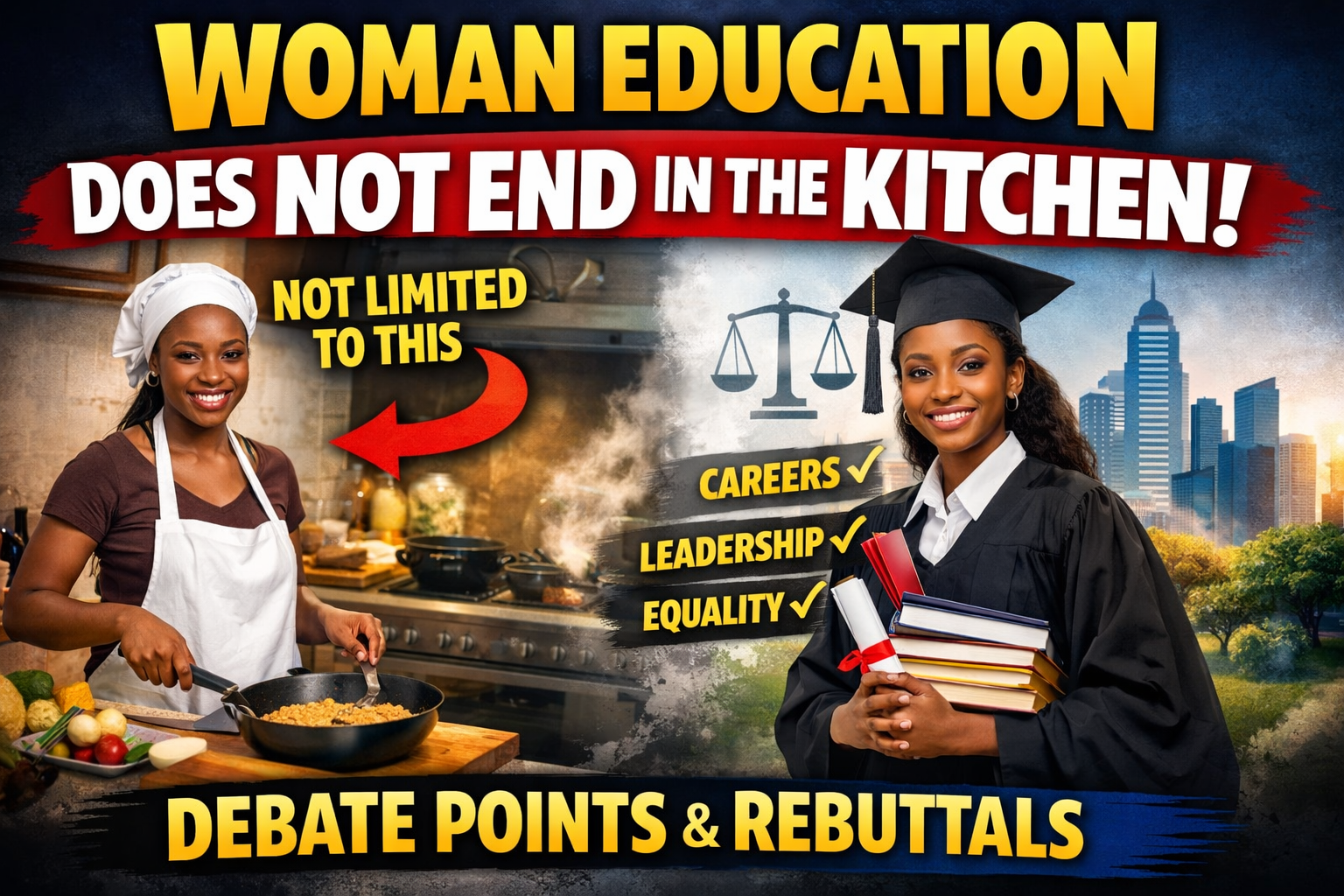
Woman Education Does Not End in the Kitchen Debate Points: Strong Arguments and Rebuttals
There is an old way of thinking that says a woman only needs enough knowledge to cook, clean, raise children, and manage a home. That idea sounds traditional to some people, but it collapses the moment you ask a serious question: is a woman only a domestic worker, or is she a full human being with intellect, ambition, rights, and social value beyond the walls of a kitchen?
That is why Woman education does not end in the kitchen debate points remains such a powerful topic. It is not really a debate about food or housework. It is a debate about limits. It asks whether society has the right to define women’s education by domestic usefulness alone.
The strongest answer is no.

Table of Contents
ToggleThis motion is not attacking the home
A weak speaker turns this topic into a fight against cooking, marriage, or family life. That is a mistake.
The motion does not mean the kitchen is useless. It means the kitchen is not the end point of a woman’s education.
That distinction matters.
Cooking is a life skill. Managing a home is valuable. Caring for a family is honorable. But none of those roles cancel a woman’s right to broad education, professional ambition, independent judgment, or participation in society. If a man’s education is not reduced to the kitchen, a woman’s should not be reduced there either.
That simple contrast already gives the motion strength.
The kitchen is a room, not a boundary
This is the cleanest line in the whole debate: a kitchen is part of life, but it should not define the size of a woman’s future.
Education is not just about preparing somebody for chores. It builds literacy, reasoning, confidence, problem-solving, and the ability to make decisions. UNESCO describes girls’ education as central to gender equality and notes that educating girls improves health, economic growth, and social development in communities. UNICEF similarly states that girls who receive an education are less likely to marry young and more likely to lead healthy, productive lives while participating in decisions that affect them.
So when someone suggests that a woman’s education ends in the kitchen, they are not only limiting her career. They are limiting her voice, her choices, and her contribution to society.
A woman needs education for life, not just for domestic tasks
One of the best debate points for the motion is that life is broader than domestic responsibility.
A woman may become a doctor, lawyer, entrepreneur, engineer, teacher, scientist, judge, writer, policymaker, or community leader. Even if she chooses marriage and motherhood, she still needs education to navigate health decisions, finances, technology, law, citizenship, and the changing demands of the modern world.
Domestic training alone cannot replace that.
UNICEF’s girls’ education materials explicitly connect girls’ schooling to healthier lives, higher incomes, greater participation in important decisions, and better futures for families. The World Bank likewise treats girls’ education as a strategic development priority tied to safe schools, skills, and economic growth.
That gives you a strong debate sentence:
A woman is not educated only to serve a house; she is educated to function fully in society.
Education strengthens families too
A common mistake in this debate is to act as if supporting women’s education means neglecting the family.
The opposite is often closer to the truth.
When women are educated, families benefit. UNESCO says educating girls supports family well-being and helps break cycles of poverty. UNICEF says girls’ education transforms communities and countries, not only individual lives.
That means the motion can be defended without insulting family life at all. In fact, you can argue that broader education makes a woman more, not less, effective in every role she chooses. An educated mother is often better equipped to support children’s learning, make informed health choices, understand finances, and advocate for her household.
So the debate is not “career versus family.”
It is “full education versus restricted education.”
The motion also protects dignity
This is where the argument becomes moral, not only practical.
To say a woman’s education ends in the kitchen is to imply that her highest value lies in domestic usefulness. That is a narrow view of human dignity. It suggests her mind matters less once she can perform household duties.
A strong debater should challenge that directly.
No society says a boy should only be educated enough to earn money and stop there. We assume his education can keep expanding because his potential is not tied to one role. The same standard should apply to girls and women. UNESCO’s gender-and-education work frames girls’ and women’s education as part of rights, equality, and empowerment, not merely household preparation.
That framing is powerful in a debate hall because it moves the issue from custom to fairness.
Why this topic matters so much in Nigeria and similar contexts
This debate becomes even more serious when you place it in real educational conditions.
UNICEF Nigeria says one in every five of the world’s out-of-school children is in Nigeria, and a 2022 UNICEF Nigeria brief reported 7.6 million girls out of school in the country. UNICEF’s Girls’ Education Project Phase 3 in northern Nigeria aimed to improve basic education, increase social and economic opportunities for girls, and reduce disparities in learning outcomes between girls and boys.
So this is not just a theoretical argument. Limiting women’s education has real consequences. It shapes who gets access to school, who stays in school, and who is encouraged to dream beyond domestic roles.
That local relevance makes the motion more urgent, not less.
The strongest supporting points for the motion
Here are the most persuasive points to build around in a class debate.
Education gives women independence
A woman who is educated has more ability to earn, decide, and stand on her own judgment. She is less likely to depend entirely on others for information, money, or direction. The World Bank and UNICEF both connect girls’ education with skills, income, and better life outcomes.
Education improves decision-making
Women make decisions about health, finances, children, work, and community life. Those decisions require more than domestic skill. They require knowledge and confidence. UNICEF directly links girls’ education to participation in decisions that most affect their lives.
Society loses talent when women are limited
When girls are taught that education ends in the kitchen, society throws away doctors, inventors, teachers, leaders, and entrepreneurs before they are even allowed to emerge. UNESCO and the World Bank both treat girls’ education as a broad social and economic issue because countries benefit when girls develop their full abilities.
Education helps women challenge harmful norms
UNICEF says its girls’ education work tackles discriminatory gender norms and harmful practices that deny girls access to school and quality learning. That matters because some limits survive only when women are denied the knowledge and confidence to question them.
A woman can be both educated and family-centered
This point is essential because it blocks a common attack. A woman does not have to choose between being educated and being caring. Those are not opposites. Education expands options; it does not destroy values.
What the opposition may say
A serious debate article should not ignore the other side.
The opposition may argue:
- women traditionally manage the home, so education should focus there
- excessive career focus may weaken family life
- practical domestic knowledge is more useful than advanced schooling for many women
- culture and religion may assign different roles to men and women
- not every woman wants a career outside the home
These points can sound persuasive if left unanswered. So they need sharp rebuttals.
Rebuttals that hit the center of the argument
Rebuttal 1: Tradition is not the same as truth
Many things were traditional before they were challenged. Tradition can explain a belief, but it cannot automatically justify it. If a tradition restricts human potential unfairly, it deserves criticism.
Rebuttal 2: Family life does not require intellectual limitation
A woman can care for a family and still be highly educated. The idea that education damages womanhood is not proof; it is fear dressed as argument.
Rebuttal 3: Choice only matters when it is real
Some people say, “What if a woman chooses domestic life?” That is fine. But a choice is only meaningful when she had access to broader opportunities first. Restricting her education and then praising her “choice” is dishonest.
Rebuttal 4: Domestic skill is useful, but incomplete
Yes, domestic knowledge matters. But it does not cover economics, law, health systems, technology, politics, entrepreneurship, or civic life. A woman lives in all those worlds too.
Rebuttal 5: If the same limit is not placed on men, it is unjust
This is often the cleanest rebuttal in the room. If nobody says a man’s education ends in the workshop, office, or farm, then saying a woman’s education ends in the kitchen reveals a double standard.
A sample debate speech
Chairperson, judges, accurate timekeeper, co-debaters, ladies and gentlemen.
I stand to support the motion that woman education does not end in the kitchen.
The kitchen is an important part of life, but it is not the full measure of a woman’s purpose. To say that a woman only needs education for domestic work is to reduce her intelligence, ambition, and contribution to society.
A woman needs education not only to cook or care for a home, but to make informed decisions, earn a living, raise healthy families, lead communities, and participate fully in national development. UNESCO explains that girls’ education improves health, economic growth, and social development. UNICEF adds that educated girls are more likely to lead healthy, productive lives and take part in the decisions that affect them most.
This means women’s education is not a luxury. It is a necessity.
Those who oppose this motion may appeal to tradition. But tradition should never become a prison. A woman can value family life and still pursue broad education. She can be caring and intelligent, domestic and ambitious, supportive and independent.
Therefore, woman education does not end in the kitchen. The kitchen may be part of her life, but it should never be the ceiling of her mind.
Thank you.
The clearest judgment
The motion is stronger than the opposition because it protects both fairness and reality.
Fairness, because women deserve the same respect for their intellect as men.
Reality, because modern life demands far more from women than domestic skill alone. Education today shapes health, employment, leadership, digital literacy, public voice, and family welfare. Global organizations working on girls’ education consistently describe those wider benefits, which makes the opposition look narrow and outdated.
So the best conclusion is not that the kitchen is irrelevant. It is that the kitchen is not enough.
FAQ Section
What does “woman education does not end in the kitchen” mean?
It means a woman’s education should not be limited to domestic work. She deserves broad learning, career opportunities, critical thinking, and full participation in society.
Is this debate topic against cooking or homemaking?
No. It does not attack homemaking. It rejects the idea that homemaking is the final purpose of a woman’s education.
What is the strongest point for the motion?
The strongest point is that women need education for full life participation, not just household duties. Education improves decision-making, independence, income, and social contribution.
What is the strongest rebuttal against the opposition?
That tradition cannot fairly limit women’s intellectual growth, especially when the same limitation is not placed on men.
Why is this topic important in Nigeria?
Because girls’ education remains a major real-world issue there. UNICEF Nigeria and the World Bank both highlight continuing efforts to improve girls’ access, retention, and opportunity in education.
Conclusion
A strong set of Woman education does not end in the kitchen debate points should do more than praise education in general. It should expose the real weakness in the opposing view: the attempt to reduce a woman’s future to domestic usefulness.
The kitchen can be part of a woman’s life. It can even be an important part. But it cannot be the end of her education, her ambition, or her value. A woman deserves education for thought, leadership, work, dignity, family, citizenship, and choice. Once you argue it that way, the motion stops sounding like a slogan and starts sounding like common sense.