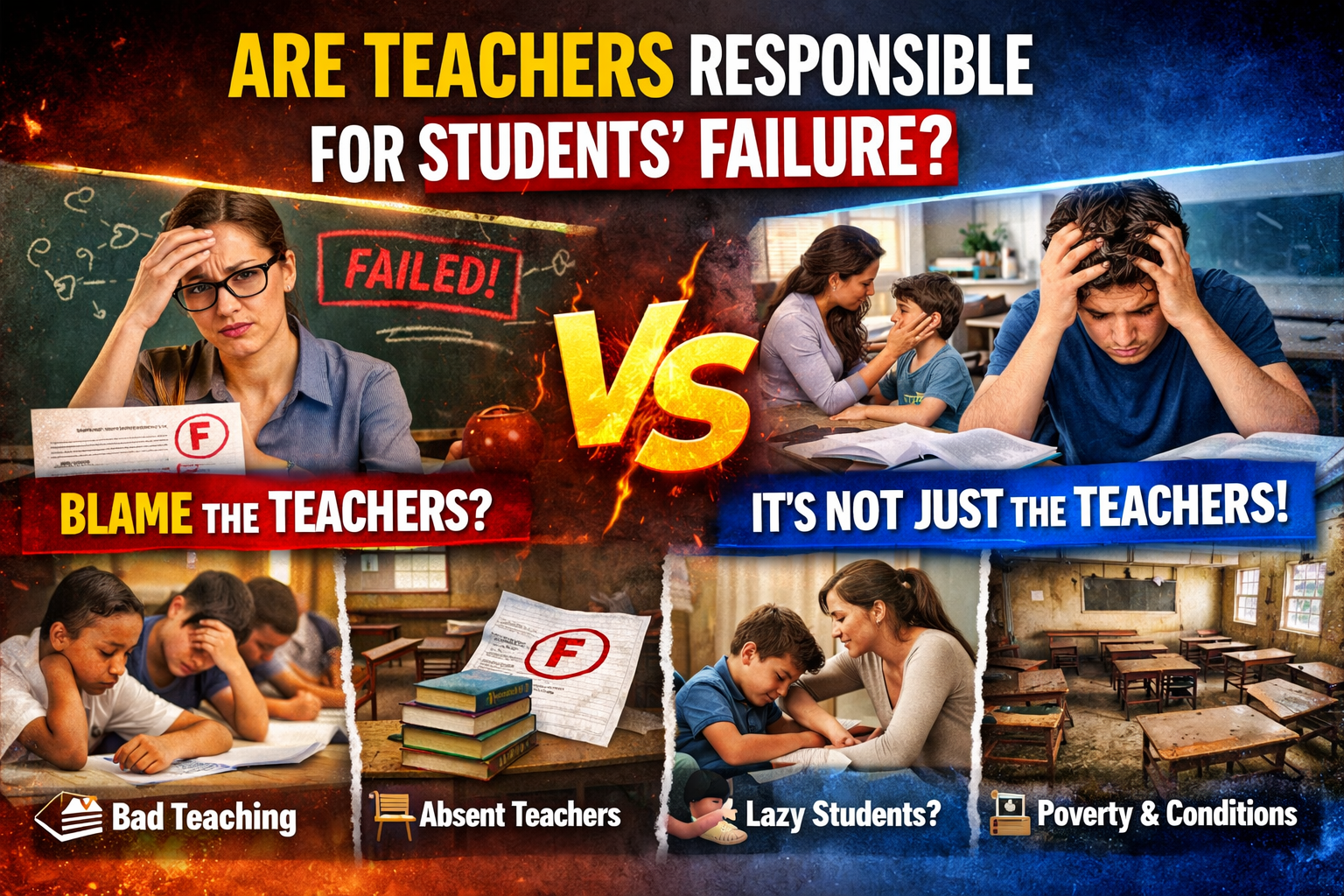
Debate on Teachers Are Responsible for Students Failure: Strong Arguments for Both Sides
It is easy to blame teachers when students fail. They stand in front of the class, explain the lessons, set assignments, and often become the most visible face of the education system. So when results are poor, many people quickly say: the teachers are responsible.
That sounds reasonable at first. But once you look deeper, the issue becomes harder than it appears.
A serious debate on teachers are responsible for students failure should not be reduced to emotion or blame. The real question is not whether teachers matter. Of course they do. The real question is whether they should carry the main burden for failure when students are also shaped by home background, school conditions, motivation, discipline, poverty, and government policy.
This is why this topic remains powerful in school debates. It forces students to think beyond a simple accusation and ask a more mature question: who truly shapes academic success or failure?
Table of Contents
ToggleFirst, understand what “responsible” means
In debate, one word can decide the whole argument.
If the motion says teachers are responsible for students failure, does it mean:
- teachers are fully responsible?
- teachers are mostly responsible?
- teachers are partly responsible?
That distinction matters.
If “responsible” means fully responsible, the motion becomes weak, because student failure is rarely caused by one person alone.
If “responsible” means partly responsible, the motion becomes much easier to defend, because teachers clearly influence academic performance.
So the smartest debaters do not rush. They define the motion first. That gives them control.
The strongest argument for the motion
Those supporting the motion should start from one simple point: teachers are the professionals directly assigned to guide learning. If that guidance fails, students are likely to fail too.
Teachers control classroom learning
A teacher decides how topics are introduced, explained, revised, and tested. When lessons are confusing, rushed, outdated, or poorly delivered, students may leave the class without understanding the subject.
That matters because classroom teaching is not optional. It is the core academic contact students have with formal learning.
A student may be willing to learn, but if the explanation is weak, examples are poor, and correction is missing, that student can struggle badly.
Poor teaching methods produce weak understanding
Some students fail not because they are lazy, but because they were never properly taught.
A teacher who only dictates notes, reads from a textbook without explanation, or discourages questions may cover the syllabus without truly teaching it. Students may memorize a few points, but they do not develop understanding.
UNESCO notes that quality learning depends on evidence-based teaching and assessment, and that classroom assessment helps teachers identify learning levels and adjust instruction. When instruction is not adjusted, weak learners can remain weak for too long.
That is a powerful debate point: if teachers are expected to diagnose learning gaps and help students improve, then failure to do so makes them partly responsible for students failure.
Teachers shape motivation
Students do not learn only with books. They also learn through confidence.
A harsh, insulting, careless, or uninterested teacher can destroy a student’s belief in a subject. A child who is repeatedly embarrassed in mathematics may stop trying. A student mocked for poor English may avoid speaking or writing at all.
On the other hand, a good teacher can turn average students into high performers.
That means teachers are not just subject-deliverers. They are motivators, interpreters, and guides. When they misuse that role, student failure can follow.
Lack of feedback leaves students behind
Many students perform poorly because no one corrected them early enough.
When teachers fail to mark exercises properly, fail to explain mistakes, or ignore weak students at the back of the class, those learners continue repeating the same errors. By the time exams arrive, the foundation is already broken.
This argument is especially strong in oral debates because it feels real. Most students have seen classmates who kept failing because nobody showed them exactly where they were going wrong.
Teacher absenteeism and weak preparation hurt performance
A teacher who is often absent, late, unprepared, or disengaged creates academic loss. Students cannot recover that lost time easily.
Research and official education reports in Nigeria and West Africa have linked teacher attendance, instructional time, working conditions, and teaching quality with learning outcomes. UNICEF’s Time to Teach work and Nigerian education assessment reports both describe how lost teaching time and teacher-related factors can damage student learning.
For a debate, this becomes a sharp line:
If teachers are paid to teach, but do not teach effectively or consistently, they bear responsibility for the failure that follows.
Why this motion sounds true in many schools
The motion becomes persuasive because students often experience the school system through teachers more than through policy documents.
A student does not sit in a ministry office. A student sits in a classroom.
So when:
- a teacher skips key topics
- lessons are not explained
- scripts are not marked
- questions are brushed aside
- students are insulted instead of supported
the student sees the teacher as the immediate cause of failure.
This is why the proposition side usually gets loud agreement from an audience. It speaks to lived experience.
And to be fair, that frustration is not always wrong.
The strongest argument against the motion
Now comes the deeper side of the debate.
The opposition does not need to prove that teachers are perfect. It only needs to show that blaming teachers for student failure is too narrow and unfair.
That argument is strong.
Students also carry responsibility
Learning is not something teachers pour into passive minds. Students must listen, read, revise, practice, and ask questions.
A student who refuses to study, misses assignments, cheats during tests, joins bad company, or ignores correction cannot turn around and place all blame on the teacher.
Even with excellent teaching, some students still fail because they do not do the work required.
This is one of the most effective opposition points because it appeals to personal responsibility. Education is a partnership, not a one-way transfer.
Parents and home background matter more than many people admit
A child who returns from school to a home with no support, no quiet place to read, no encouragement, and constant stress may struggle even under a good teacher.
OECD material on student performance shows that socio-economic background can strongly influence learning outcomes, while UNESCO and related education sources also point to the role of family support, resources, and wider context in shaping performance.
So if a student is hungry, overworked at home, emotionally unstable, or never supervised, can a teacher honestly be called the sole cause of that student’s failure?
That is where the motion starts to weaken.
Poverty and inequality affect learning
A child may fail not because of poor teaching, but because of poor conditions for learning.
When students lack textbooks, transport, proper nutrition, electricity, digital access, or even regular attendance, achievement suffers. Nigerian and regional education reports identify factors such as socioeconomic status, nutrition, instructional time, parental education, class size, and insecurity as influences on student learning.
This matters for a debate because it shifts the issue from personal blame to system reality.
A teacher can explain brilliantly in class, but if the student cannot revise at home, misses school often, or studies in unstable conditions, performance may still collapse.
School leadership and policy failures also shape results
Sometimes teachers work inside broken systems.
Maybe classes are overcrowded. Maybe there are no laboratories. Maybe the curriculum is unrealistic. Maybe salaries are delayed. Maybe one teacher handles too many students. Maybe supervision is weak.
In such situations, poor results cannot be pinned on teachers alone.
The broader education literature consistently treats learning outcomes as the product of multiple linked factors, including teacher quality, school resources, assessment systems, leadership, and student background.
That makes the opposition case intellectually stronger:
teachers influence student performance, but they do not operate alone.
Some students fail despite good teaching
This point is simple but effective.
In the same class, under the same teacher, some students pass while others fail. If the teacher were the only cause, all students should perform similarly.
But they do not.
Why? Because students differ in discipline, interest, background, mental readiness, attendance, and effort.
This does not remove the teacher’s role. It simply proves that the teacher is not the whole story.
The line that wins this debate
The best debaters know the real contest is not between “teachers matter” and “teachers do not matter.”
That would be childish.
The real contest is between these two claims:
Claim A: Teachers are a major factor in student performance.
Claim B: Teachers are the main people responsible for student failure.
Claim A is easy to defend. Claim B is much harder.
That is the key distinction.
A teacher may contribute to failure. A teacher may even be a major contributor in some cases. But saying teachers are responsible for students failure in a broad, general way ignores the role of students, parents, school leadership, and social conditions.
If you can explain that difference clearly, you already sound more intelligent than most speakers on this topic.
Smart rebuttals for the proposition side
If you are supporting the motion, these rebuttals can help:
“Students have responsibility too.”
Yes, but teachers are trained professionals. Students come to school because they need guidance. When guidance is poor, failure becomes more likely.
“Home background matters.”
True, but the school exists to reduce disadvantage, not worsen it. A committed teacher can still identify struggling students and support them.
“Poverty causes poor results.”
Poverty is real, but a poor child with a great teacher still has a better chance than a poor child with a careless one.
“Some students fail despite good teaching.”
That does not remove teacher responsibility in general. It only shows there are exceptions.
Smart rebuttals for the opposition side
If you are opposing the motion, these are stronger:
“Teachers spend the most time teaching students.”
Teaching time alone does not make teachers solely responsible. Learning depends on effort, support, environment, and available resources.
“Bad teaching causes failure.”
Sometimes yes, but the motion is broad. It wrongly turns one possible cause into the main cause for all student failure.
“Teachers should detect weak students early.”
Agreed, but if classes are overcrowded or support systems are weak, that burden cannot rest on teachers alone.
“Teachers are paid to produce results.”
Teachers are paid to teach, guide, and assess. They are not magicians who can replace parenting, eliminate poverty, or force unwilling students to study.
A balanced judgment: which side is stronger?
The stronger side is usually the opposition, unless the debate is framed very narrowly.
Why?
Because the motion overstates the teacher’s role.
A balanced reading of education shows that teachers are important, sometimes extremely important, but student failure is usually multi-causal. Research and policy sources repeatedly describe learning outcomes as shaped by instruction, family background, socioeconomic conditions, attendance, resources, and support systems together, not by one actor alone.
So the wisest conclusion is this:
Teachers are not fully responsible for students failure, but they can be significantly responsible in cases where teaching quality, commitment, feedback, or attendance are poor.
That position is fair, realistic, and hard to defeat.
Sample debate speech
Here is a speech version you can study or adapt:
Chairperson, judges, accurate timekeeper, co-debaters, ladies and gentlemen.
I stand to oppose the motion that teachers are responsible for students failure.
No one denies that teachers play a major role in education. Teachers explain lessons, guide students, and prepare them for examinations. A bad teacher can weaken a student’s confidence and understanding. On that point, we agree.
But the motion before us is too wide and too absolute.
Students do not fail only because of teachers. Some fail because they do not study. Some fail because they are absent from school. Some fail because parents do not supervise them. Others struggle because of poverty, stress, lack of books, hunger, or overcrowded classrooms.
If a student ignores assignments, refuses correction, and spends no time revising, will we still blame only the teacher? That would be unfair.
Even education evidence from major organizations shows that learning outcomes are affected by several factors, including social background, school conditions, and teaching quality. That means teachers matter, but they are not the only people responsible.
Let us also remember that in the same class, under the same teacher, some students pass and some fail. That alone proves that failure cannot be blamed on the teacher alone.
Therefore, the sensible position is not that teachers are responsible for students failure, but that teachers are only one part of a larger educational system.
For these reasons, I strongly oppose the motion.
Thank you.
A useful way to frame the topic in class or exams
If your teacher asks you to write or speak on this topic, avoid extreme statements. Extreme arguments sound emotional, but balanced arguments sound mature.
A stronger framing is:
- teachers are influential
- poor teaching can contribute to failure
- but failure usually has multiple causes
- shared responsibility is the most accurate conclusion
That approach works well in debates, essays, and exam answers because it shows judgment.
Where authoritative sources fit naturally
If you want to strengthen the article or a school assignment, you can reference broader education evidence on quality learning and learning outcomes and on socio-economic status and student performance. These sources support the idea that teachers matter greatly, but student results are also shaped by wider conditions beyond one classroom.
FAQ Section
Are teachers responsible for students failure?
Teachers can be responsible in some cases, especially when teaching is poor, irregular, or discouraging. But they are usually not the only cause of student failure.
What is the best position in a debate on teachers are responsible for students failure?
The strongest position is usually a balanced opposition: teachers influence performance, but students, parents, school conditions, and social factors also matter.
Can I support the motion and still sound reasonable?
Yes. Focus on classroom control, teaching quality, feedback, motivation, and absenteeism. Avoid claiming teachers are the only cause of failure.
Why is the opposition often stronger?
Because the motion is broad. It turns one important factor into the main explanation for all student failure, which is difficult to defend.
What examples can I use in this debate?
Use examples such as poor explanation of lessons, unmarked assignments, insulting teachers, absenteeism, lack of parental support, student laziness, overcrowded classrooms, and poverty-related learning barriers.
Conclusion
A strong debate on teachers are responsible for students failure should go beyond blame and look at reality. Teachers matter deeply. They can inspire success, and they can also contribute to failure through poor teaching, poor preparation, weak feedback, or negative attitudes. But student failure is rarely caused by teachers alone.
The strongest conclusion is that responsibility is shared. Students must study. Parents must support. Schools must provide structure. Governments must improve conditions. Teachers must teach well. Once you understand that, your argument becomes sharper, fairer, and more persuasive than a simple speech built on blame alone.