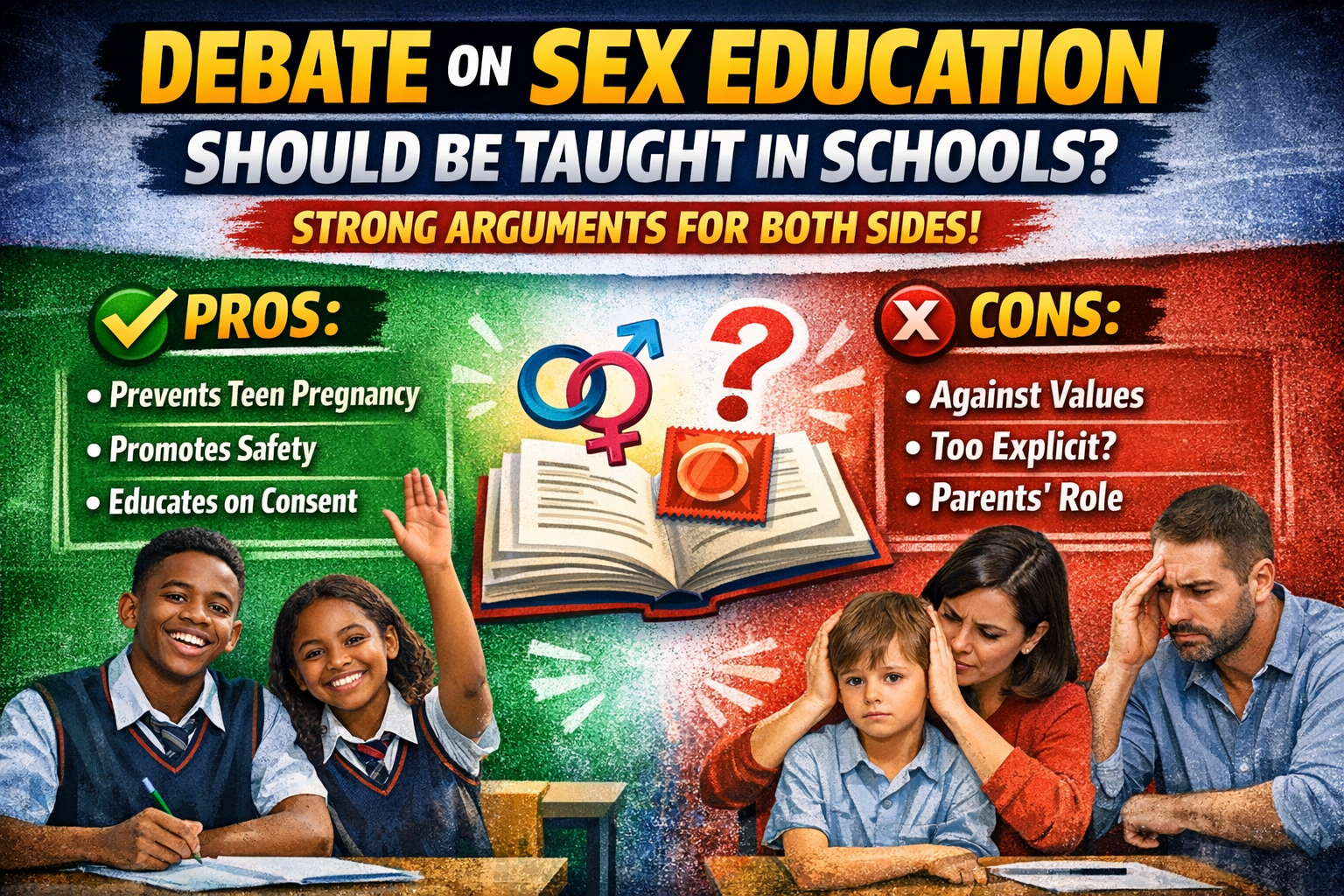
Debate on Sex Education Should Be Taught in Schools: Strong Arguments for Both Sides
Yes, sex education should be taught in schools, but the real argument is not whether children should be exposed to shocking material. The real question is whether young people should receive age-appropriate, accurate, structured guidance about their bodies, boundaries, relationships, safety, and health before misinformation reaches them first. That is why the debate on sex education should be taught in schools remains important in countries like Nigeria and beyond.
The phrase “sex education” often creates instant resistance because many people imagine the most extreme version of it. They picture explicit lessons, moral decline, or a curriculum that pushes children into adult conversations too early. That picture is misleading. Both WHO and UNESCO describe comprehensive sexuality education as age-appropriate, curriculum-based, scientifically accurate, and culturally relevant. It begins with simple ideas such as respect, family, bodily changes, and safety, then becomes more detailed only as learners grow older.
So a smart debate should begin by defining terms. If one side argues against a distorted version of sex education while the other side argues for a careful, age-sensitive version, the debate becomes confused. The strongest students avoid that trap.

The motion sounds simple, but it hides three different questions
When people say, “Should sex education be taught in schools?” they are usually mixing up three separate questions.
First, what should be taught?
Second, at what age should it begin?
Third, who should teach it: schools, parents, or both?
Once those questions are separated, the issue becomes clearer. Very few reasonable people object to children learning about respect, personal boundaries, puberty, abuse prevention, or how to seek help from trusted adults. In fact, WHO says well-designed programmes can include consent, privacy, bodily integrity, recognizing abuse, healthy relationships, and safe use of digital technologies, not just reproduction or disease prevention.
That matters because opponents sometimes argue as if sex education only means teaching students how to have sex. It does not. In strong educational practice, it also includes how to protect oneself, how to understand body changes, how to recognize coercion, how to respect others, and how to avoid dangerous myths.
Why the affirmative side is usually stronger
The strongest argument for teaching sex education in schools is brutally simple: young people do not grow up in an information vacuum.
If schools stay silent, students still learn. They learn from friends, pornography, rumor, social media, older peers, and half-understood online content. UNESCO notes that many young people now turn to the digital environment as a key source of information about sexuality, and it warns that the absence of high-quality, age-appropriate education can leave them vulnerable to misinformation, exploitation, bullying, and online violence.
That point alone shifts the debate. The question is no longer “education or no education.” It becomes “good education or careless education from unreliable sources.”
1. Schools can provide a common baseline of accurate information
Not every child has a parent or guardian who is informed, available, comfortable, or willing to discuss puberty, relationships, consent, or reproductive health. Some families handle these conversations wisely. Many do not. Some avoid them entirely.
That is one reason schools matter. A school can at least provide a minimum standard of information so that students do not enter adolescence with fear, confusion, or dangerous ignorance. WHO describes quality sexuality education as a way to improve understanding, correct misconceptions, build self-awareness, and help young people make informed choices and seek help when needed.
This does not mean schools should replace parents. It means schools can prevent a child’s access to truth from depending entirely on luck.
2. Sex education is also about safety, not just sex
This is where many debates become shallow. They focus only on pregnancy or disease and ignore the wider protective function of sex education.
A thoughtful curriculum can teach students about consent, bodily autonomy, abuse recognition, inappropriate touching, pressure, manipulation, and when to report unsafe behaviour. UNESCO says age-adapted programmes introduce younger learners to concepts like respect and kindness, while older learners engage more complex issues such as consent, gender-based violence, HIV, pregnancy, and care-seeking. WHO likewise includes privacy, bodily integrity, abuse recognition, and digital safety among core topics.
That is not moral corruption. It is protection.
A child who has the language to say, “This is wrong,” is safer than a child who has only confusion and shame.
3. Good sex education does not automatically encourage sexual activity
This objection appears in almost every debate: if you teach students about sex, they will become curious and experiment earlier.
It sounds plausible, but it is not what the major authorities summarize from the evidence. WHO states that high-quality, well-implemented comprehensive sexuality education can delay sexual initiation, reduce sexual risk-taking, and increase contraceptive use, while UNESCO also says good programmes can delay sexual debut and increase condom or contraceptive use when learners become sexually active. WHO further states that evidence does not show CSE increases sexual activity or encourages earlier sexual behaviour.
That is a powerful rebuttal in any student debate. Information is not the same thing as permission. Knowing how fire burns does not make a person careless with matches. Often it makes them more careful.
4. Silence does not preserve innocence as well as people think
Many adults defend silence because they believe it preserves purity. But silence often preserves only ignorance.
Ignorance can look innocent from a distance. In real life, it can mean fear during puberty, inability to identify abuse, embarrassment about menstruation, confusion about consent, or total dependence on misleading peers. UNESCO argues that sexuality education helps children and young people understand their bodies, build communication and decision-making skills, and know where to go for help.
A student who knows what puberty is not “spoiled.” A student who understands consent is not “corrupted.” A student who can report abuse is not “too exposed.” That student is better prepared.
Why many people still oppose it
A good debate does not dismiss the other side as ignorant. Some objections are serious and deserve fair treatment.
1. Parents believe moral teaching belongs first to the family
This is a legitimate concern. Families do not want schools to overstep and become the final authority on intimate moral questions. In many communities, sexuality is tied closely to religion, culture, modesty, and family values.
Parents are right to insist that schools should not bulldoze those values. WHO and UNESCO both stress that sexuality education should be culturally relevant and adapted to context, not dropped into communities in a tone-deaf way.
That means the best pro-sex-education argument is not “parents do not matter.” It is “parents matter so much that schools should work with them, not around them.”
2. Poorly designed programmes can damage trust
This objection is also fair. A badly written curriculum, an untrained teacher, or an ideologically rigid approach can make parents suspicious and students uncomfortable.
If the content is not age-appropriate, if teachers are not trained, or if schools present sensitive material without context, then backlash is predictable. WHO notes that access and quality remain uneven, and UNESCO points to persistent gaps between policy and actual curriculum delivery.
So defenders of school-based sex education should admit this plainly: bad implementation is a real risk. But that is an argument for doing it well, not for abandoning it altogether.
3. Some fear it weakens abstinence and discipline
In more conservative settings, some people believe the safest message is simple: avoid sex entirely until marriage. They worry that broader education normalizes behaviour they morally oppose.
The weakness in that argument is that it confuses moral aspiration with educational sufficiency. WHO says programmes that address both delaying sex and contraceptive use are more effective than abstinence-only programmes.
A school can still promote self-control, discipline, and responsibility while also giving factual knowledge. Those ideas do not cancel each other out.
The rebuttal that usually wins the room
The most convincing position in this debate is not extreme.
It is not:
“Leave everything to schools.”
And it is not:
“Leave everything to families.”
It is this:
Schools should teach the facts, the safety skills, and the health basics. Families should shape the moral, religious, and personal values surrounding them.
That middle-ground argument is harder to attack because it respects both education and family authority.
In practical terms, that means schools can teach:
- puberty and body changes
- consent and personal boundaries
- respect in relationships
- abuse recognition and reporting
- reproductive health basics
- digital safety and pressure online
Families, meanwhile, can teach:
- moral convictions
- religious interpretation
- personal expectations
- deeper cultural meaning
- family standards about relationships and conduct
This division is sensible. A biology teacher may explain menstruation or reproduction. A parent may explain the family’s moral values around sexual conduct. Those roles can coexist.
A sharper way to argue the affirmative side
Students often make one mistake in this debate: they argue only from health statistics or only from morality. A stronger case combines health, safety, and common sense.
Here is the sharper version:
Young people face real physical, emotional, and digital risks during adolescence. Because not every child receives reliable guidance at home, schools should provide age-appropriate sex education so students can understand their bodies, protect their boundaries, recognize abuse, avoid misinformation, and make safer decisions. This does not replace parents or encourage sexual behaviour; it gives students a factual foundation and leaves room for families to guide values.
That is a harder argument to defeat than simply saying, “Sex education is important.”
A debate-ready paragraph students can adapt
If you need a classroom-ready position, this version works:
Sex education should be taught in schools because schools are the one place where all students can receive accurate, age-appropriate information about puberty, consent, safety, and reproductive health. Without that guidance, many young people rely on friends, social media, and other unreliable sources. Good sex education does not promote immorality or promiscuity. Instead, it corrects myths, helps students recognize abuse, teaches respect, and supports better decision-making. Parents should still teach values, but schools should provide the basic knowledge every student deserves.
The strongest opposition line—and how to answer it
A strong opponent might say:
“Sex education should not be taught in schools because it interferes with parental rights and can expose children to sensitive topics too early.”
That sounds persuasive until you ask two follow-up questions.
First, what exactly counts as “too early”? Teaching a child about privacy, unsafe touching, or bodily changes is not the same as teaching explicit adult behaviour.
Second, if schools avoid the topic completely, where is the guaranteed alternative? Not every home provides reliable guidance. Many provide none.
That is why the best rebuttal is calm, not aggressive:
The issue is not whether children will learn; it is whether they will learn correctly, safely, and at the right stage.
What a fair final judgment looks like
A fair-minded conclusion should admit that the opposition raises real concerns about age, values, and curriculum quality. Those concerns deserve attention. But they do not outweigh the core case for school-based sex education.
Why?
Because the risks of ignorance are greater than the risks of responsible teaching.
Because students need more than warnings; they need understanding.
Because silence does not protect every child.
And because education, when done properly, does not destroy values. It gives young people the knowledge needed to live by values with clearer judgment.
For that reason, the stronger side in the debate on sex education should be taught in schools is the affirmative side, especially when the programme is age-appropriate, culturally sensitive, and taught in partnership with parents rather than in conflict with them. This is exactly how major public-health and education authorities frame quality sexuality education: structured, learner-centered, age-adapted, and respectful of context. See WHO’s fact sheet on comprehensive sexuality education and UNESCO’s overview of comprehensive sexuality education for the clearest official summaries.
FAQ Section
Does sex education in schools encourage promiscuity?
High-quality evidence summarized by WHO says properly implemented comprehensive sexuality education does not encourage earlier sexual behaviour and can reduce sexual risk-taking.
At what age should sex education start?
It should begin in an age-appropriate way. UNESCO explains that younger children are introduced to simple ideas like respect, kindness, family, safety, and body awareness, while older students handle more complex topics.
Should parents or schools teach sex education?
The strongest answer is both, but with different roles. Schools should teach accurate facts, safety, and health basics. Parents should add moral guidance, cultural context, and personal values.
What is the best single argument for teaching sex education in schools?
That students will learn about sex and relationships anyway. The real issue is whether they learn from trained adults using age-appropriate information or from rumor, peers, and the internet.
Conclusion
The debate on sex education should be taught in schools is really a debate about whether society wants young people to face adolescence with clarity or confusion. A well-designed school programme does not replace parents, attack culture, or encourage recklessness. It gives students a factual foundation for safety, consent, body awareness, and responsible decision-making. That is why the most convincing conclusion is not that schools should teach everything, but that schools should teach the essentials well—and families should help shape the values that guide them.