Science Is Better Than Art Debate Points for School Debates
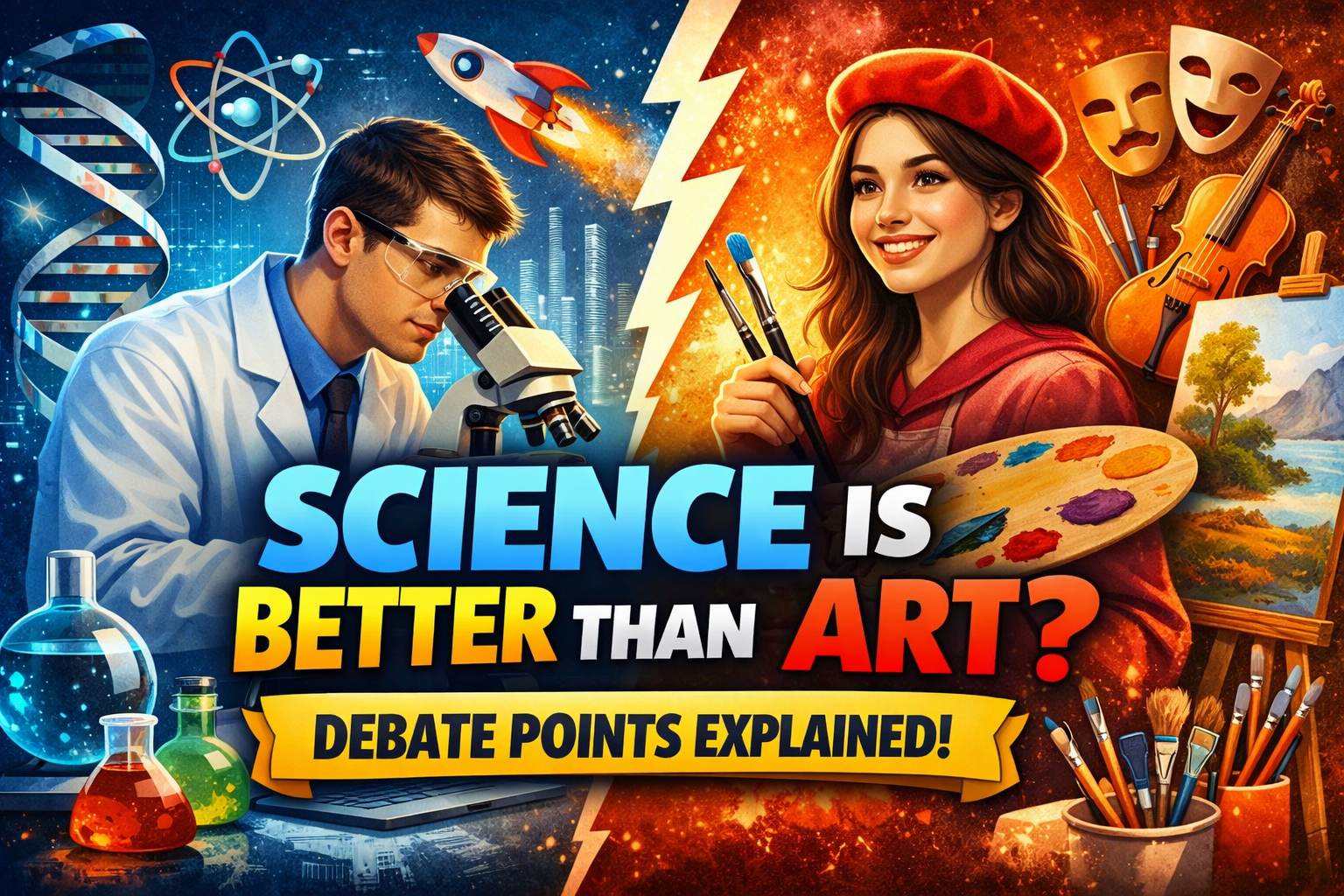
When students search for science is better than art debate points, they usually do not want a philosophical lecture. They want arguments they can stand up and deliver in class without sounding confused, extreme, or shallow. This guide is built for that exact need.
If you are defending the motion, your strongest path is not to insult art. It is to show that science has a more direct and measurable effect on human survival, public health, national development, and everyday problem-solving. That is where the debate is easiest to win.
Table of Contents
ToggleFirst, understand what the motion is really asking
A lot of students lose this debate because they misunderstand the word better.
In a school debate, “better” rarely means one field has absolute value and the other has none. It usually means one is more essential, more practical, more beneficial to society, or more urgent for human progress.
That matters. Once you frame the motion that way, science becomes easier to defend.
You are not saying paintings, music, literature, drama, or design are useless. You are saying that if society had to rank which field does more to keep people alive, solve material problems, and improve the standard of living, science stands higher.
What science and art mean in this debate
Science is the systematic study of the natural world through observation, testing, and evidence. Britannica defines science as knowledge concerned with the physical world and its phenomena, built through observation and experimentation.
Art, by contrast, is centered on expression, imagination, meaning, and aesthetic creation. Britannica describes art as something consciously created through skill or imagination.
That distinction helps you shape your argument:
- science explains, tests, predicts, and solves
- art expresses, interprets, moves, and communicates
Both matter. But if the motion asks which is better, the science side can argue that solving life-and-death and society-wide problems carries greater weight.
The most convincing science-is-better-than-art debate points
1. Science protects human life in a direct way
This is usually your strongest point.
Science gives us medicine, vaccines, surgery, sanitation systems, disease control, clean water treatment, and medical technology. When people are sick, hungry, or facing environmental danger, science provides the tools that can save them.
Art can comfort people emotionally, but science can stop an infection, repair a broken bone, improve childbirth safety, and help doctors detect disease early. In debate terms, that is a stronger and more immediate form of usefulness.
A simple line you can use:
Art may inspire life, but science saves life.
That is memorable, clear, and hard to ignore.
2. Science drives national development
Countries do not build modern infrastructure through imagination alone. They need engineers, doctors, chemists, computer scientists, environmental scientists, and technicians.
Roads, electricity systems, hospitals, internet networks, agricultural improvement, telecommunications, weather forecasting, and industrial production all depend heavily on scientific knowledge and scientific thinking.
So if your debate is framed around social importance, science has the advantage because it supports the systems a country needs to function and grow.
A useful debate sentence:
A nation can admire beauty through art, but it develops through science.
3. Science solves practical problems with evidence
One reason science often wins this motion is that it does not stop at ideas. It tests them.
Science asks:
- What is the problem?
- What is the cause?
- What evidence do we have?
- What solution works?
That method makes science powerful. It is not just knowledge. It is a disciplined way of getting reliable answers.
If a bridge is collapsing, a community does not hold a poetry session to fix it. It turns to engineering.
If a virus spreads, society turns to medicine, biology, and public health.
If crops are failing, people turn to agricultural science.
This does not mean art has no value. It means science has greater problem-solving power when the issue is practical, urgent, and measurable.
4. Science improves daily life even when people do not notice it
One of the smartest ways to argue this debate is to move from dramatic examples to ordinary life.
Science is not only in laboratories. It is in:
- mobile phones
- refrigeration
- internet access
- transport systems
- electricity
- water purification
- household appliances
- weather forecasting
- food preservation
Many people praise art openly but rely on science constantly, often without even thinking about it.
That hidden dependence is a powerful argument. It shows that science is not only useful in emergencies. It shapes daily convenience, safety, communication, and productivity.
5. Science creates the tools that even artists use
This point is underrated, but it is effective.
Modern art often depends on scientific and technological tools:
- cameras
- audio software
- digital tablets
- film technology
- stage lighting
- printing systems
- animation software
- streaming platforms
In other words, science does not merely compete with art. It often enables art to reach wider audiences.
You can phrase it like this:
Science can exist without art, but much modern art now depends on science-driven tools.
That line gives your argument an advantage because it presents science as foundational.
6. Science has greater measurable impact
Debates become stronger when you compare outcomes.
Science can be evaluated by clear results:
- lower disease rates
- faster communication
- stronger buildings
- higher crop yields
- improved transportation
- safer water
- cleaner energy systems
Art certainly affects emotion, identity, and culture, but those effects are harder to measure and often more subjective.
In a formal debate, measurable impact is persuasive. Judges and teachers often respond well to arguments that show concrete social outcomes rather than broad emotional claims.
7. Science prepares societies for the future
The future will keep presenting hard problems: climate change, disease outbreaks, food insecurity, cybersecurity, energy demands, waste management, and new technologies.
Science equips societies to face those challenges through research, experimentation, and innovation.
That makes science not just useful for today but necessary for tomorrow.
A strong line here:
Art helps people interpret the future, but science helps people survive it.
8. Science encourages objective thinking
Science trains the mind to question claims, examine evidence, and separate opinion from proof. That habit matters far beyond the classroom.
Students who learn science well often strengthen skills such as:
- careful observation
- logical reasoning
- hypothesis testing
- evidence-based judgment
- intellectual discipline
Those habits are valuable in public decision-making, medicine, engineering, law enforcement, environmental planning, and business.
This point becomes especially strong if you want your speech to sound mature rather than merely emotional.
A smart debater admits what the art side gets right
Here is where many science-side speakers make a mistake: they act as though art contributes nothing important. That weakens credibility.
Art matters because it shapes culture, identity, empathy, imagination, and communication. UNESCO notes that arts education can strengthen academic and non-academic outcomes, including creative and critical thinking, collaboration, resilience, and classroom behaviour. OECD also emphasizes that creativity and critical thinking prepare students for innovative economies and wellbeing.
That is why a strong article on this topic should not pretend the art side is foolish. It is not.
In fact, if you want your argument to sound serious, say this clearly:
Art is valuable, but value alone does not make it greater than science.
That sentence helps you look balanced while keeping control of the motion.
You can even strengthen the article with natural reference points such as UNESCO’s overview of culture and arts education and the OECD discussion of creative thinking in education, both of which show that art contributes meaningfully to education and human development.
Why include this if you are defending science? Because honest acknowledgment makes your case stronger. It shows you are not afraid of the opposing side.
The best rebuttals to common pro-art arguments
If they say, “Art expresses human emotion, so it is better”
Reply with this idea:
Expression is important, but survival is more important.
A society first needs health, safety, food systems, transport, and functioning technology. Science secures those foundations.
If they say, “Without art, life would be dull”
A good rebuttal is:
The debate is not about which makes life beautiful. It is about which is more essential.
Something can enrich life without being more necessary than the field that preserves it.
If they say, “Art came before modern science”
You can answer:
Earlier appearance does not prove greater importance.
Many ancient human activities came first, but that does not mean they now solve more modern problems than science does.
If they say, “Art builds culture”
Say this:
Culture matters, but culture also needs healthy, functioning societies to survive.
Science supports the physical conditions in which culture can flourish.
If they say, “Science is cold, but art is human”
This is a powerful moment for contrast:
Science is human too.
Every vaccine, medical breakthrough, and engineering solution begins with human concern for life, safety, and improvement.
If they say, “Science without art becomes dangerous”
This is one of the strongest art-side points, so answer carefully.
You can say:
That argument proves art is a helpful guide, not that it is greater than science.
Ethics, creativity, and communication matter, but they do not replace the practical power of scientific knowledge.
A debate-ready structure you can actually use
If you are speaking for the motion, your argument can follow this order:
- define the motion clearly
- show that “better” means more essential or more beneficial to society
- argue that science saves lives
- argue that science drives development
- argue that science solves practical problems through evidence
- admit that art is valuable
- explain why value is not the same as greater societal necessity
- close with a strong contrast between inspiration and survival
That order works because it starts with logic, moves into evidence-based usefulness, and ends with emotional force.
Sample opening speech
Good day, judges, teachers, and fellow students.
I stand to support the motion that science is better than art. Let me be clear: this does not mean art is useless. Art is beautiful, expressive, and important to culture. But if we are asked which is more essential to human progress and daily survival, the answer is science.
Science gives us medicine, electricity, clean water, transport, communication technology, and solutions to disease and environmental challenges. Science does not only entertain the mind; it protects life and improves living conditions. A nation may celebrate art, but it depends on science to build hospitals, grow food efficiently, treat illness, and develop infrastructure.
Art can move the heart, but science changes the material conditions of human life. That is why science is better than art in this debate.
The strongest way to sound mature in your conclusion
Here is the truth a weak debate misses and a strong debate understands:
In real life, science and art should work together.
Science without imagination can become narrow. Art without practical systems cannot solve enough material problems. Even major education bodies now stress creativity, critical thinking, and interdisciplinary learning rather than rigid separation between human expression and technical knowledge. UNESCO highlights the role of arts education in nurturing creativity, innovation, and critical thinking, while OECD frames creativity and critical thinking as essential future-facing competencies.
But in the narrow frame of this motion, you are not being asked whether art matters. You are being asked which is better.
And on that question, the science side has the stronger case because science is more directly linked to life preservation, social development, practical problem-solving, and measurable progress.
That is the key distinction.
FAQ Section
What are the best science is better than art debate points?
The strongest points are that science saves lives, drives national development, solves practical problems through evidence, improves daily living, prepares society for the future, and creates many of the tools modern artists also depend on.
Is it wrong to admit that art is important in this debate?
No. It is actually smart. Admitting that art matters makes your argument more balanced and believable. Then you can explain that being valuable is different from being more essential.
What is the shortest strong argument for the motion?
A simple one is:
Science is better than art because science saves lives, solves real-world problems, and drives development in ways that are direct, practical, and measurable.
What if the opposing side says art builds creativity?
You can reply that creativity matters, but creativity alone does not replace medicine, engineering, agriculture, transport systems, or public health solutions. Art contributes to human development, but science carries greater practical weight. UNESCO and OECD both recognize the educational value of creativity and the arts, which actually helps you make a more honest distinction rather than pretending art has no role.
Should I end by saying science and art work together?
Yes, if you want to sound thoughtful. Just make sure you still return to the motion and state that science remains stronger on necessity, survival, and societal function.
Conclusion
If you need clear science is better than art debate points, the safest and strongest case is this: science is better in a debate setting because it has a more direct effect on human survival, public health, technological progress, national development, and evidence-based problem-solving. Art remains important for expression, culture, imagination, and emotional life, but science carries the heavier practical burden in society. That is the distinction that wins the debate.