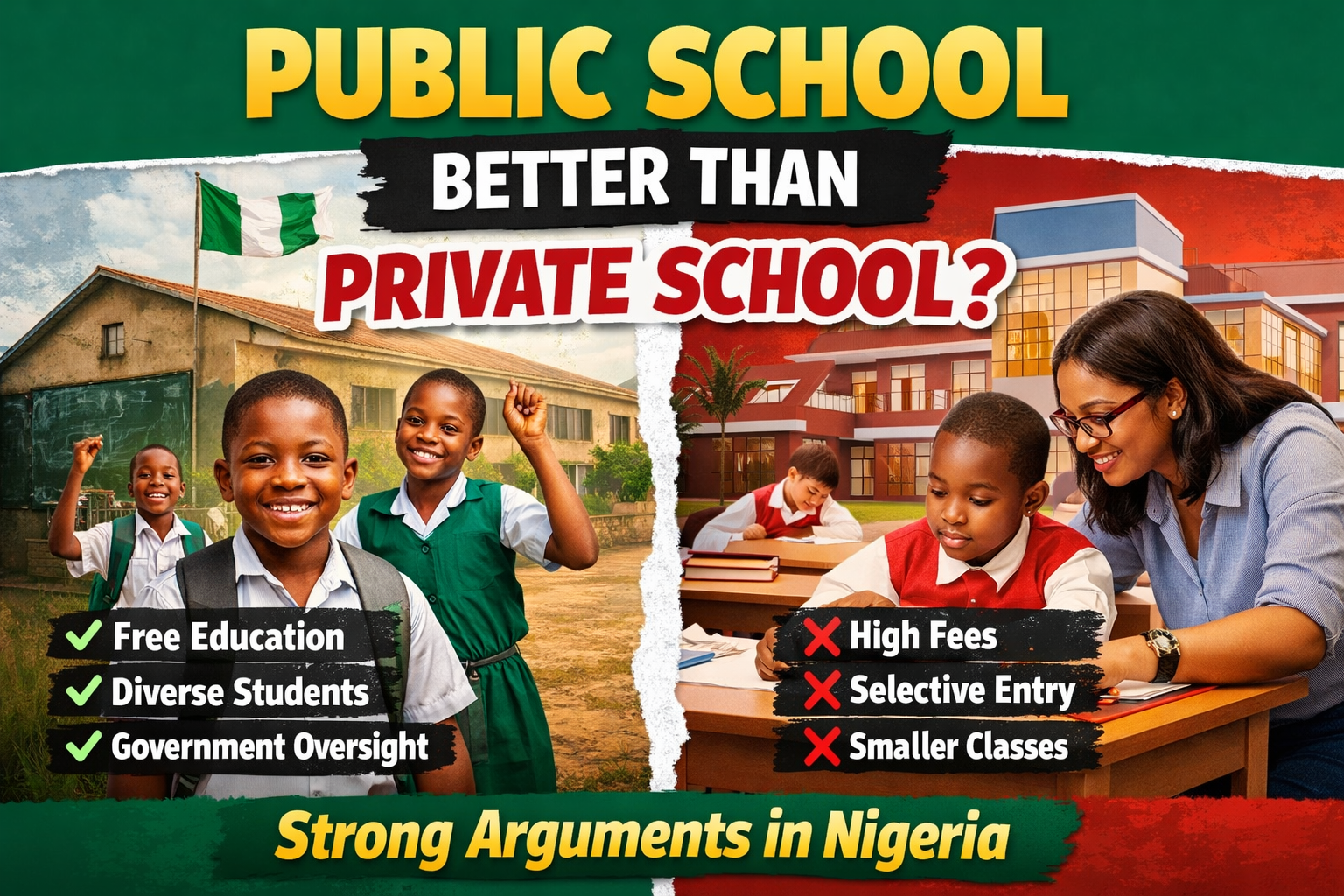
Public School Better Than Private School: Strong Debate Points
If you are trying to make the case that public school better than private school, the strongest argument is not that every public school is excellent or that every private school is overrated. That would be too easy to challenge. The better argument is that public schools usually have the stronger case on affordability, access, social inclusion, and public responsibility. In Nigeria, that matters a lot because basic education is supposed to be free and compulsory in public primary and junior secondary schools under the UBE framework and the UBE Act.
This debate also matters because many parents and students compare schools through reputation alone. That can be misleading. A school’s signboard, fee level, or social prestige does not automatically tell you how inclusive, sustainable, or educationally sound it is. Nigeria’s own policy direction shows that public education remains the backbone of mass access, while non-state schools are recognized as important but complementary providers that still need regulation and minimum standards.
This article draws on the Universal Basic Education Commission, the UBE Act 2004, the UNICEF Nigeria education page, and the Federal Ministry of Education’s policy on non-state schools to build a case that is useful for students, parents, and debate writers alike.
Table of Contents
ToggleWhat public and private schools mean in Nigeria
In Nigeria, public schools are schools owned or funded by government and tied to the national education system. At the basic level, the UBE framework covers six years of primary school and three years of junior secondary school, and UBEC describes this as free, compulsory, and continuous education for school-aged children.
Private schools, which federal policy now often calls non-state schools, are run by private owners, faith-based bodies, organizations, or other non-government providers. Nigeria’s 2025 policy on non-state schools explicitly says the government recognizes the critical role these schools play in serving millions of children, but it also notes infrastructure issues, limited resources, and the need to improve teaching and learning and ensure minimum standards.
That alone tells you something useful: the comparison is not “good schools versus bad schools.” It is really a comparison between two systems with different purposes and pressures. Public schools are designed to serve the whole society. Private schools are often designed to meet demand where parents are willing and able to pay.
Public school better than private school: the strongest case
Public schools are more affordable
This is the clearest argument, and in Nigeria it is not a minor detail. The UBE Act states that services in public primary and junior secondary schools are free of charge, and UBEC’s FAQ says the programme provides free and compulsory nine-year basic education. It also lists tuition, core textbooks, classrooms, and other basic items as part of what should be provided free under the programme.
That matters because affordability is not just about saving money. It is about educational continuity. A school is only truly “better” if a child can stay in it consistently without the family collapsing under fees, levies, transport burdens, and hidden costs. For many Nigerian households, public school is not simply the cheaper option. It is the realistic option that keeps a child in school.
Public schools are built for access, not selectivity
Public schools exist to absorb large numbers of learners, not just families who can pay. The legal and policy framework around UBE is built around access and continuity, and UNICEF Nigeria notes that primary education is officially free and compulsory even though the country still faces severe access gaps.
That makes the public school argument stronger, not weaker. When millions of children are still out of school, the value of a system that is meant to be open to all becomes more obvious. UNICEF says about 10.5 million children aged 5 to 14 in Nigeria are out of school, and only 61 percent of children aged 6 to 11 regularly attend primary school. In that context, a system designed around broad access serves a deeper public need than a system that depends on household purchasing power.
Public schools carry a larger social mission
Private schools can deliver quality. Some do. But public schools serve a wider social purpose. The UBE Act and UBEC framework are built around the idea that basic education is a public good, not just a private consumer choice. The federal role includes quality control, maintenance of uniform standards, and coordination of implementation across states.
That matters in an argument about which is “better.” Better for whom? If the answer is “for the whole society,” then public schools have a clear advantage. They are part of the state’s promise to citizens. They are not just service providers. They are part of the country’s social contract.
Public schools expose children to wider social diversity
This point is often overlooked. Public schools usually bring together children from more varied family backgrounds, language groups, neighbourhoods, and economic situations than many private schools do. That kind of diversity matters because education is not only about exam scores. It is also about learning how to live in a real society.
This is a reasoned point rather than a statistic, but it fits Nigeria’s public education mission of equity and broad access. A child in a public school often grows up with a fuller sense of the country as it is, not just as one income bracket experiences it. In a plural society, that is not a small educational advantage. It shapes empathy, resilience, and social confidence.
Public schools are accountable to public standards and oversight
The Federal Ministry of Education says it coordinates a national Education Quality Assurance system, sets and improves standards below tertiary level, and ensures minimum standards and quality control of instructional activities through regular evaluation and continuous supervision. That public oversight matters because it gives families a formal standard to point to, even when implementation is uneven.
Public schools also sit inside community-facing structures more directly. UBEC’s School-Based Management Committee School Improvement Programme says it encourages community participation and ownership of schools, with funds disbursed for infrastructure, learning materials, and equipment to improve access, quality, and equity. That kind of framework strengthens the case that public schools are not just government schools; they are meant to be community schools too.
Public schools can be the more realistic path for long-term educational continuity
A school may look impressive in the short term but still become a problem if the cost is unstable, the fees rise sharply, or the family has to withdraw the child halfway through. Public schools often offer more continuity because they are not built around frequent tuition demands. In households managing uncertain income, continuity matters as much as image.
This is especially important in a country where underinvestment and learning gaps still affect the whole system. UNICEF says only 1.9 percent of Nigeria’s GDP is spent on education in the cited investment case and that 70 percent of 10-year-olds in Nigeria cannot read a simple sentence. Those figures show that the national challenge is not “public versus private” in a shallow sense. The deeper problem is how to build a system that keeps children in school and learning. Public schools remain central to that effort.
Why this argument matters in Nigeria
The Nigeria angle changes the conversation. In places where public education is already stable, well-funded, and near-universal, the debate may sound mostly like a lifestyle choice. In Nigeria, it is more serious.
UBEC says the UBE programme was introduced to provide greater access to and ensure quality of basic education throughout Nigeria. Yet UNICEF still reports very high numbers of out-of-school children. That means public education is carrying a national burden that goes far beyond individual preference.
At the same time, the Federal Ministry of Education’s non-state schools policy shows that government recognizes the growing role of private providers. The policy says non-state schools play an important role in expanding access, but it also stresses regulation, minimum uniform standards, compulsory participation in school census and personnel audit, and a vision in which non-state schools complement government efforts rather than replace them.
That is a key point for any essay or debate. Even the federal policy does not frame private schools as the superior substitute for public schools. It frames them as part of a broader system that still depends on government direction and public standards. That makes the motion easier to defend: public schools remain the foundation, not the backup plan.
The best counterarguments for private schools
A serious article should admit where private schools often look stronger.
Some private schools offer smaller class sizes, closer supervision, faster discipline, cleaner facilities, and more visible branding. In some towns and cities, parents associate them with better English-speaking environments, stronger exam coaching, or more polished presentation.
That perception exists for a reason. In Lagos, World Bank research found that private schools are a major provider and that nearly 60 percent of primary and secondary students attended a non-state school in the context studied, partly because private providers responded to unmet demand where government supply was limited.
Those are not weak counterarguments. They are real. The mistake is assuming they settle the matter.
Smart rebuttals that keep the article honest
The first rebuttal is simple: private schools vary enormously in quality. Nigeria’s non-state school policy specifically notes variability in standards and the need for better regulation, improved teaching and learning, and minimum standards. So “private” is not a reliable synonym for “better.”
The second rebuttal is that prestige is not the same as public value. A school can look efficient and still be inaccessible to most families. When school quality depends too heavily on ability to pay, the system becomes socially narrow. Public schools, by contrast, are designed around inclusion, not selectivity. That design matters in a country still fighting access and learning crises.
The third rebuttal is that some private sector growth reflects public shortages, not proof of natural superiority. The World Bank’s Lagos report explicitly says private schools were responding to unmet demand and limited government supply in parts of the state. That is a supply-gap story, not a clean verdict that private schools are inherently better schools.
Common mistakes readers make when comparing public and private schools
One mistake is assuming every private school is strong because it charges more. Nigeria’s own policy language warns against that kind of lazy conclusion by stressing minimum standards and quality variation among non-state schools.
Another is assuming every public school is weak because some public schools are overstretched. That is also too crude. Public schools operate under national laws, uniform basic education goals, quality assurance systems, and community-support structures. The challenge is often implementation and underinvestment, not absence of educational purpose.
A third mistake is focusing only on exam performance. Exam results matter, but they are not the whole picture. Cost, continuity, social exposure, legal protections, access, and long-term sustainability matter too. Parents sometimes ask, “Which school produces the best results?” A better question is, “Which school gives this child a stable, affordable, and meaningful education over time?”
How to decide what is actually better for a child
Even if you support the argument that public schools are better overall, the practical decision still depends on the child, the school, and the family’s reality.
A public school may be the better choice when affordability is a serious issue, when the family wants a school tied to public standards and continuity, or when the child benefits from a wider social mix and a less insulated environment.
A private school may still be worth considering if a specific school has clearly better teaching, safer facilities, more reliable supervision, and fees the family can genuinely sustain without constant pressure. The key word is sustain.
That last point matters more than many parents admit. Educational success is rarely built on one dramatic school admission. It is built on consistency. A modest but stable school can outperform an expensive, fragile arrangement over time.
FAQ Section
1. Are public schools really better than private schools in Nigeria?
They can be, especially when you judge “better” by affordability, access, equity, and long-term sustainability. Public basic education in Nigeria is backed by the UBE framework and legal provisions making public primary and junior secondary schooling free of charge.
2. Why do many people still prefer private schools?
Many parents associate private schools with smaller classes, tighter supervision, and better presentation. In some areas, private providers have also expanded because government supply was limited. But that does not mean every private school offers stronger overall education.
3. What is the biggest advantage of public schools?
The biggest advantage is access. Public schools are meant to serve all children, not only families that can pay significant fees. That makes them central to educational equity in Nigeria.
4. Do private schools have quality problems too?
Yes. Nigeria’s National Policy on Non-State Schools says there is variability in the quality and standard of education in non-state schools and stresses the need for regulation and minimum standards.
5. Is public school free in Nigeria?
At the basic level, the law provides that services in public primary and junior secondary schools are free of charge, and UBEC describes UBE as free and compulsory nine-year education. In practice, families may still face some indirect costs, but the formal policy basis is clear.
6. Is this topic good for a debate or essay?
Yes. It works well for both because it allows you to discuss cost, access, equity, quality assurance, and social value. It is strongest when you defend public schools without pretending private schools have no strengths.
7. What authority sources can I cite in a school assignment?
Good sources include the UBEC website, the UBE Act 2004, the UNICEF Nigeria education page, the Federal Ministry of Education non-state schools policy, and the World Bank’s Lagos private education report.
Conclusion
The strongest case for saying public school better than private school is not that public schools win every comparison. It is that they usually carry the more important educational values in a country like Nigeria: access, affordability, continuity, equity, public accountability, and broad social inclusion. Private schools can be effective, and federal policy clearly recognizes their role. But even that policy treats them as complements within a system still anchored by public standards and public responsibility. For families, students, and debate writers, that is the heart of the argument. Public school is often better not because it is more fashionable, but because it is built to serve more children more fairly.