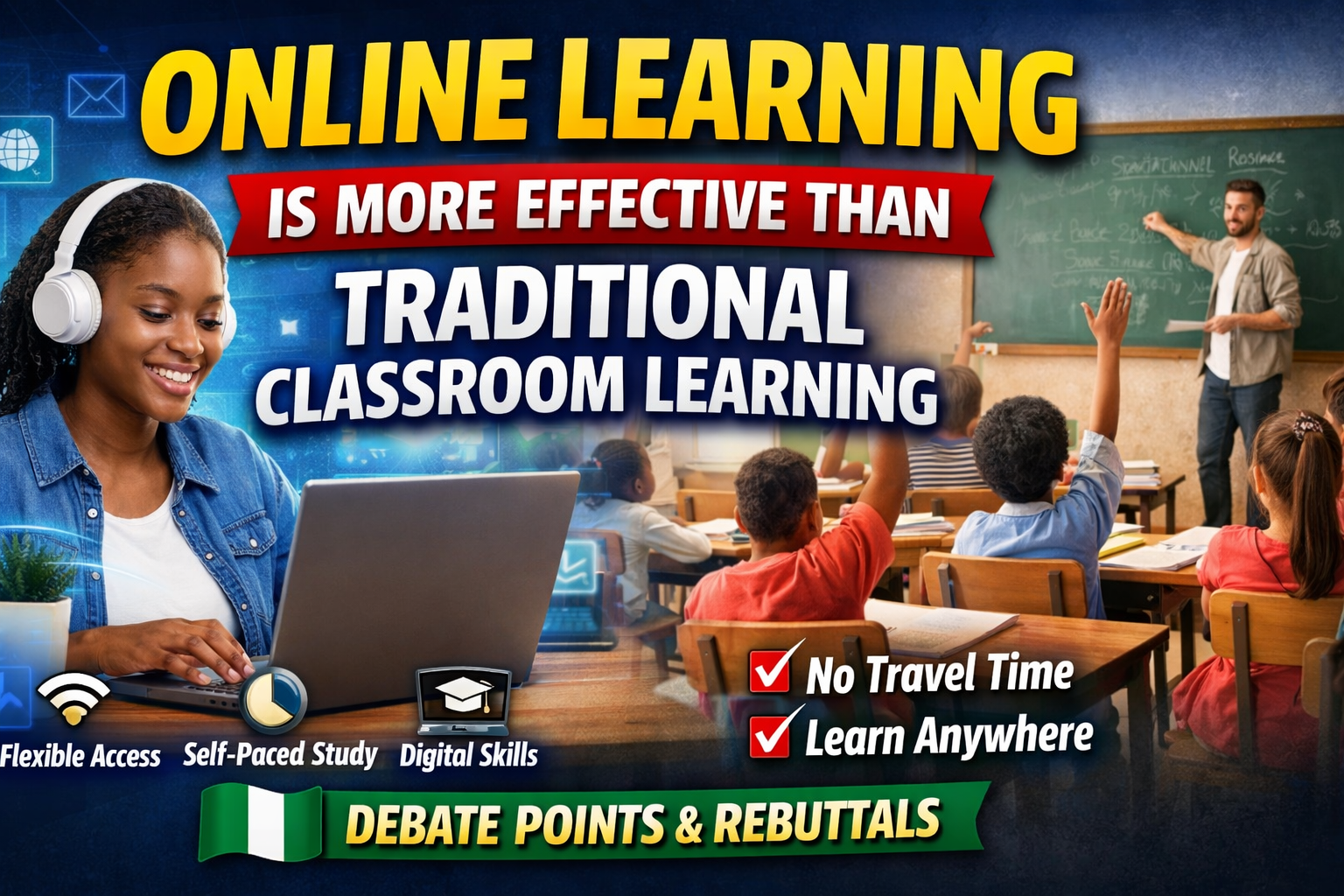
Online Learning Is More Effective Than Traditional Classroom Learning Debate Points, Examples and Rebuttals
If you need online learning is more effective than traditional classroom learning debate points for a school debate, speech, or classroom assignment, the real problem is not finding arguments. It is finding arguments that are clear, defensible, and realistic. That matters even more in Nigeria, where digital learning has real promise but also real obstacles. UNESCO says online learning helped keep education going during school closures, reaching over 1 billion learners in theory, but it also failed to reach at least half a billion students worldwide. In Nigeria, UNICEF reports that only 24 percent of households have internet access, and in rural areas that drops to 15 percent.
That is why a strong debate answer should not sound extreme. The best proposition case is not “online learning is always better in every subject for every student.” That sounds weak because it is easy to attack. A better case is this: online learning can be more effective than traditional classroom learning when effectiveness is judged by access, flexibility, continuity, resource availability, personalization, and modern skill development.
That definition gives you a stronger foundation from the start. In a debate, words matter. If the opposition defines “effective” only as “students sitting in one room with a teacher,” they will control the argument. You should define effectiveness more broadly: a method is effective if it helps more students learn, understand, revisit lessons, stay connected during disruptions, and gain useful skills for the modern world.
Table of Contents
ToggleWhat the motion really means
Before giving your points, make one thing clear: online learning does not simply mean watching random videos. It includes live virtual classes, recorded lessons, digital assignments, discussion platforms, online quizzes, downloadable notes, and structured learning systems.
You should also explain that traditional classroom learning has strengths, especially for supervision, social interaction, and hands-on practical work. Admitting that does not weaken your side. It makes your position sound honest. Then you can argue that online learning still becomes more effective in many important ways, especially when the question is scale, convenience, reach, and continuity.
For a debate, that is a smart strategy. It shows maturity, reduces exaggeration, and makes your later rebuttals easier.
Online Learning Is More Effective Than Traditional Classroom Learning Debate Points
Point 1 — It expands access beyond the physical classroom
Traditional classroom learning is tied to one place at one time. Online learning breaks that limit. A student in a remote area can access lessons from a teacher in another city. A learner who misses class because of illness, transport issues, or distance can still keep learning.
This is one of the strongest points you can use because it connects effectiveness to access. A learning method cannot be called effective for everyone if large numbers of students cannot reach the classroom consistently. UNESCO’s education technology review shows that digital tools can widen access, while Nigeria’s education and digital policy documents also frame digital learning as a way to improve inclusivity and continuity.
A simple debate line here is: online learning removes the wall of distance.
Point 2 — It gives students flexibility and saves time
Many students learn better when they can fit study into their real lives. Online learning cuts commuting time, reduces delays caused by transport, and lets students learn from home, hostels, workplaces, or other safe spaces.
This matters in Nigeria, where transport stress, fuel costs, and long travel times can affect attendance. Time spent getting to class is not always time spent learning. Online learning can shift more of that time back into actual study, revision, and task completion.
Flexibility also helps different categories of learners: working students, nursing mothers, students preparing for exams, and learners who need extra time to understand difficult topics. Effectiveness is not only about being present. It is also about being able to keep learning consistently.
Point 3 — It supports self-paced and repeat learning
In a physical classroom, once a teacher explains a point and moves on, that moment is gone. Some students catch up quickly. Others do not. Online learning gives students the chance to pause, replay, rewatch, and review.
That makes a huge difference for difficult topics like mathematics, grammar, chemistry theory, economics, or literature analysis. Students do not all learn at the same speed. Online learning respects that reality better than the one-speed classroom model.
This point becomes even stronger when you explain that repetition improves retention. A student who can revisit a lesson three times often understands more than a student who heard it once in a crowded classroom and felt too shy to ask questions.
Point 4 — It offers wider learning resources and expert access
Traditional classrooms often depend on one teacher, one textbook, and one timetable. Online learning opens the door to more. Students can compare explanations, use simulations, join webinars, watch tutorials, read articles, attempt quizzes, and access digital libraries.
UNESCO notes that technology has dramatically increased access to teaching and learning resources, while its broader guidance also warns that these tools work best when they are tied to real pedagogy rather than used for their own sake. That is exactly how you should frame this point: online learning is not powerful because screens are magical; it is powerful because it multiplies resources.
A strong way to phrase it in debate is: the internet turns one classroom into many classrooms.
Point 5 — It improves digital literacy and independent learning
A student who learns online is not only learning subject content. That student is also learning how to search, evaluate, organize, submit, communicate, and solve problems in digital spaces. Those are no longer optional skills.
Nigeria’s Federal Ministry of Education says its National Digital Learning Policy aims to improve the effectiveness, efficiency, and inclusivity of digital learning. A recent World Bank policy note on Nigeria also explains that digital literacy supports access to information, opportunity, and employability, and treats digital education policy as part of a broader national skills agenda.
This gives you a powerful modern argument: even when online learning delivers the same academic result as classroom learning, it may still be more effective overall because it also prepares students for the digital economy.
That is especially relevant for Nigerian students, since school no longer prepares learners only for exams. It also prepares them for university portals, digital job applications, remote work, online collaboration, and technology-driven careers.
Point 6 — It can personalize learning better
In a traditional classroom, one teacher may be handling dozens of students at once. That makes personalization hard. Online platforms can do more targeted work. They can track progress, show weak areas, recommend revision, repeat quizzes, and adjust pace.
That does not mean every app is brilliant. It means the model itself creates room for more personalized feedback than many crowded classrooms can offer. UNESCO’s review stresses that technology helps only when it is tied to learning goals and teaching design, not when devices are simply distributed without proper use.
So your argument should be precise: online learning can be more effective because it allows a more individualized path, especially for revision and assessment.
Point 7 — It supports learning continuity during disruption
This is one of the most practical and evidence-based arguments you can use. When schools close because of health emergencies, insecurity, weather, strikes, or local disruption, traditional classroom learning stops. Online learning does not have to.
UNESCO says online learning prevented education from collapsing during COVID-19 school closures, even though access remained unequal. The World Bank also reports that in Edo State, Nigeria, 56 percent of primary and junior secondary students who had access to the EdoBEST@home programme were able to learn away from school. The same World Bank lesson is important: technology alone is not enough; teacher training and two-way interaction matter too.
That gives you a balanced but strong debate point. Online learning is more effective in crises because it keeps education moving instead of freezing it completely.
Why these points matter even more in Nigeria
Nigeria is one of the clearest places to discuss this topic honestly. On one hand, the country is actively pushing digital learning. The Federal Ministry of Education’s policy documents describe digital learning as a route to inclusivity, efficiency, better content, teacher support, and resilience in times of disruption. A World Bank policy note also highlights digital literacy as a foundation for opportunity and participation in a modern economy.
On the other hand, access remains uneven. UNICEF’s 2024 situation analysis says only 24 percent of Nigerian households have internet access, dropping to 15 percent in rural areas, and it also points to limited electricity and low digital access as barriers. Nigeria’s communications regulator reported broadband penetration at 44.43 percent by December 2024, which shows progress but not universal readiness.
That means the best Nigerian argument is not “online learning is already perfect.” It is “online learning is the more future-ready and scalable model, even though Nigeria still needs better infrastructure to unlock its full value.”
That distinction is important. A weak speaker confuses the promise of online learning with the current state of digital access. A strong speaker separates them. The model can still be more effective in principle and in many real cases, even when infrastructure is not yet good enough for everyone.
Strong rebuttals the opposition will use and how to answer them
“Many students do not have internet or devices”
This is the opposition’s strongest point, so do not dodge it. Accept the reality, then answer carefully.
You can say: limited access is a problem of infrastructure, not proof that the learning model itself is inferior. If a road is bad, that does not mean cars are useless. It means the system needs investment.
Use Nigeria here. UNICEF’s data on household internet access shows the access gap is real, while the national policy direction shows the country is trying to close that gap through digital learning frameworks, skills development, and infrastructure support.
“Traditional classrooms have better discipline”
This is partly true. Physical classrooms do make supervision easier. But supervision is not the same as effectiveness.
Your response should be that online learning can build self-discipline, time management, and personal responsibility. These are valuable forms of learning too. In many cases, students who learn to manage deadlines, review content independently, and communicate online are building habits that help them beyond school.
You can also add that poorly disciplined online learning is usually a design problem. Clear schedules, teacher feedback, frequent assessments, and active participation tools improve accountability.
“Face-to-face learning gives better interaction”
This point has weight, and you should admit that in-person interaction is often stronger for immediate emotional connection, classroom energy, and spontaneous discussion.
But your answer is that online learning does not eliminate interaction. It changes its form. Live video classes, chat-based discussion, breakout rooms, forums, collaborative documents, and recorded feedback all create interaction. In fact, some shy students participate more online than they do in physical classrooms.
The strongest version of your response is not “online interaction is always better.” It is “online learning can still produce meaningful interaction, and in some cases wider participation.”
“Practical subjects cannot be taught well online”
Here again, do not overclaim. Some practical subjects clearly need laboratories, workshops, clinics, studios, or physical demonstration.
Your answer should be that the motion does not require online learning to replace every practical experience. It only requires showing that online learning can be more effective overall in many contexts. Theory-heavy subjects, revision classes, exam preparation, professional development, digital skills training, and content delivery often work extremely well online.
Research also points to nuance here. The well-known U.S. Department of Education meta-analysis found online learning performed better on average than face-to-face learning, but the stronger effects were seen when online elements were blended into teaching rather than used as a simplistic fully isolated substitute. More recent OECD work also suggests that fully online learning is not automatically better for higher-order thinking, while blended models often show stronger results.
That actually helps you. It lets you sound informed, not exaggerated.
Common mistakes students make in this debate
The first mistake is saying online learning is better in every way. It is not. Once you claim that, the opposition only needs a few practical examples to damage your whole case.
The second mistake is using foreign examples only. If you are debating in Nigeria, local relevance matters. Mention internet access gaps, digital learning policy, and examples such as continuity efforts like EdoBEST@home.
The third mistake is confusing convenience with effectiveness. Convenience helps, but you should connect it to actual learning outcomes: more revision, less wasted time, more consistent attendance, broader access, and improved digital skills.
The fourth mistake is ignoring the difference between fully online and well-designed online or blended learning. Strong speakers understand that online learning works best when it is structured, interactive, and supported.
A short sample closing argument
Here is a simple closing you can adapt:
Online learning is more effective than traditional classroom learning because it breaks the limits of distance, saves time, supports self-paced study, gives wider access to resources, builds digital skills, and keeps learning going even when schools are disrupted. Traditional classrooms still have strengths, but education today is no longer judged only by four walls and a chalkboard. The more effective system is the one that reaches more learners, offers more flexibility, and prepares students for the world they are actually entering.
FAQ Section
1. Is online learning really more effective than traditional classroom learning?
It can be, depending on what you mean by “effective.” If you mean flexibility, access, continuity, replay value, and digital skill development, online learning has a strong case. If you mean hands-on supervision or lab-based practice, traditional classrooms may still do better in some settings. Research from UNESCO, OECD, and the U.S. Department of Education supports a more nuanced view than a simple all-or-nothing answer.
2. What are the strongest debate points for supporting online learning?
The strongest points are access, flexibility, self-paced revision, wider resources, digital literacy, personalization, and learning continuity during disruption. These are harder for the opposition to dismiss because they connect directly to how students actually learn.
3. What Nigerian example can I use in this debate?
A good example is the World Bank’s report on EdoBEST@home in Edo State. It found that 56 percent of primary and junior secondary students with access to the programme were able to learn away from school. That shows online or remote learning can help maintain continuity when classrooms are unavailable.
4. What is the best rebuttal to “not everyone has internet”?
Say that unequal access is a serious infrastructure problem, but it does not prove the learning model is weak. It proves Nigeria still needs better connectivity, devices, electricity, and digital support. UNICEF’s figures on internet access and Nigeria’s policy push toward digital learning support that response.
5. Is blended learning stronger than fully online learning?
Often, yes. The evidence is fairly consistent that blended learning is frequently stronger than purely online learning because it combines digital flexibility with human guidance and face-to-face support. That point can actually strengthen your debate if you use it carefully.
6. Can I still support the motion if I admit classroom learning has advantages?
Yes. That usually makes your argument better. Debate judges often prefer a balanced speaker who understands both sides and still proves why one side is stronger overall.
7. What is the best way to end this debate in one sentence?
Try this: Online learning is more effective because it makes education more flexible, more accessible, more resilient, and more relevant to the digital age.
Conclusion
The best way to argue this topic is with confidence and restraint at the same time. You do not need to pretend that traditional classrooms have no value. You only need to show that, in many modern situations, online learning does more: it reaches beyond distance, helps students learn at their own pace, widens access to knowledge, builds digital skills, and keeps education running when physical classrooms cannot. That is why these online learning is more effective than traditional classroom learning debate points are strongest when they are practical, evidence-based, and grounded in Nigeria’s real educational context.