How to Study Past Questions Effectively: 5 Proven Hacks to Smash Your Exams (Stop Cramming)
You just bought that thick “Face of JAMB” or “Lamlad” past question series. You feel productive. You feel ready. You spend hours memorizing the answers: “1998 Question 4 is B,” “2005 Question 12 is A.”
But here is the bitter truth: If this is your strategy, you are setting yourself up for a shock in the exam hall.
I’ve seen students who “knew” all the past questions score 180. Why? Because the exam bodies aren’t stupid. They know you have these books. They rarely repeat questions word-for-word, but they always repeat concepts.
If you want to know how to study past questions effectively, you need to stop treating them like a script to memorize and start treating them like a map to understand. Let’s break down how the top scorers actually use these books to get those high grades.
1. Reverse Engineering (The Topic Hunt)
Most students read a question, pick an answer, check the back of the book, and move on.
That is lazy studying.
Instead, try this: When you see a question, ask yourself, “Which topic is this coming from?”
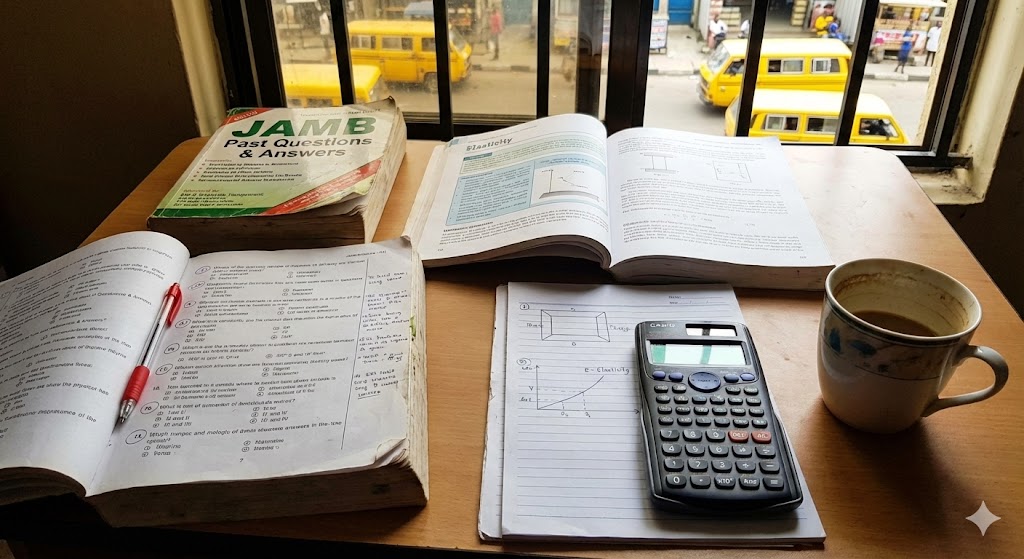
If you see a question on “Elasticity of Demand,” don’t just circle option C. Go back to your recommended textbook. Read the entire chapter on Elasticity. By doing this, you aren’t just learning the answer to that specific question; you are mastering the whole topic.
The Joint Admissions and Matriculation Board (JAMB) extracts questions from their syllabus. If you use the past question to guide you back to the syllabus, you become untouchable.
2. The “Why” Rule (Analyze the Wrong Options)
This is a secret weapon most students ignore.
Let’s say the answer to a question is Option A. Don’t stop there. Ask yourself: “Why are Options B, C, and D wrong?”
By analyzing the wrong answers, you are preparing yourself for future questions. Next year, JAMB might ask a question where Option B is the correct answer. If you already know what Option B means, you will smile in the exam hall while others are sweating.
This method is critical for subjects like Biology and Literature, where options can look very similar.
3. Simulate the Exam Hall (Kill the Distractions)
It’s easy to get a correct answer when you are lying on your bed, eating gala, and checking WhatsApp notifications every five minutes.
But the exam hall is a different beast. It’s hot, tense, and the clock is ticking.
Once a week, pick a year (e.g., JAMB 2021 Physics). Set a timer for the exact duration of the real exam. Put your phone away. Sit at a desk.
Force yourself to answer under pressure. This helps you manage your time and anxiety. Top universities like Olabisi Onabanjo University (OOU) use strict timing for their Post-UTME. If you aren’t used to speed, you will panic even if you know the answers.
4. Don’t Trust the Answer Key Blindly
Let’s be honest with ourselves. The people who print these past question booklets are human. They make mistakes.
I’ve seen countless “Correct Answers” in these booklets that are completely wrong. If you blindly memorize them, you will carry that error into the exam hall.
If an answer looks suspicious, or if it contradicts what your teacher said, check your textbook. Don’t argue with your textbook because of a N500 pamphlet. Verify everything.
5. Spot the Patterns (WAEC is Predictable)
If you study the last 10 years of WAEC papers, you will notice something funny.
They love certain topics. For example, in Chemistry, you will almost always see a question on “Organic Chemistry” or “Electrolysis.” In Government, “Military Rule in Nigeria” is a regular customer.
Use your past questions to identify these recurring themes. If a topic has appeared in 2018, 2019, 2021, and 2022, you can bet your last card it will show up in your exam. Focus 80% of your energy on these high-frequency topics.
Final Thoughts: It’s About Understanding, Not Cramming
“La cram, la pour” might work for a class test, but it won’t work for standardized exams.
Using past questions effectively means using them to test your knowledge, not to be your knowledge. Use them to find your weak spots. If you keep failing questions on “Calculus,” that is a sign to go back to your math teacher or textbook, not a sign to memorize the answer.
You have the tools. You have the time. Now, use them the right way.