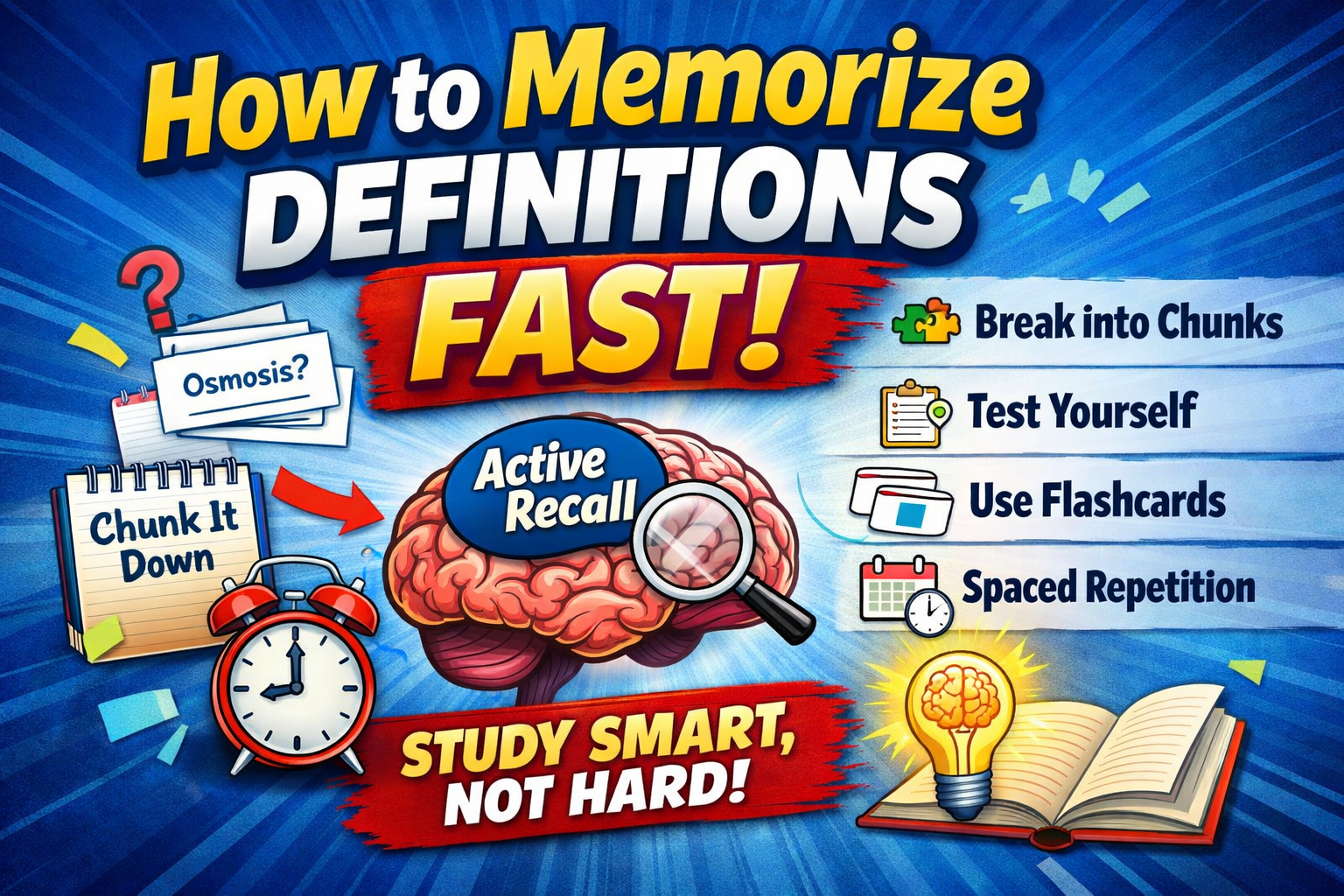
How to Memorize Definitions Fast: Study Methods That Actually Work
If you want to know how to memorize definitions fast, the first thing to fix is your study method. Most students try to memorize definitions by reading them again and again, underlining key words, and hoping the sentence will stick. That feels productive, but learning research consistently rates rereading and highlighting as weak strategies compared with practice testing and spaced practice.
Definitions are hard for a reason. They are often compact, abstract, and packed with precise wording. In subjects like Biology, Economics, Government, Literature, and Education, one missing phrase can change the meaning. So the goal is not just to “look familiar” with the words. The real goal is to recall the definition on your own and still recognize what each part means. Retrieval practice, spaced practice, and a few simple memory tools make that much easier.
Table of Contents
ToggleWhat memorizing definitions really means
A lot of students confuse recognition with memory. Recognition is when the definition looks familiar once you see it on the page. Recall is when you can produce it without the page in front of you. Retrieval practice is built around that difference: instead of staring at the definition, you bring it back from memory. Research-based learning guides recommend this because pulling information out of memory improves later recall more than simply looking over notes.
Understanding also matters. If a definition is just a string of words to you, memorization becomes fragile. But when you understand what each part is doing, you give your brain more connections to hold onto. Learning-science reviews rate elaborative techniques such as asking why and how as more useful than passive review, especially when combined with stronger methods like retrieval and spacing.
This is why cramming disappoints so many students. It can create the feeling of short-term familiarity, but spaced study tends to produce stronger and more durable learning. The Learning Scientists describe spacing as the opposite of cramming and note that the same amount of study time spread over time leads to better retention than packing it all into one session.
How to memorize definitions fast without wasting time
The fastest route is not “repeat the sentence twenty times.” A better route is this: break the definition down, understand it, recall it, correct it, and revisit it later.
Start by chunking the definition. Chunking means recoding smaller units into larger, familiar units, and research suggests it can reduce working-memory load. That matters because long definitions often overwhelm students not because they are impossible, but because they arrive as one dense block. When you split a definition into two, three, or four meaningful parts, it becomes far easier to hold and rebuild.
Then turn the definition into a prompt. Instead of staring at “Osmosis is the movement of water molecules from a region of higher water potential to a region of lower water potential through a selectively permeable membrane,” turn it into: “What moves? From where? To where? Through what?” That kind of prompt pushes you toward retrieval instead of passive reading. Retrieval practice works best when the answer is not right in front of you and you have to bring it to mind yourself.
Next, say the idea in your own simple words before trying to master the official wording. This is where many students speed up. When you first learn the meaning in plain language, the formal version stops feeling random. You are no longer memorizing noise. You are memorizing a compressed idea you already understand. That is closely aligned with elaboration and self-explanation, which help learners build connections around what they are studying.
After that, close the book and test yourself. Not later. Immediately. Write what you remember, say it aloud, or answer from a flashcard. Then check what you missed. Learning-science guidance recommends exactly that sequence: retrieve first, then use notes to correct gaps and misunderstandings, and then retrieve again later.
The best study techniques for definition-heavy subjects
Retrieval practice
This is the backbone. Put the definition away and try to produce it. That can mean practice questions, flashcards, writing from memory, or explaining it aloud. Research reviews rank practice testing and retrieval-based study among the highest-utility techniques for learning across subjects and learner groups.
Spaced repetition
Do not study the definition once and assume it is safe. Review it after a short delay, then again later, then again after a longer gap. The Learning Scientists describe spacing as spreading learning over time rather than cramming, and they call spacing plus retrieval the two most important study strategies because they have the strongest evidence and broadest usefulness.
Flashcards used the right way
Flashcards help only when you use them for recall, not recognition. That means you should look at the term, pause, answer from memory, and only then flip the card. The Learning Scientists also note that flashcards should go beyond shallow cue-and-response when possible by linking concepts and comparing ideas rather than just peeking at the back.
Dual coding
Some definitions stay abstract until you add a visual. Dual coding means combining words with visuals. That could be a diagram, arrow flow, timeline, sketch, symbol, or graphic organizer. Learning-science guidance explains that when the same idea is represented in words and visuals, you gain two routes for remembering it later.
Elaboration and comparison
Ask what makes this definition different from a similar one. Ask why each phrase is there. Ask what would become inaccurate if one word changed. These questions force precision. They also help you avoid a common exam problem: mixing up similar definitions because you memorized them as sound rather than meaning. Learning-science guidance recommends elaborative questioning as part of making sure you actually understand material before testing yourself on it.
A step-by-step method to memorize one definition quickly
Here is a simple method you can use in one short study block.
First, read the definition once or twice for meaning. Do not start chanting it yet.
Second, break it into chunks. A good chunk is a meaningful unit, not just any three words. For example:
- the thing being defined
- its action or function
- the condition or direction
- any special limit or qualifier
Third, rewrite it in plain language. Keep the meaning, reduce the pressure.
Fourth, close your notebook and recall it from memory. Write it down or say it aloud.
Fifth, compare your answer with the original and correct the gaps.
Sixth, review it again later the same day, the next day, and a few days after that. That is where spacing does its job.
This process is faster than rereading because it exposes the exact point where memory breaks. You stop wasting time on lines you already know and start attacking the parts you keep dropping.
Example of how to memorize a long definition
Take this example from science:
Osmosis: the movement of water molecules from a region of higher water potential to a region of lower water potential through a selectively permeable membrane.
Do not try to swallow the whole line at once. Break it like this:
- What is moving? Water molecules
- From where? Higher water potential
- To where? Lower water potential
- Through what? A selectively permeable membrane
Now turn it into your own words: “Water moves from where there is more available water to where there is less, across a membrane that only allows some things through.”
Now test yourself. Cover the definition and answer:
- What moves in osmosis?
- In which direction does it move?
- What kind of membrane is involved?
Once you can answer those cleanly, rebuild the formal wording. This is where memorization becomes much faster. You are not forcing one long sentence into your head. You are rebuilding it from meaning and structure, which is exactly what chunking, elaboration, and retrieval support.
You can do the same with non-science subjects. A Government definition, for example, can be split into actor, authority, process, and purpose. An Economics definition can be split into concept, condition, limitation, and result. The pattern changes slightly, but the method remains the same.
Common mistakes that slow memorization
The first mistake is passive rereading. Students often believe that reading a definition five times equals learning it. It usually equals familiarity, not recall. Research reviews specifically rate rereading and highlighting as lower-utility techniques than practice testing and distributed practice.
The second mistake is trying to memorize what you do not understand. This makes every sentence heavier than it needs to be. If a phrase is unclear, pause and decode it first. Ask what each part means, what role it plays, and how it differs from nearby concepts.
The third mistake is using flashcards badly. If you flip too early, you train recognition, not memory. A flashcard becomes powerful only when you struggle a little, answer first, and then check. In fact, The Learning Scientists point out that retrieval works best after you have forgotten the material at least a little, not when you simply repeat what is still sitting in front of you.
The fourth mistake is studying definitions only once. Fast memorization is not one perfect session. It is a short cycle of learning, testing, correcting, and returning later. That is what makes it last.
How to make definitions stick until exam day
Use a short review rhythm. For example, learn the definition today, test yourself again tonight, review it tomorrow, revisit it in two or three days, and then test it again before the exam. That rhythm is simple enough to use in a real timetable and still follows the logic of spaced practice.
Also mix old and new definitions. Do not only review the chapter you read today. Pull in two older terms. That small amount of mixing makes recall less dependent on short-term familiarity and more dependent on actual memory. It also shows you very quickly what is fading.
Sleep matters too. NIH resources note that sleep helps with learning and the formation of long-term memories, and insufficient sleep can hurt attention and thinking. So if you are memorizing definitions late at night, cutting sleep to keep rereading is usually a poor trade.
The bigger point is simple: the fastest method is rarely the most frantic one. You usually memorize definitions faster when you reduce overload, retrieve more, and spread your review.
Who this method helps most
This method is especially useful for students dealing with definition-heavy material: secondary school students learning textbook concepts, university students handling theory courses, and exam candidates revising large volumes of notes.
It also helps students who say things like:
- “I read it but I can’t say it back.”
- “I know it when I see it, but I forget it in the exam hall.”
- “I can memorize for one night, but not for next week.”
If that sounds familiar, the problem is probably not effort. It is method. And once the method changes, memorization usually becomes more efficient and much less frustrating.
FAQ Section
1. What is the fastest way to memorize definitions for an exam?
The fastest reliable method is to combine chunking, simple explanation, retrieval practice, and spaced review. Learning-science research consistently favors practice testing and distributed practice over passive rereading and highlighting.
2. Is reading a definition repeatedly enough?
Usually, no. Repeated reading can make a definition feel familiar, but stronger learning happens when you try to recall the definition from memory and revisit it over time.
3. Are flashcards good for memorizing definitions?
Yes, but only if you use them for active recall. Look at the term, answer before flipping, then check and correct. Flashcards are weaker when you peek too early or just read both sides repeatedly.
4. How often should I review a definition after learning it?
A practical approach is to review it shortly after learning, again the next day, and then after longer gaps. That follows the logic of spaced practice, which is more effective than cramming one long session.
5. How do I memorize long definitions word for word?
Break the definition into meaningful parts, understand each part, recall it in plain language first, then rebuild the formal wording. Chunking helps reduce memory load, which makes long definitions easier to handle.
6. Does understanding a definition really help memorization?
Yes. When you understand the meaning and structure of a definition, you have more mental connections to use during recall. Elaboration and self-explanation are useful because they help you see why the wording matters.
7. Can I memorize definitions overnight?
You may remember some of them briefly, but overnight cramming is weaker than spaced study for lasting retention. It is better to use short retrieval sessions over time than depend on one final rush.
Conclusion
Learning how to memorize definitions fast is less about raw speed and more about using the right sequence. Break the definition into chunks, understand it in simple language, test yourself without looking, correct the gaps, and review it again later. That approach aligns far better with what learning research recommends than endless rereading or last-minute cramming. Add sleep and a simple review schedule, and definitions stop feeling like slippery sentences you can never hold onto.