How to Calculate CGPA for Nigerian Universities: A Simple 5-Step Guide to Avoid “Spill-Over”
How to Calculate CGPA for Nigerian Universities: A Simple 5-Step Guide to Avoid “Spill-Over”
You just saw your results on the portal. You see a few A’s, a couple of B’s, and maybe that one annoying E in a borrowed course. Your friends are shouting “Scholar!” but deep down, you are confused. You don’t actually know if you are on a First Class or if you are dangerously close to “Probation.”
It happens to the best of us.
Many Nigerian students wait until their 400 Level clearance to realize their CGPA is a mess. By then, it’s too late. You see people calculating their points with scientific calculators during lectures, looking stressed. Don’t be that person.
Whether you are at OOU, UNILAG, or a private uni, understanding how to calculate CGPA for Nigerian universities is the only way to stay in control of your graduation. Here is the breakdown, minus the headache.

The Dictionary of Pain: Understanding the Terms (CU, GP, TGP)
Before we do the math, you need to know the language. If you don’t know these three things, you are just guessing.
-
Credit Unit (CU): This is the “weight” of the course. A 4-unit course (like Project or difficult Math) is heavier than a 1-unit course (like GST). Failing a 4-unit course is a disaster.
-
Grade Point (GP): This is the score assigned to your grade. Usually, A = 5, B = 4, C = 3, D = 2, E = 1, F = 0.
-
Total Quality Points (TQP): This is your Grade Point multiplied by the Credit Unit.
The Grading System: Is Your School using 5.0 or 4.0?
Most federal and state universities in Nigeria, as regulated by the National Universities Commission (NUC), use the 5.0 grading scale.
However, some schools used to run a 4.0 scale (and some polytechnics still use different metrics). For this guide, we are sticking to the standard 5.0 scale because that’s what 90% of you will encounter.
Here is the standard breakdown:
-
A (70-100%): 5 Points
-
B (60-69%): 4 Points
-
C (50-59%): 3 Points
-
D (45-49%): 2 Points
-
F (0-44%): 0 Points (The dreaded “Carryover”)
Step-by-Step: How to Calculate Your GPA (One Semester)
Let’s imagine a scenario. You are a 100-level student in your first semester. Here is what your result slip looks like:
-
GST 101 (2 Units): You scored 72 (A).
-
MTH 101 (3 Units): You scored 45 (D).
-
PHY 101 (3 Units): You scored 60 (B).
The Calculation:
-
GST 101: 2 units × 5 points (A) = 10 Quality Points
-
MTH 101: 3 units × 2 points (D) = 6 Quality Points
-
PHY 101: 3 units × 4 points (B) = 12 Quality Points
Now, add them up. Total Quality Points (TQP): 10 + 6 + 12 = 28 Total Credit Units (TCU): 2 + 3 + 3 = 8
Your GPA Formula: TQP ÷ TCU GPA: 28 ÷ 8 = 3.50
So, for that semester, you are sitting on a 3.50. Not bad, but MTH 101 dragged you down.
The Real Math: How to Calculate CGPA (Cumulative)
CGPA stands for Cumulative Grade Point Average. This is where “Cumulative” matters. It means everything you have done from 100 Level first semester until now.
You don’t just add your GPA from Semester 1 and Semester 2 and divide by two. That’s wrong math.
You must add the Total Quality Points for ALL semesters and divide by the Total Credit Units for ALL semesters.
Example:
-
Semester 1: 28 Points / 8 Units
-
Semester 2: 40 Points / 10 Units
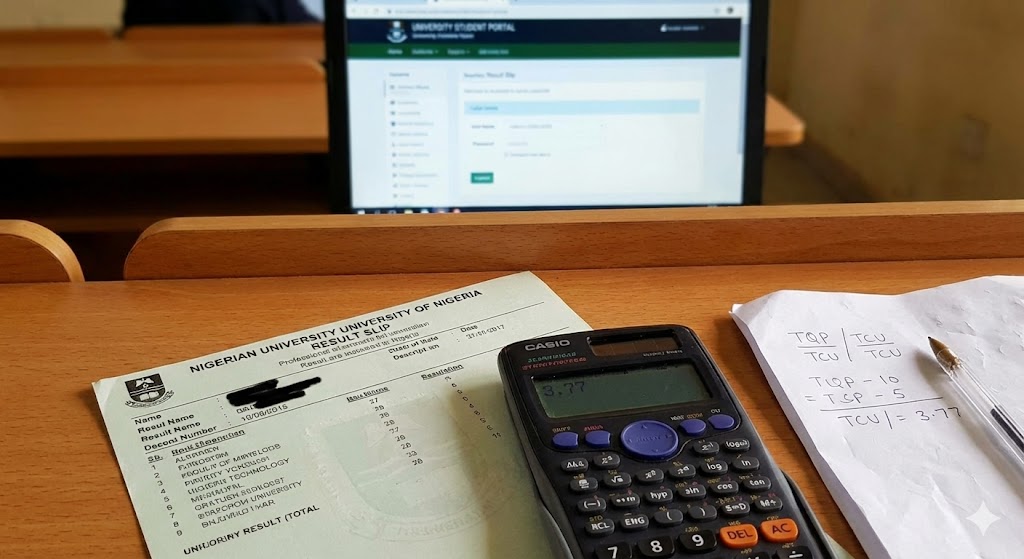
CGPA Calculation: (28 + 40) ÷ (8 + 10) 68 ÷ 18 = 3.77
Your CGPA is 3.77. You are officially in the Second Class Upper division.
The Verdict: What Your CGPA Says About You
In Nigerian universities, your CGPA determines your bragging rights—and sometimes, your job prospects. According to most student handbooks, like the ones from Olabisi Onabanjo University (OOU) or the University of Lagos (UNILAG), the classes are strictly defined.
Here is the ladder:
-
4.50 – 5.00: First Class (The “Efiko” gang. Very rare.)
-
3.50 – 4.49: Second Class Upper (2:1). (Most serious students aim here.)
-
2.40 – 3.49: Second Class Lower (2:2). (You are safe, but you need to wake up.)
-
1.50 – 2.39: Third Class. (You are walking on thin ice.)
-
1.00 – 1.49: Pass.
-
Below 1.00: Probation or Withdrawal (This is where the school advises you to go home).
Common Mistakes: How Students Crash Their CGPA Without Knowing
You might think you are doing well, but small mistakes can ruin your final grade.
1. Ignoring the “Small” Courses You focus all your energy on the difficult 3-unit courses and neglect the 1-unit GSTs. If you get an ‘F’ in a 1-unit course, it drags your CGPA down more than you think. Every point counts.
2. The “Let My People Go” Mentality Some students just want an ‘E’ to escape a course. This is dangerous. An ‘E’ gives you only 1 point. It is mathematically better to struggle for a ‘C’ than to settle for an ‘E’.
3. Failing to Calculate Early Many websites, like Myschool.ng, offer tools to help, but nothing beats doing it yourself manually. If you don’t track it, you won’t know when you need to sit up.
Final Words: Check Your Portal Now
Calculating your CGPA isn’t just about math; it’s about strategy. If you know you are sitting on a 3.45, you know you just need a few ‘A’s to cross into the 2:1 region. But if you don’t calculate it, you’ll fly blind until graduation day.
Don’t rely on rumors or what your course rep told you. Sit down, get your results, and punch the numbers.
Is your current CGPA looking healthy, or do you need to declare a state of emergency next semester?