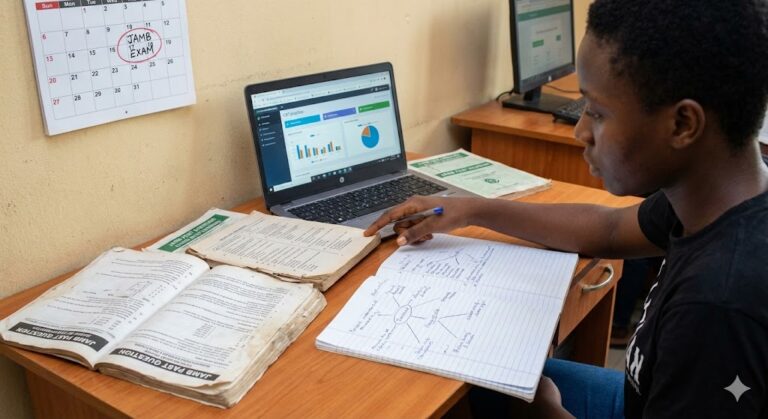
How to Balance University School Work and Learning a Tech Skill: 7 Proven Ways to Avoid Carryovers
Let’s face it: the pressure to become a “Tech Bro” or “Tech Sis” in a Nigerian university right now is choking.
Every time you open Twitter (X) or LinkedIn, you see someone your age posting their workspace setup, talking about “earning in dollars,” or sharing their certificate from a bootcamp. Meanwhile, you are stuck in a hot lecture hall, trying to understand a lecturer who has been using the same handout since 1999.
It’s tempting to just ignore your school work and focus entirely on coding or design. After all, “school na scam,” right?
Wrong.
School is not a scam. And having a degree—especially a good one—is still a massive safety net in Nigeria. But here is the problem: how do you combine the stress of assignments, impulsive tests, and 8 AM classes with the intense focus needed to learn Python, UI/UX, or Data Analysis?
It feels impossible. But plenty of students are doing it. I’ve seen 400-level students graduate with First Class degrees while already working remote jobs.
Here is how to balance university school work and learning a tech skill without landing on probation.


1. The “1-Hour” Rule is Your Best Friend
You might think you need 8 hours a day to learn to code.
Honestly, that’s a lie. If you try to study for your department courses during the day and then code for 6 hours at night, you will burn out in two weeks. Guaranteed.
Instead, aim for just one hour of focused learning every day. Consistency beats intensity. An hour of undistracted learning (no WhatsApp, no TikTok) every day adds up to 365 hours a year. That is enough to become proficient in HTML, CSS, and JavaScript.
Treat it like a compulsory course. If you can attend a 2-hour GNS class that adds almost no value to your life, you can find 1 hour for a skill that will pay your bills.
2. Master “Ghost Mode” in the Hostel
Distraction is the killer of ambition.
In the hostel, there is always noise. Someone is playing loud music, arguing about Messi vs. Ronaldo, or asking for “urgent 2k.” If you want to balance tech and school, you need to disappear.
Find a spot where nobody can disturb you. It could be the school library, an empty classroom, or just putting on noise-canceling headphones (or simply heavy earpieces).
When you are in “Ghost Mode,” you are working. Tell your roommates, “Guy, I dey code/study, abeg no distract me.” They might laugh at first, but eventually, they will respect your time.
3. Use the “Nigerian Factor” to Your Advantage
We all hate them, but ASUU strikes and long semester breaks are actually golden tickets for Nigerian students.
While your course mates are sitting at home complaining about the government or watching unlimited seasons of series, this is your time to go hard.
During the semester, your priority is your GP. During the break (or strike), your priority is your tech skill.
According to reports from The Guardian Nigeria, strikes have kept students at home for months at a time. Don’t waste those months sleeping. That is the time to take that intensive bootcamp or build that portfolio project.
4. Stop “Tutorial Hell”
Here is a mistake almost every beginner makes. You watch 50 videos on YouTube about “How to build a website using React.” You feel like you are learning.
But the moment you open your code editor to do it yourself, your mind goes blank.
This is called “Tutorial Hell.” You are passively consuming content instead of building. It wastes time you don’t have.
As a student, your time is limited. Watch one video, then immediately try to build something small with what you learned. If you are learning Data Analysis, don’t just watch a video on Excel; find a dataset and clean it.
Platforms like FreeCodeCamp are great because they force you to do the work, not just watch.
5. Know When to Hit the “Pause” Button
This is where many students crash.
You have a MTH 201 exam on Monday, but you are debugging your code on Sunday night because you want to finish a project.
Don’t do it.
Your primary assignment in the university is to graduate. A few weeks before exams, you need to pause the tech learning. Put the laptop away if you have to. Focus on your handouts, your past questions, and your continuous assessment (CA).
Getting a carryover because you were busy designing a landing page is painful. It drags you back and adds extra stress to your next semester. A First Class or Second Class Upper degree is still a reputable achievement that opens doors, even in the tech world.
6. Do Not Walk Alone
Trying to learn a tech skill alone while studying for a degree is lonely. You will feel like quitting.
Find a community. Look for the “Tech Bro” clique in your department or join a community on campus. Most universities like Olabisi Onabanjo University (OOU) or UI have student tech hubs or GDSC (Google Developer Student Clubs) chapters.
When you have friends who are also struggling to balance Java assignments with learning JavaScript, it becomes easier. You can share resources, complain about the stress together, and motivate each other to keep going.
7. Merge Your Worlds
The smartest way to balance school and tech is to make them work together.
If you are a Computer Science student, this is easy. Use your tech skills for your final year project. If you are in a different department, can you build a website for your faculty association? Can you use your data skills to analyze a survey for a sociology assignment?
When you apply your tech skill to your school work, you hit two birds with one stone. You get good grades, and you build your portfolio.
The Bottom Line
Balancing a degree and a tech skill is hard. There will be nights when you are tired, broke (“Sapa” is real), and frustrated with bugs in your code.
But remember why you started. The goal is to leave school not just with a certificate, but with a skill that makes you employable immediately.
Start small. Be consistent. And please, don’t forget to read for your exams.