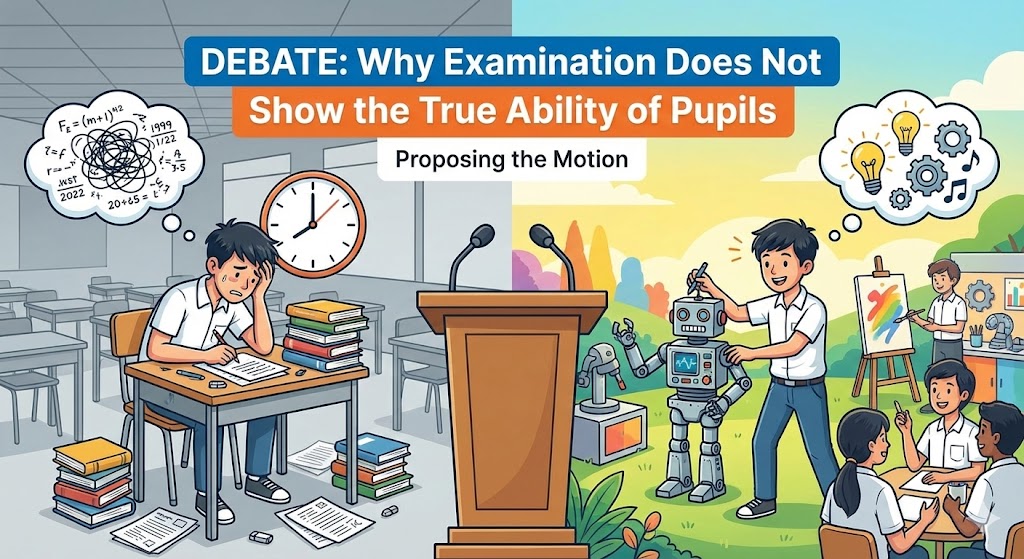
Debate: Why Examination Does Not Show the True Ability of Pupils (7 Winning Points)
Debate: Why Examination Does Not Show the True Ability of Pupils (7 Winning Points)
Good day, fellow students, debaters, and future leaders!
If you are reading this, you probably have a debate coming up on one of the most relatable topics in the history of Nigerian schools. We all know the feeling—you study hard, you know the material, but on the day of the exam, something goes wrong. Does that mean you are not intelligent? Absolutely not.
Today, we are providing a complete script supporting the motion: Why Examination Does Not Show the True Ability of Pupils.
Let’s define our terms so we are clear. An “examination” is usually a one-time test, often written, taken under pressure. “True ability,” on the other hand, is the full potential of a student—their creativity, their leadership, their practical skills, and their intelligence.
Does a 2-hour paper really measure all that? We say NO.
IMPORTANT DISCLAIMER: This article provides a debate script supporting the motion that examinations are not the best test of ability. This is strictly for educational and debating purposes. We acknowledge that exams are currently the standard method of assessment and should be taken seriously by all students.
Winning Debate Points on Why Examination Does Not Show the True Ability of Pupils
Here is your winning script. These points are written in the first person (“I”, “Me”) so you can practice them exactly as you will speak them on stage.
1. The “One Bad Day” Factor
Mr. Chairman, Panel of Judges, and Timekeeper.
My first point is simple logic. An academic session has about 365 days. An examination takes just 2 or 3 hours. How can 3 hours judge what I have done for 365 days?
It is impossible. Imagine a brilliant student who falls sick on the morning of the exam. Or imagine a student who just lost a loved one and is emotionally down. If they fail that exam because they were shaking with fever or grief, does it mean they are dull? No. It just means they had a bad day. Why examination does not show the true ability of pupils is because it judges a “snapshot” of a moment, not the full movie of our potential.
2. Cramming is Not Intelligence
Let’s be honest with ourselves. We all know that one student who plays all term, doesn’t listen in class, but two days before the exam, they “cram” the whole notebook. They pour it down on the exam paper, get an ‘A’, and then forget everything the next day.
Is that intelligence? No, that is rote memorization.
Exams mostly test your memory, not your understanding. A parrot can repeat words, but a parrot cannot think. If our system rewards students who can memorize and punishes students who try to understand but forget a specific definition, then the system is flawed. The ability to memorize is not the same as the ability to solve problems.
3. The Theory of Multiple Intelligences
Mr. Chairman, I want to refer to a famous psychologist named Howard Gardner. He proposed the theory of multiple intelligences.
He explained that some people are “Word Smart” (like lawyers), some are “Number Smart” (like engineers), but others are “Body Smart” (like footballers), “Music Smart” (like Davido or Wizkid), or “People Smart” (like great politicians).
Standard written examinations only test the first two. They completely ignore the rest. If you judge a fish by its ability to climb a tree, it will live its whole life believing it is stupid. That is exactly what exams do. They force all of us to climb the same tree, ignoring our unique, God-given talents.
4. Exam Anxiety (The Brain Freeze)
Have you ever walked into an exam hall, saw the first question, and suddenly your mind went blank? You know the answer, but the fear makes you forget it. As soon as you step out of the hall, the answer comes back.
This is called test anxiety. It is a psychological reaction to pressure.
According to [educational researchers at the Learning Scientists], anxiety interferes with working memory, making capable students underperform. A written exam tests how well you handle pressure, not necessarily how much you know. A student who is calm but knows less might score higher than a genius who is nervous. That is not a true test of ability.
5. Exams Don’t Test Real-World Skills
School is meant to prepare us for the future, right? But look at the real world.
In the real world, your boss won’t ask you to sit in a quiet room for two hours without looking at a book. In the real world, you have access to the internet, you work in teams, and you solve practical problems.
Exams isolate us. They forbid collaboration. They forbid research. They test skills that are irrelevant to modern life. A student might fail an exam but be an excellent leader, a fantastic communicator, or a brilliant entrepreneur. These practical skills are what the world needs, yet our exams give them zero marks.
6. The Problem of Malpractice and Luck
This is a hard truth, but we must say it.
An exam result can be influenced by luck or dishonesty. A student might spot a question they just read 5 minutes ago and pass. Another student might read 90% of the textbook but be asked questions from the 10% they missed. Is the first student smarter? No, just luckier.
And let’s not forget malpractice. If a student cheats and gets an ‘A’, the exam record says they are a genius. But are they? Why examination does not show the true ability of pupils is because the results can be faked. True ability cannot be faked, but exam scores can be.
7. It Kills Creativity
Finally, Mr. Chairman. Exams teach us that there is only “one right answer.”
If the marking scheme says the answer is “A,” and you write a creative, intelligent answer that is slightly different, you fail. This kills critical thinking. It trains us to be robots who follow instructions, rather than innovators who think outside the box. True ability is about creation and innovation, not just repetition.
Frequently Asked Questions (FAQs)
What is the strongest argument for the other side? The opposition will likely say, “If we don’t do exams, how do we grade people?” They will argue that exams provide a standard, objective way to measure everyone equally. To counter this, you can argue that “equality” is not “fairness” if the test itself is biased towards memory.
What is the alternative to examinations? You should suggest holistic assessment. This includes continuous assessment, project work, presentations, practical demonstrations, and portfolios. These methods track a student’s growth over time, rather than just one stressful day.
How do I conclude without sounding lazy? Make sure you emphasize that you are not afraid of hard work. You are simply asking for a fairer way to show that hard work. Use the phrase: “We want to be tested on what we can do, not just what we can remember.”
Conclusion / Summary
In conclusion, Mr. Chairman, panel of judges, and my fellow students, the evidence is overwhelming.
We have shown you that:
-
Exams are just a snapshot of one day, not a measure of potential.
-
Cramming is not the same as learning.
-
We have different talents (multiple intelligences) that exams ignore.
-
Test anxiety ruins performance for smart students.
Why examination does not show the true ability of pupils? Because it is a limited tool trying to measure a limitless human mind. It is time we look beyond the paper and see the person.
Disclaimer: Once again, this post is a debate guide supporting the motion that exams are not the true test of knowledge. In the current educational system, exams are still required, and we encourage every student to study hard and do their best.
What do you think? Do you feel exams capture your true worth? Or do you have skills that your report card never shows? Drop your opinions in the comments section below… Also, feel free to share this post with your coursemates or those in your team!