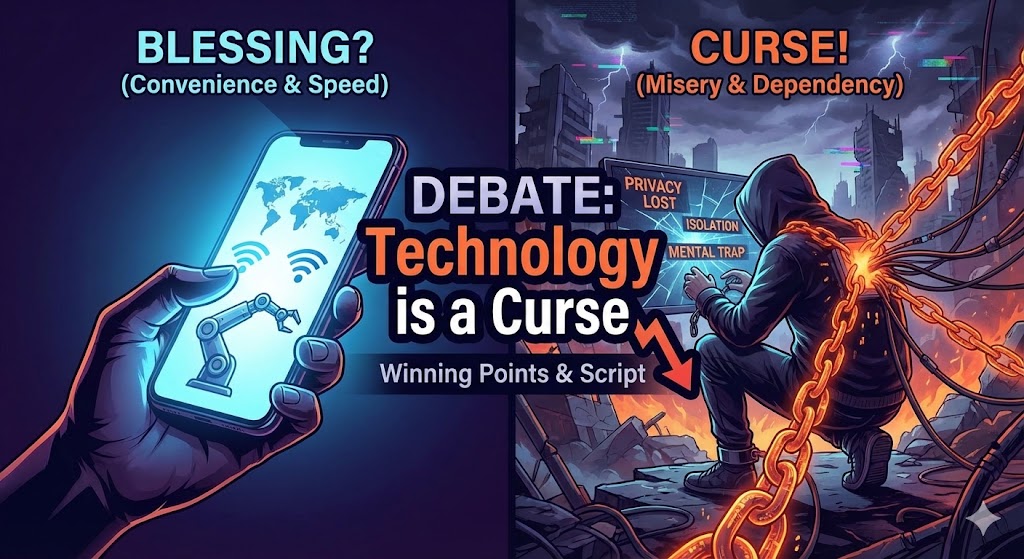
Debate: Technology is a Curse (6 Winning Points)
Debate: Technology is a Curse (6 Winning Points)
Good day, students! Are you preparing to stand before a panel of judges and argue that our modern gadgets are actually destroying us? You’ve come to the right place.
Let’s be honest. It is easy to love our phones and laptops. But if you want to win this debate, you have to look past the shiny screens. You need to prove that, despite the convenience, the damage technology does to our minds, our bodies, and our society is far greater.
Today, I’m giving you the exact script to support the motion that Technology is a Curse.
Before we get to the points, let’s define what we are talking about. Technology refers to the machinery and equipment developed from scientific knowledge—like phones, AI, and the internet. A Curse is a cause of trouble, misery, or evil. So, we are arguing that these tools bring more misery than joy.
Disclaimer: This article provides debate points supporting the motion that technology is a curse. This is for educational and debating purposes only and is not meant to condemn technological advancement entirely.

Winning Debate Points on Why Technology is a Curse
Here are 6 strong points you can copy, adapt, and use to silence your opponents.
1. It Has Destroyed Human Connection
My first point is something we see every day. Technology has killed true face-to-face interaction. Look around you. You can be in a room full of people, yet everyone is staring at a screen. We are “connected” to people thousands of miles away, but we ignore the person sitting right next to us.
This is social isolation disguised as connection. We trade real conversations for likes and comments. When we stop looking each other in the eye and start living through our devices, we lose our humanity. Judges, if a tool makes us lonelier than ever before, surely that tool is a curse.
2. The Rise of Mental Health Issues
Let’s talk about what technology does to the mind. Social media platforms are designed to be addictive. They trap us in a cycle of comparison. You scroll through Instagram or TikTok, seeing everyone’s “perfect” lives, and you start to feel inadequate.
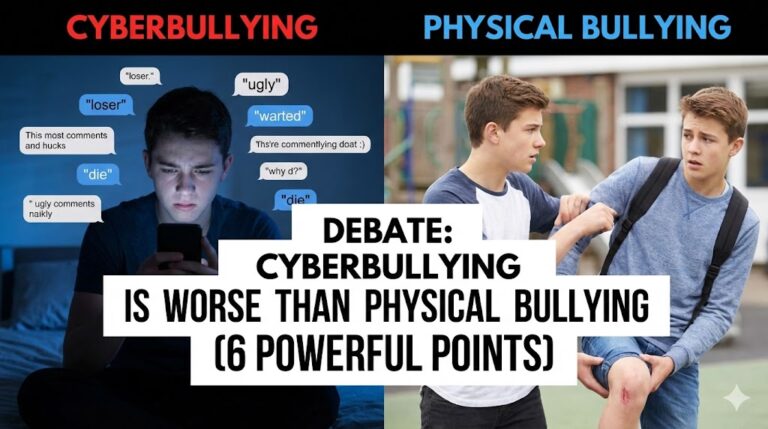
This isn’t just my opinion. [According to the World Health Organization (WHO)], there is a significant link between excessive screen time and rising rates of anxiety and depression among young people. Cyberbullying is another monster created by technology. People can hide behind screens and destroy someone’s self-esteem without consequences. If technology is the root cause of this mental anguish, then technology is a curse.
3. Physical Health is Deteriorating
We cannot ignore the physical toll. Technology promotes a sedentary lifestyle. Instead of playing outside, children are glued to video games. Instead of walking, we take cars or bikes even for short distances.
This lack of movement is leading to an obesity crisis and eye defects from staring at blue light all day. We are becoming physically weaker because we rely on machines to do everything for us. A blessing should improve your life, not ruin your health.
4. Loss of Privacy and Security
Imagine waking up to find your bank account empty or your private photos leaked online. This is the reality of the digital age. Technology has made privacy violation a daily risk.
From Yahoo boys to international hackers, technology has given criminals powerful tools to harm innocent people. We put our entire lives on the internet, and that makes us vulnerable. When your identity can be stolen with a few clicks, you have to ask yourself: is this really progress? The constant fear of being hacked proves that technology is a curse on our security.
5. Unemployment and the AI Threat
My opponents will tell you technology creates jobs. But let’s look at the bigger picture. Automation and Artificial Intelligence (AI) are rapidly replacing human workers. Machines don’t need holidays, they don’t ask for salaries, and they don’t sleep.
Factory workers, cashiers, and even drivers are losing their livelihoods to machines. What happens to the millions of people who can’t find work because a robot does it faster? Technology is widening the gap between the rich (who own the tech) and the poor (who are replaced by it). Creating mass unemployment is not a blessing; it is a disaster.
6. The Death of Critical Thinking
Finally, technology is making us mentally lazy. Why remember a phone number when your contact list has it? Why learn how to spell when you have autocorrect? Why read a book when you can watch a 30-second summary?
We are outsourcing our brains to Google. We are losing the ability to think deeply and solve problems on our own because we assume the computer knows better. A generation that cannot think without a Wi-Fi connection is a generation in trouble.
Frequently Asked Questions (FAQs)
Q: But hasn’t technology saved lives in hospitals? A: That is a valid point. However, in this debate, you are arguing that the overall impact is negative. You can acknowledge medical advances but argue that the social, mental, and environmental destruction outweighs those benefits.
Q: How do I handle the argument that “it’s not the tech, it’s how we use it”? A: This is the most common counter-argument. You should reply by saying that technology is designed to be addictive and intrusive. It is not just about user choice; the system itself is rigged to exploit us.
Q: What is a strong closing statement? A: End by asking the audience to imagine a world without the constant noise of notifications. Remind them that peace of mind is priceless, and technology has stolen that from us.
Conclusion / Summary
To wrap up this debate, let’s look at the evidence. We are lonelier, unhealthier, less secure, and more dependent on machines than ever before.
While we cannot deny that gadgets are cool, the price we pay for them is too high. From digital addiction to the loss of privacy, the evidence clearly supports the motion that technology is a curse. It is time we control the machines before they control us completely.
Disclaimer: All sides of a debate are valid. This article was written to provide points for one specific side of the argument for educational purposes.
What do you think? Drop your opinions in the comments section below… Also, feel free to share this post with your coursemates or those in your team!