Debate: Sex Education Should Be Taught in Schools (7 Winning Points)
Debate: Sex Education Should Be Taught in Schools (7 Winning Points)
Good day, students!
If you are preparing to face the panel of judges and need the absolute best arguments for your upcoming debate, you are in the right place. Today, we are tackling a sensitive but incredibly important topic: “Sex Education Should Be Taught in Schools.”
This is one of those motions that gets people talking. But remember, as a debater, your job is to deal with facts, logic, and reality—not fear or shyness.
So, what are we really talking about? When we say Sex Education, we aren’t talking about encouraging bad behavior. We are talking about equipping students with the correct information about their bodies, their health, and their future. It is about replacing ignorance with knowledge.
Below, I have written out 7 winning points supporting this motion. These are written in the first person, so you can pick the ones that resonate with you and deliver them with confidence.
Disclaimer: This article provides debate points supporting ONE side of the motion for educational purposes. It is designed to help students formulate logical arguments and does not dismiss the role of parents or religious institutions in moral upbringing.

Winning Debate Points on Why Sex Education Should Be Taught in Schools
1. Prevention is Better Than Cure (Reducing Teenage Pregnancy)
My first point is simple: ignorance is expensive. We cannot pretend that teenagers aren’t curious. The reality is that without proper guidance, curiosity leads to mistakes. One of the biggest issues facing our society today is the high rate of teenage pregnancy.
When Sex Education Should Be Taught in Schools, it gives young people the tools to understand consequences. If I know how my body works and I understand the risks involved in certain actions, I am far less likely to make a mistake that could derail my entire education. Keeping students in the dark doesn’t protect them; it leaves them vulnerable. Education is the strongest shield we have.
2. Combating Health Risks (STDs and STIs)
Let’s talk about health. It’s a scary world out there when it comes to diseases. HIV/AIDS and other sexually transmitted diseases (STDs) are real threats to our generation. How can we fight an enemy we don’t understand?
Schools are where we learn about hygiene, biology, and physical health. Why should reproductive health be any different? By teaching sex education, schools provide accurate, life-saving information on how to stay safe. As noted by global health bodies like the [World Health Organization (WHO)], comprehensive education is a primary factor in reducing the spread of infections among young people. We need facts, not whispers.
3. Busting Myths and Misinformation
Have you ever heard something on the playground or saw a rumor on social media that turned out to be completely false? That happens with sex and reproductive health every single day.
If schools don’t teach us, the internet will. And the internet is full of bad advice, dangerous myths, and twisted information. By formalizing this subject in the curriculum, teachers can correct these misconceptions. They can replace “street talk” with scientific facts. It ensures that every student, regardless of their background, gets the same correct information.
4. Understanding Consent and Boundaries
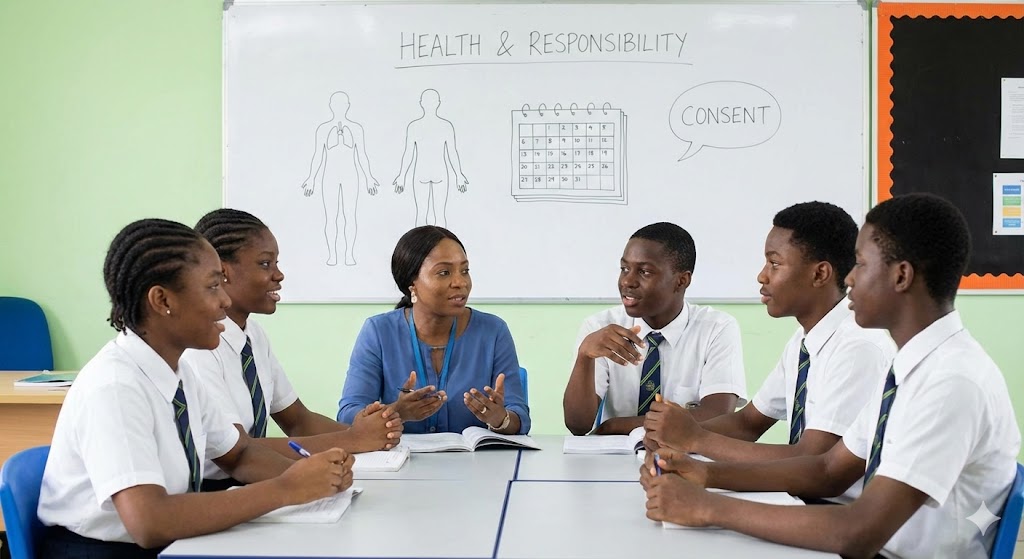
This point is crucial for the safety of every student. Sex education isn’t just about biology; it’s about respect. It teaches us about consent—learning that “No” means “No,” and understanding that we have the right to set boundaries over our own bodies.
In a world where abuse and harassment are unfortunately common, knowing your rights is a superpower. If schools teach us early on to respect the personal space of others and to demand respect for ourselves, we build a safer, more empathetic society. This isn’t just education; it’s character building.
5. Reducing Abortion Rates
This follows logically from my earlier points. Critics often argue that sex education promotes promiscuity, but the data suggests the opposite. When young people are informed, they make smarter, more cautious choices.
When we reduce unwanted pregnancies through education, we automatically reduce the number of unsafe abortions. It’s a chain reaction. Knowledge leads to caution, caution leads to fewer accidents, and fewer accidents mean fewer young lives are put at risk trying to “fix” a mistake. It is a protective measure for the youth.
6. Empowering Informed Decision Making
You cannot make a good decision if you don’t have all the facts. It’s like trying to write an exam without studying the textbook. Sex Education Should Be Taught in Schools because it empowers us to take charge of our lives.
When I understand the emotional, physical, and social implications of relationships, I can decide when I am ready. I won’t be pressured by peers or confused by emotions. I will have the logic and the knowledge to say, “I am focusing on my studies right now.” Education gives us the power of choice.
7. Bridging the Gap for Shy Parents
Let’s be honest—some parents find this topic incredibly difficult to discuss. It can be awkward. Because of this awkwardness, many homes go silent on the topic, leaving the child to figure it out on their own.
Schools provide a neutral, professional environment. A teacher can explain the biology and the facts without the embarrassment that might happen at the dinner table. It supports what parents are doing at home (or filling the gap if they aren’t doing it) to ensure no child is left behind just because their parents were too shy to have “the talk.”
Frequently Asked Questions (FAQs)
Q: Doesn’t teaching sex education encourage students to experiment? A: This is the biggest myth out there. Research, including studies cited by [UNESCO], consistently shows that comprehensive sexuality education does not increase sexual activity. In fact, it often delays it because students understand the risks and the seriousness of the topic.
Q: Isn’t this the parents’ job? A: Ideally, it is a partnership. Parents play a huge role in teaching values and morals. However, schools are best equipped to teach the science, the biology, and the health facts objectively.
Q: At what age should it start? A: It should be age-appropriate. Younger students might learn about “good touch vs. bad touch” and hygiene, while older students tackle more complex topics. It grows as the student grows.
Conclusion / Summary
To wrap this up, the argument that Sex Education Should Be Taught in Schools is not about corrupting the youth; it is about saving them. We have discussed how it prevents teenage pregnancy, stops the spread of diseases, teaches consent, and empowers students to make smart life choices.
Ignoring the topic doesn’t make it go away—it just leaves students unprepared. We must choose knowledge over ignorance every single time.
Disclaimer: The views expressed in this debate script are for academic argumentation only. All sectors of society, including families and religious bodies, play a vital role in the holistic upbringing of a child.
What do you think? Is it time for schools to step up, or should this stay at home? Drop your opinions in the comments section below… Also, feel free to share this post with your coursemates or those in your team!