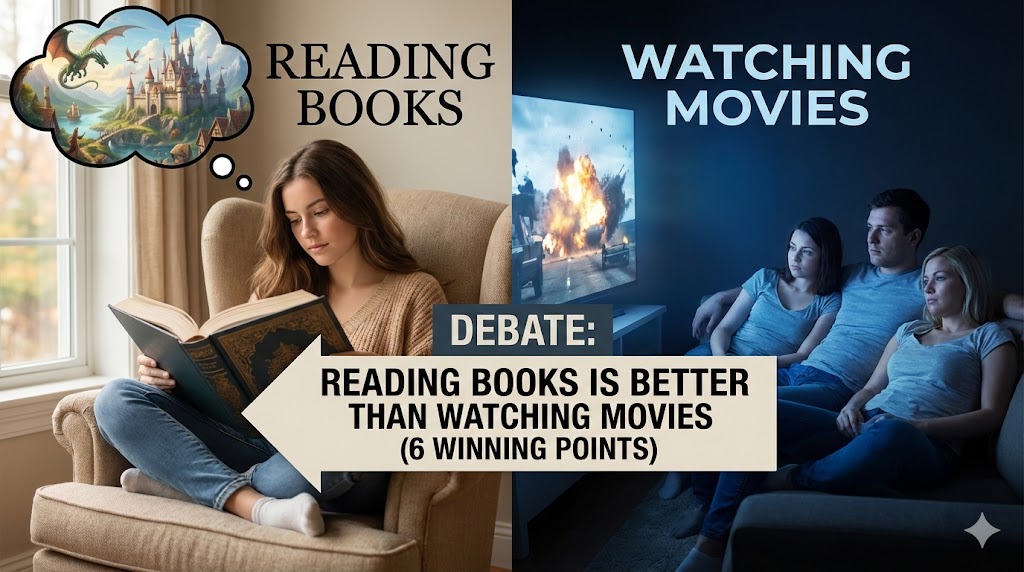
Debate: Reading Books is Better Than Watching Movies (6 Winning Points)
Debate: Reading Books is Better Than Watching Movies (6 Winning Points)
Good day, fellow students!
Are you ready to convince the judges? If you are looking for the absolute best arguments to support the motion that Debate: Reading Books is Better Than Watching Movies, you have just struck gold.
We live in a Netflix world, I get it. It’s easy to just sit back and watch. But when we talk about actual value—mental growth, creativity, and depth—movies simply cannot compete with books. Reading is an active workout for your brain, while watching a movie is often just passive entertainment. Today, I’m handing you the script to prove exactly why the written word is king.
Disclaimer: This article provides a debate script supporting the proposition. It is designed for educational purposes to help students build critical thinking skills. We love movies too, but for the purpose of this academic exercise, we are arguing for the superiority of reading.
Winning Debate Points on Why Reading Books is Better Than Watching Movies
Here are 6 winning points that will help you dominate the podium. These are written in the first person, so you can read them straight to the audience.
1. The Power of “Active” vs. “Passive” Entertainment
Mr. Chairman, Panel of Judges, let’s start with the basics. When you watch a movie, you are a spectator. You sit there, and the director does all the work for you. He tells you what the hero looks like, what the voice sounds like, and exactly how the scenery appears.
But when I read a book, I am the director. My brain has to actively construct the world. I have to imagine the dragon’s roar or the look of the haunted house. This is active engagement. It forces my brain to work, creating new neural pathways. Watching a movie is like watching someone else lift weights; reading is lifting the weights yourself. Which one do you think actually builds muscle?
2. Boosting Imagination and Creativity
“The book was better than the movie.” How many times have we heard that? There is a reason for it. Movies are limited by budget, CGI technology, and the director’s vision.
Books have zero limits. In a book, the special effects are as good as your imagination allows them to be. [According to a study by Emory University], reading fiction actually improves brain connectivity and function. When you read, you aren’t just processing words; you are simulating the experience in your mind. Movies rob you of that creative power by spoon-feeding you every single image.
3. Depth of Detail and Character Development
Let’s be honest. A movie has maybe two hours to tell a whole story. They have to cut corners. They have to rush.
A book has days. In a novel, I can hear the character’s internal thoughts. I understand their fears, their secret motivations, and their past. I get the full picture. Movies often focus on the action—the explosions and the chases—but they miss the soul of the story. If you want to truly understand a story, you have to read it. Watching the movie is just reading the summary.
4. Improving Focus and Attention Span
We are living in a world of 15-second TikToks and YouTube Shorts. Our attention spans are dying. Movies, with their fast cuts and loud noises, just feed into this need for constant stimulation.
Reading is the antidote. It requires patience. It trains you to focus on one thing for an hour at a time. It builds the discipline you need for studying and taking exams. If we want to be students who can actually concentrate in class, we need to put down the remote and pick up a book. It is the best mental exercise there is.
5. Vocabulary and Language Mastery
This is a simple fact: you will never learn as many new words from a movie as you will from a book. In movies, dialogue is often simple and conversational. It has to be quick.
Books are where the rich language lives. Writers use descriptive words, metaphors, and complex sentence structures that you just don’t hear in casual conversation. By reading regularly, I am subconsciously expanding my vocabulary and improving my own writing skills. If you want to pass WAEC English with an A1, Netflix won’t help you—but reading novels will.
6. The “Pause and Reflect” Advantage
When you are watching a movie in a cinema or with friends, the train keeps moving. You can’t stop to think about a profound line or a complex idea without ruining the flow.
With a book, I am in total control of the pace. If I read a sentence that blows my mind, I can stop. I can look out the window and think about it. I can re-read it. This allows for deep comprehension and critical thinking. Books allow you to digest information; movies just throw it at you.
Frequently Asked Questions (FAQs)
Q: Isn’t watching a movie faster and more efficient? A: Faster? Yes. More efficient? No. Fast food is faster than a home-cooked meal, but it isn’t better for you. If your goal is just to “finish” the story, sure, watch the movie. But if your goal is to understand and grow, the book is the only way.
Q: What if I’m not a good reader? A: That is exactly why you should support this motion! Reading is a skill. The more you do it, the better you get. Avoiding books because they are “hard” is how you stay stagnant. Movies are the easy way out.
Q: How do I conclude this speech powerfully? A: Remind the audience that the richest man in the world, Elon Musk, didn’t learn about rockets from watching movies. He learned by reading books.
Conclusion / Summary
To wrap up, the argument that Debate: Reading Books is Better Than Watching Movies is supported by science, logic, and common sense.
We have discussed how reading builds imagination, improves focus, expands vocabulary, and offers a depth of storytelling that a two-hour film simply cannot match.
Disclaimer: Once again, this article is for educational debates. Movies are a wonderful art form, but they serve a different purpose than books. This script highlights the unique cognitive benefits of reading.
What do you think? Did I miss a key point? Drop your opinions in the comments section below… Also, feel free to share this post with your coursemates or those in your team!