Debate: Parents Are to be Blamed for the Misconduct of Their Children (6 Winning Points)
Debate: Parents Are to be Blamed for the Misconduct of Their Children (6 Winning Points)
Good day, fellow debaters! Are you ready to shake the table and deliver some hard truths? You have landed on the right page.
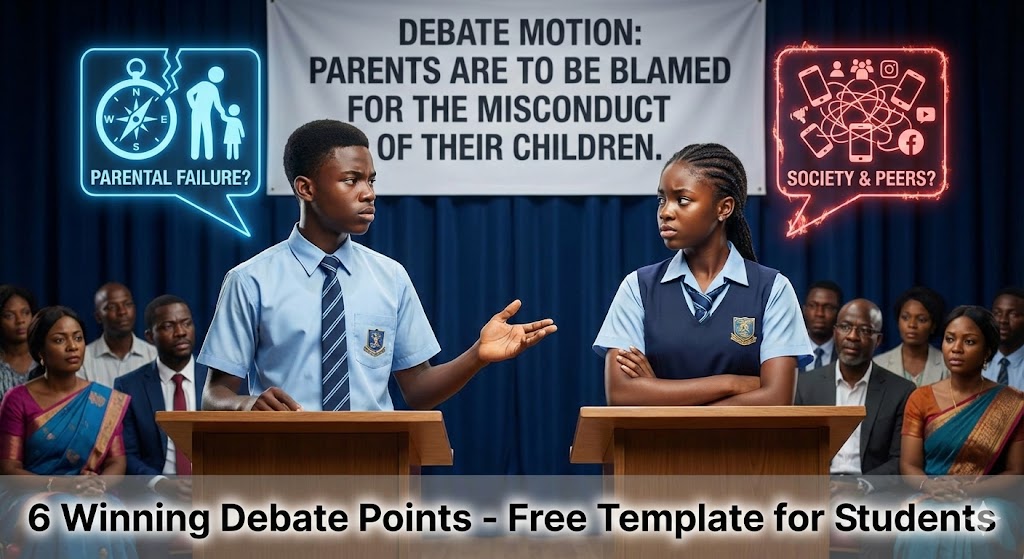
Today, we are discussing a motion that might make some adults uncomfortable, but it needs to be said. The motion is: Parents Are to be Blamed for the Misconduct of Their Children.
Let’s be honest. When we see a child acting out—fighting, stealing, or being rude—our first thought isn’t “Oh, that’s just bad luck.” No. We instantly wonder, “Who raised this child?” This debate is about accountability. It is about the root cause, not just the symptoms.
Definitions:
-
Misconduct: Bad behavior, indiscipline, or actions that violate social and moral rules.
-
Parents: The primary caregivers (biological or guardians) responsible for the upbringing and training of the child.
Disclaimer: This article provides a debate script supporting the motion that parents bear the primary responsibility for their children’s behavior. This is for educational debating purposes only. We understand that peer pressure and society also play a role.

Winning Debate Points on Why Parents Are to be Blamed for the Misconduct of Their Children
Here are your winning arguments. These points are written in the first person, so you can stand on that podium and speak directly to the judges.
1. Charity Begins at Home
Mr. Chairman, Panel of Judges, my first point is the oldest truth in the book: Charity begins at home.
The home is the first school. Before a child meets a teacher, a pastor, or a bad friend, they meet their parents. The mind of a child is like a blank slate (tabula rasa). Who holds the pen? The parents. If the foundation is shaky, the building will collapse.
If a child is rude to elders outside, check how they speak to people inside their house. If a child has no respect for rules, check if there are any rules at home. You cannot plant yam and expect to harvest cassava. If parents plant discipline and love, they will harvest a well-behaved child. But if they plant negligence, they cannot blame society for the weeds that grow. Parents are to be blamed for the misconduct of their children because they are the architects of that child’s character.
2. The Curse of Absentee Parenting
Let’s talk about the reality of today. My second point focuses on Parental Negligence.
We live in a world where parents are chasing money from Monday to Sunday. They leave the house before the kids wake up and return when the kids are asleep. Who is raising the children? The television? The house help? The internet?
When parents are physically or emotionally absent, children seek attention elsewhere. And often, negative attention is better than no attention at all. A child who feels unloved or ignored at home is an easy target for gangs and bad peer groups. [According to a study by the National Institute of Health], lack of parental supervision is one of the strongest predictors of conduct problems in youth. The parents might be rich, but if they are absent, they are failing.
3. Children Are Copycats (Role Modeling)
My third point is simple: Action speaks louder than voice.
Children don’t listen to what their parents say; they watch what their parents do. You tell your child not to lie, but when the landlord knocks, you tell the child, “Go and tell him I’m not around.” What have you just taught them? You have taught them that lying is a survival skill.
If a father beats the mother, the son learns that violence is how you solve problems. If a mother spends all day gossiping and insulting neighbors, the daughter learns that being rude is normal. Parents are the first role models. If the original copy is bad, the photocopy cannot be good. It is hypocritical to blame the child for acting out the script the parents wrote for them.
4. Spoil the Rod and Spoil the Child
Now, let’s address Discipline.
Some parents today are too afraid to be parents. They want to be their child’s “best friend.” They confuse love with permissiveness. When the child does something wrong, instead of correcting them, they defend them. “Oh, he’s just a child, let him be.”
This is dangerous. When a child learns that there are no consequences for bad actions, they grow up thinking they are above the law. They take that attitude to school, and eventually to the streets. A parent who refuses to say “No” is preparing their child for a life of misconduct. As the Bible says, “He who spares his rod hates his son.” The failure to discipline is a failure of parenting.
5. Ignoring the Early Warning Signs
My fifth point is about Denial.
Misconduct doesn’t happen overnight. It starts small. Maybe a small lie, or taking a pencil that isn’t theirs. Good parents catch these things early and correct them. But negligent parents turn a blind eye. They say, “It’s not a big deal.”
By the time the police are involved, or the child is expelled from school, the parents act surprised. But they shouldn’t be. They saw the smoke and refused to put out the fire. Because they failed to nip it in the bud, parents are to be blamed for the misconduct of their children when it grows into a forest fire.
6. The “My Child Can Do No Wrong” Syndrome
Finally, let’s look at the defensive attitude of modern parents.
Have you ever seen a parent come to school to fight a teacher because the teacher scolded their child? It happens every day. instead of asking “What did my child do?”, they ask “Who are you to correct my child?”
When parents shield their children from correction, they are validating bad behavior. They are telling the child, “You are perfect, everyone else is the problem.” This breeds arrogance and disrespect. If a child knows their parents will always bail them out, why would they ever behave well?
Frequently Asked Questions (FAQs)
Q: What about peer pressure? Isn’t that a major cause? A: Peer pressure is real, but a child with a strong moral foundation at home is better equipped to resist it. If a child easily falls for peer pressure, it often means the values taught at home were not strong enough to withstand the wind outside.
Q: Can good parents have bad children? A: It is possible, but rare. In the vast majority of cases, if you dig deep enough, you will find a gap in the parenting—whether it’s lack of time, lack of discipline, or poor role modeling.
Q: How do I conclude without sounding disrespectful to parents? A: You can say, “We love our parents, but love involves truth. Holding parents accountable is the only way to ensure they take their job seriously, which benefits society as a whole.”
Conclusion / Summary
To wrap this up, we cannot keep blaming society, teachers, or the government for the failures of the home.
-
Charity begins at home; it is the first school of life.
-
Absent parents leave room for bad influences.
-
Children mimic what they see their parents do.
-
Lack of discipline creates entitled children.
We must face the hard truth. [According to child development experts at the CDC], consistent parenting is the single most important factor in a child’s behavioral outcome. If we want a better society, we need better parenting. It’s that simple.
Disclaimer: This post supports the motion that parents are to blame for their children’s misconduct. We acknowledge that every family situation is unique.
What do you think? Is it fair to blame the parents for everything? Or is the society just too corrupt? Drop your opinions in the comments section below… Also, feel free to share this post with your coursemates or those in your team!