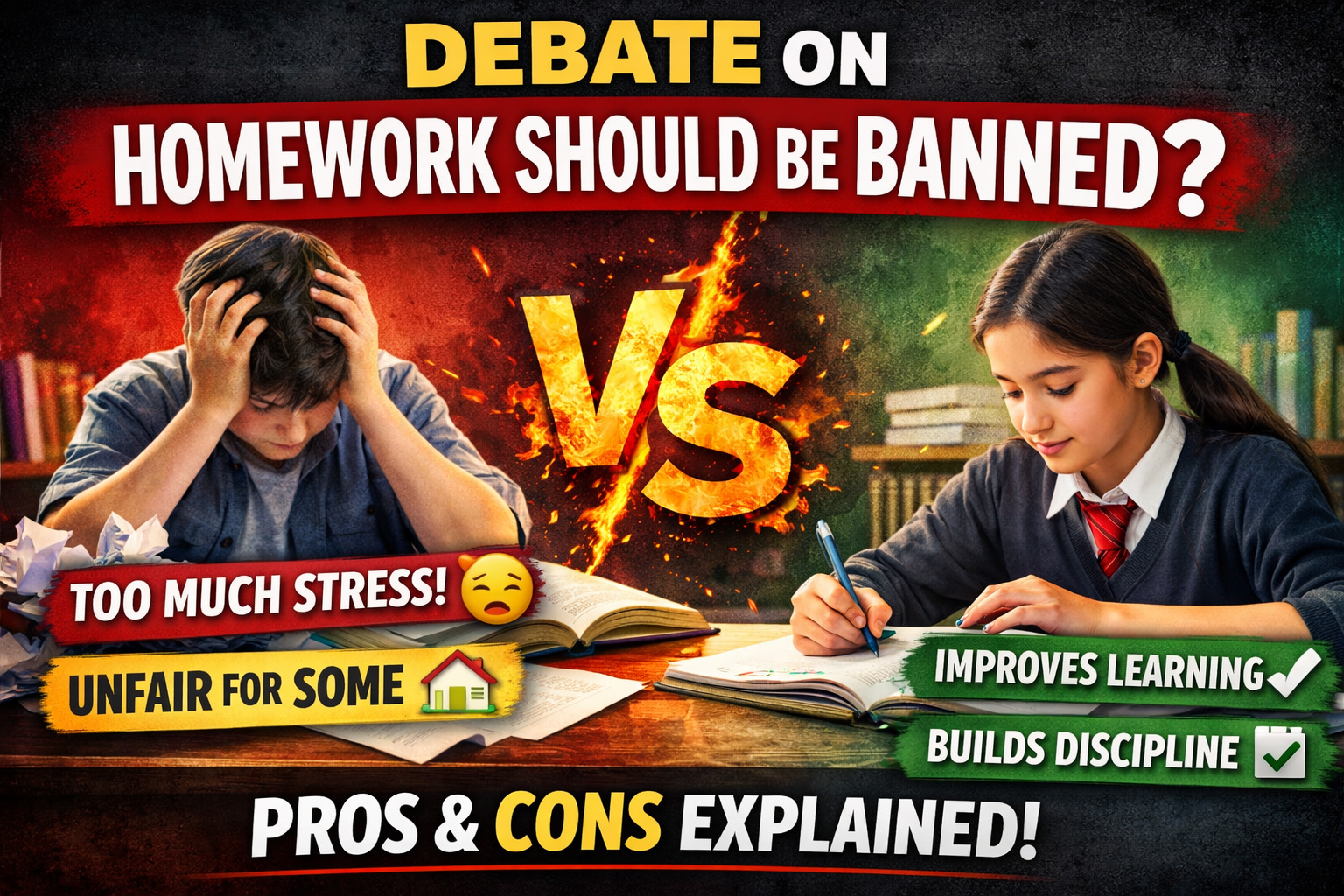
Debate on Homework Should Be Banned: Strong Arguments for and Against
If you are looking for a strong debate on homework should be banned, you probably need more than a few emotional lines about stress. You need a clear understanding of the motion, strong points on both sides, and a conclusion that sounds thoughtful rather than copied. That matters because the evidence around homework is mixed. The Education Endowment Foundation says homework has a positive average impact, especially in secondary school, but also stresses that quality matters more than sheer quantity. The OECD adds another complication: homework can deepen inequality when students do not have the same support, time, or learning conditions at home.
This article takes the topic seriously. It explains what the motion means, gives arguments for and against, shows what research suggests, and helps you build a smarter classroom response. The goal is not to hand you a loud opinion. It is to help you argue well.
Table of Contents
ToggleWhat the motion really means
When people say homework should be banned, they do not usually mean that students should never read at home, revise for exams, or practice what they learned. The real claim is narrower: schools should stop making compulsory take-home assignments a normal part of daily learning.
That distinction matters. A student can oppose regular homework and still believe in private study. A teacher can defend homework and still reject overloaded worksheets. Most class debates become weak because students argue against the wrong version of the motion.
In a Nigerian school setting, this topic often feels practical rather than theoretical. Students may already be balancing school hours, extra lessons, chores, transport time, and exam pressure. So the debate is really about one question: does compulsory homework improve learning enough to justify the cost?
Why this debate matters
Homework sits at the intersection of learning, fairness, discipline, family life, and student well-being. That is why the topic refuses to disappear.
On one side, teachers argue that learning cannot end the moment the bell rings. Practice matters. Revision matters. Independent work matters.
On the other side, students and parents often see the downside first. Some homework is useful, but some of it is repetitive, poorly explained, and added simply because homework is expected. When that happens, students are not deepening learning. They are carrying school into every evening.
UNESCO’s education and well-being work makes the bigger point here: healthy, safe, thriving learners are better able to learn and complete their education. In other words, school systems should not talk about achievement as if well-being is a side issue. It is part of learning itself.
Strong arguments supporting the motion
Excessive homework can create pressure instead of progress
The first strong argument for the motion is simple: too much homework can stop being educational and start becoming harmful.
A Stanford summary of research on high school students found that excessive homework was linked with greater stress, health complaints, and less balance in students’ lives. It also reported that many students saw homework as a primary source of stress and that very heavy loads could become counterproductive.
That point is powerful in debate because it avoids exaggeration. You do not need to claim that all homework is harmful. You only need to show that schools often confuse more work with better learning. Those are not the same thing.
Homework can cut into sleep, rest, and recovery
Students are not machines. They need rest to learn well.
The American Academy of Sleep Medicine recommends 9 to 12 hours of sleep for children aged 6 to 12 and 8 to 10 hours for teenagers aged 13 to 18. It also links regular, adequate sleep with better attention, learning, memory, behavior, and emotional regulation.
That does not prove homework always destroys sleep. But it strengthens a very reasonable debate point: when schools pile on evening work without considering age, travel time, chores, and other commitments, sleep is often the first thing students sacrifice. That is a bad trade if the purpose of school is to help students think clearly and stay healthy.
Homework can be unfair because home conditions are unequal
This is one of the strongest arguments in the entire debate.
Homework assumes that every student goes home to the same conditions: a quiet space, electricity, internet access where needed, helpful adults, time, and calm. Real life is not that equal.
The OECD has noted that more advantaged students tend to spend more time on homework, and that while homework may be associated with mathematics performance, other factors matter more for system-wide performance. The Education Endowment Foundation also warns that access barriers such as devices, resources, and quiet study space can limit homework completion and widen gaps.
That is why this argument carries weight. Homework does not only test what students learned in class. Sometimes it tests what kind of home environment they have. That is a serious fairness problem.
Busywork is not the same as meaningful education
Another reason some people support the motion is that a lot of homework is poorly designed.
The Education Endowment Foundation makes this point clearly: the quality of the task matters more than the amount of work, and homework works best when it is linked directly to classroom learning and followed by useful feedback. It also notes that impact may diminish as time spent on homework increases.
So the pro-ban side can argue that banning homework, as it is commonly practiced, is really a rejection of low-value busywork. If teachers assign pages of repetitive copying, vague projects, or punishment tasks, students are right to question the value.
Strong arguments against the motion
Homework can reinforce what students learned in class
The strongest argument against a total ban is that learning usually needs repetition and recall. Students often need time beyond the classroom to practice a concept, revise a lesson, or prepare for the next topic.
The Education Endowment Foundation reports a positive average impact for homework, especially in secondary schools, and notes that homework can support practice, consolidation, revision, and inquiry.
That matters most for older students. As subjects become harder, many learners need some structured work outside class. A blanket ban could remove a useful support.
Good homework can build independence
Not every educational benefit is visible in a test score the next day. Some of the value of homework lies in habits.
When homework is purposeful and clearly explained, it can help students learn how to plan, meet deadlines, review mistakes, and work without constant supervision. Those are real academic skills.
Even the critics of excessive homework usually do not argue against independence. They argue against overload. That is an important distinction for the side opposing the motion.
Older students often need revision outside the classroom
A realistic anti-ban argument is that school time alone is rarely enough for every kind of preparation. Revision for tests, reading ahead, writing practice, and problem-solving exercises often need protected time outside lessons.
This is especially true when students are approaching major exams. At that stage, the smarter question is not whether students should ever work at home. The smarter question is what kind of home study is useful, manageable, and fair.
A total ban throws away good homework with bad homework
This may be the cleanest argument against the motion.
If the real problem is excessive, irrelevant, or unfair homework, then banning all homework is too blunt. It removes bad homework, yes, but it also removes useful practice, structured revision, and thoughtful preparation.
The National Education Association points to a common rule of thumb many districts use: about ten minutes per grade level, adjusted for subject and student needs. You may or may not agree with that exact formula, but the larger idea is sensible: moderation and fit matter more than extremes.
What the evidence actually suggests
By this stage, the best answer is clearer. The evidence does not support simple slogans.
First, homework can help, but the effect is not automatic. The Education Endowment Foundation estimates a positive average impact and says benefits are stronger in secondary than primary settings. It also rates the evidence base as limited and says schools should apply judgment rather than treat homework as magic.
Second, more homework is not automatically better homework. The same EEF guidance says quality matters more than quantity and suggests impact may fall as time spent increases. Stanford’s reporting on student homework burden also points to diminishing returns and rising stress when loads become excessive.
Third, well-being is not a side issue. UNESCO frames health and well-being as part of successful learning, and sleep guidance for children and adolescents shows that adequate rest supports attention, memory, learning, and emotional regulation. A school cannot ignore those foundations and still claim to be fully serving students.
Fourth, access matters. OECD and EEF both point toward a difficult truth: homework can reproduce social advantage when some students have quiet study environments, devices, support, and time, while others do not.
Put together, the evidence suggests a balanced conclusion: homework is not useless, but careless homework is.
A better middle ground than banning all homework
This is where many good debate responses become stronger than the average classroom script.
Instead of treating the issue as a fight between “homework every day” and “no homework ever,” propose a better standard.
Good homework should be:
- short enough to be realistic
- clearly linked to what was taught in class
- purposeful, not routine for routine’s sake
- appropriate for the student’s age
- flexible enough to account for access barriers
- followed by feedback, not ignored after submission
That approach matches the strongest parts of the education evidence. EEF highlights task quality, classroom connection, and feedback. It also suggests schools should address barriers such as device access and quiet study space.
Schools should also stop using homework as punishment. A child who struggles in class does not automatically need more after-school burden. They may need better explanation, guided practice, or support during school hours. EEF explicitly says homework should not be used as a penalty for poor performance.
For many schools, a smarter policy would look like this: less volume, more purpose, better feedback, fewer penalties, and support systems such as supervised study periods or homework clubs.
How to present this topic in a school debate
A strong debate speech is not just a pile of points. It is a clean line of reasoning.
If you are speaking for the motion
Do not argue that learning at home is bad. That is too easy to attack.
Argue this instead: compulsory homework, as commonly practiced, creates unfairness, overload, and low-value work. Then focus on three points:
- too much homework creates stress and reduces balance
- students do not have equal home conditions
- busywork is not meaningful learning
That version is sharper and harder to dismiss.
If you are speaking against the motion
Do not defend every worksheet teachers have ever assigned. That sounds unrealistic.
Argue that purposeful, limited homework helps students revise, practice, and build independence. Then admit the obvious truth: bad homework exists. By conceding that point, you sound more credible.
Rebuttal lines that actually work
If you support the motion, say:
- “My opponents are defending ideal homework, but students often receive routine homework, not ideal homework.”
- “If a task depends heavily on home privilege, it is not a fair measure of learning.”
- “A tired student is not a better learner just because they spent more hours on a worksheet.”
If you oppose the motion, say:
- “The problem is not homework itself but poor homework design.”
- “Banning all homework removes useful revision along with bad assignments.”
- “Students still need structured practice outside class, especially as subjects become harder.”
Those lines work because they attack the logic, not just the emotion.
Final takeaway before the FAQ
The strongest position is rarely the loudest one. A smart speaker will recognize that homework can help learning, but only when it is purposeful, limited, and fair. Once homework becomes automatic, excessive, or disconnected from real learning, the case against it becomes much stronger.
That is the heart of the issue. Not every assignment deserves to survive just because schools are used to assigning it.
FAQ Section
1. Should homework be banned in primary schools?
There is a stronger case for reducing or tightly limiting homework in primary school than in secondary school. The Education Endowment Foundation says homework tends to have a smaller average impact in primary than in secondary settings, which suggests younger children need a more cautious approach.
2. Does homework improve academic performance?
It can, but not automatically. Evidence from the Education Endowment Foundation suggests a positive average effect, especially in secondary school, yet it also stresses that quality, feedback, and classroom connection matter more than volume alone.
3. What is the strongest argument for the motion?
The strongest argument is usually fairness. Homework can reward students with better home conditions and punish students who lack time, quiet space, devices, or support. OECD and EEF both point to access and disadvantage as real issues in homework design.
4. What is the strongest argument against the motion?
The strongest counterargument is that a total ban is too extreme. Good homework can reinforce classroom learning, support revision, and build independent study habits, especially for older students.
5. Can homework affect sleep?
Yes, especially when the workload is heavy. Sleep guidance from the American Academy of Sleep Medicine shows that children and teenagers need substantial sleep for healthy learning, attention, and emotional regulation. Large homework loads can compete directly with that need.
6. What kind of homework is most useful?
Short, focused homework tied to classroom learning tends to be more useful than long, repetitive tasks. EEF also highlights the importance of clear purpose and feedback.
7. How can teachers make homework fairer?
Teachers can reduce volume, give flexible tasks, avoid assuming internet access, explain the purpose clearly, and create support options such as supervised study time or homework clubs. Those ideas align with EEF guidance on addressing barriers to completion.
Conclusion
A thoughtful debate on homework should be banned should not pretend that all homework is useless or that all homework is helpful. The real issue is design, fairness, and cost. When homework is excessive, repetitive, or dependent on home privilege, the case for banning it becomes strong. When it is short, purposeful, and connected to classroom learning, the case against a total ban becomes stronger.
That is why the smartest conclusion is this: schools should stop defending homework as a tradition and start judging it by results. If an assignment improves learning without damaging sleep, well-being, or fairness, it has earned its place. If it does not, students are right to challenge it.