Debate on Cyber Bullying Is Worse Than Physical Bullying: Points, Rebuttals, and Conclusion
The topic debate on cyber bullying is worse than physical bullying looks simple at first, but it is actually one of those school debate motions that rewards careful thinking. Many students rush straight into emotional claims. That is usually where the argument becomes weak.
A strong debate does not depend on loud language. It depends on clear comparison. You need to show what cyberbullying is, what physical bullying is, how each one causes harm, and why one can reasonably be judged as worse. If you do that well, your speech will sound mature, balanced, and convincing.
For students in Nigeria, this motion is especially relevant because school life is no longer limited to the classroom or playground. Class groups, social media, messaging apps, online gaming, and shared photos have made peer conflict more public and harder to escape. UNICEF Nigeria and the Nigerian Communications Commission both publish child online safety guidance that treats cyberbullying as a real risk for children and teenagers, not a minor internet problem.

Table of Contents
ToggleWhat the motion means
Before arguing, define the key terms.
Cyberbullying is bullying carried out through digital technologies such as phones, tablets, social media, messaging apps, forums, and gaming platforms. Official guidance from UNICEF and StopBullying.gov explains that it includes harmful messages, humiliating posts, fake accounts, threats, impersonation, and the sharing of private or embarrassing material.
Physical bullying, by contrast, involves direct bodily aggression or intimidation. It may include hitting, pushing, kicking, physical assault, or using size and force to create fear. WHO places bullying within a wider framework of violence against children and notes that violence can lead to severe injuries, mental health problems, and educational harm.
The word “worse” is where the real debate happens. Worse can mean more painful, more dangerous, more frequent, harder to escape, more damaging to mental health, or more destructive to a student’s reputation and school life. If you define your standard clearly, your argument becomes much stronger.
How to approach a debate on cyber bullying is worse than physical bullying
The safest way to argue this motion is not to pretend physical bullying is small. That would be careless and easy to attack.
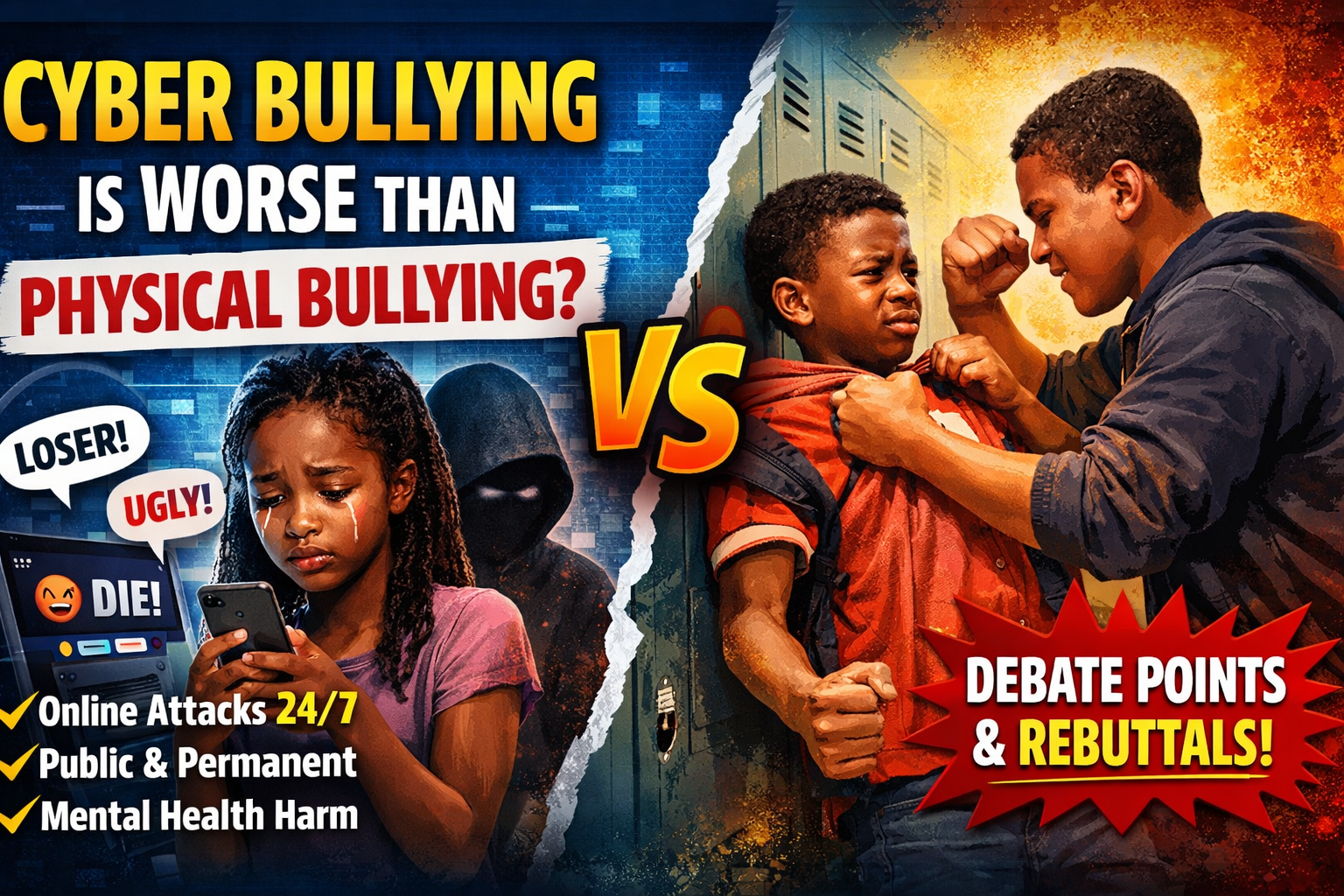
Instead, say this: physical bullying can be brutal and immediately harmful, but cyberbullying can be worse because it is persistent, public, shareable, and capable of following the victim every hour of the day. StopBullying.gov describes cyberbullying as having special concerns because it can be persistent, permanent, and public, while UNICEF adds that it can feel as though the victim is being attacked everywhere, even at home.
That is the ranking angle that makes this article useful and the debate persuasive. It does not deny reality. It compares forms of harm carefully.
Why many students support the motion
Cyberbullying follows the victim everywhere
A student who is bullied physically may still find relief after leaving school. The school gate closes, and for a few hours there may be some breathing space.
Cyberbullying often removes that escape. Messages arrive at night. Comments spread during weekends. Screenshots reappear in new groups. A humiliating post does not stay in one place. According to StopBullying.gov, digital devices make it possible for harm to continue 24 hours a day, making relief difficult. UNICEF similarly notes that online bullying can feel inescapable and can affect a person mentally, emotionally, and physically.
That point matters in debate because suffering is not measured only by a single painful moment. It is also measured by duration.
It can be public, permanent, and hard to erase
A slap in a hallway is terrible. A humiliating photo or video shared online can be terrible in a different way. The audience can be much larger. Strangers can watch it. Classmates can forward it. Even after deletion, copies may remain on other devices.
StopBullying.gov warns that online content can create a kind of permanent public record and damage the online reputations of everyone involved. UNICEF also points out that cyberbullying leaves a digital footprint. That digital trace can help prove the abuse, but it also means the humiliation can outlast the original event.
This gives the proposition a powerful line: physical bullying may hurt the body immediately, but cyberbullying can keep hurting the mind, name, and social identity long after the first act.
Anonymity can make bullying bolder
Many physical bullies act in front of teachers, classmates, or other witnesses. Online, a bully may hide behind a fake name, a burner account, or a group page. That distance can make some people crueler than they would ever dare to be face to face.
This matters because anonymity changes the balance of fear. The victim may not even know who is responsible. That uncertainty can create paranoia, mistrust, and shame. The attack becomes harder to predict and harder to confront directly.
One act can spread to many people at once
Physical bullying is often limited by place and time. Cyberbullying can spread fast. One message can be copied. One video can be reposted. One rumour can move from a private chat to a whole class, then to another school, then beyond the student’s community.
That scale is one reason the topic keeps appearing in school debates. UNICEF reported that one in three young people across 30 countries said they had experienced online bullying, and one in five said they had skipped school because of cyberbullying and violence. Social networks were identified by most respondents as the main space where online bullying happens.
When you use that point in a debate, do not just say “many people can see it.” Go further. Explain that scale increases shame, loss of control, and reputational damage.
It can quietly damage mental health and school performance
Physical bullying usually produces visible signs. Bruises, torn clothes, or witnessed aggression are easier for adults to notice. Cyberbullying can be hidden behind a screen.
That hidden nature is part of the danger. UNICEF describes effects such as fear, shame, anxiety, isolation, headaches, nausea, sleep loss, and loss of motivation. UNICEF Nigeria’s guidance for caregivers and teachers also notes emotional distress, behavioural changes, and academic decline as warning signs.
So the proposition can argue that cyberbullying is sometimes worse because adults may discover it late, after the damage has deepened.
Why some students oppose the motion
A good article should not dodge the strongest counterargument.
The opposition will say physical bullying is worse because it causes immediate bodily harm. That is not a weak point. WHO states clearly that violence against children can lead to severe injuries, long-term health consequences, anxiety, depression, and even death in the most extreme forms of violence.
The opposition may also say physical bullying creates direct terror. A student who fears being beaten on the way to class may live in constant anxiety. Some forms of physical aggression are impossible to dismiss as “just online words.”
That side of the debate deserves respect. In fact, your own speech becomes stronger when you admit it plainly before rebutting it.
Strong rebuttals for the proposition
The best rebuttals are not dramatic. They are precise.
Rebuttal 1: Immediate injury is serious, but nonstop harm can be worse
You can concede that physical bullying may produce visible injury. Then make the comparison sharper: cyberbullying can continue day and night, return repeatedly, and reach the victim even in spaces that should feel safe.
That persistence is not a small detail. It changes the whole experience from an event into an environment.
Rebuttal 2: Physical bullying often ends when the scene ends, but cyberbullying travels
A physical act usually happens in one location. Cyberbullying moves from phone to phone, platform to platform, and group to group. The victim cannot simply “leave the place” when the place is the internet itself.
That is a powerful debate line because it reframes harm as inescapability.
Rebuttal 3: Public humiliation can outlast physical pain
A bruise may heal. A degrading video, fake story, or manipulated image can keep resurfacing. StopBullying.gov notes the long-term reputational risk of permanent digital content, while UNICEF emphasizes that online bullying can generate wide unwanted attention, including from strangers.
This is one of the strongest points in the entire motion.
Rebuttal 4: Cyberbullying is easier to hide from adults
Because cyberbullying takes place in private chats, direct messages, comment sections, and online groups, teachers and parents may not see it quickly. UNICEF Nigeria advises adults to watch for withdrawal, irritability, reluctance to go online, emotional distress, and falling academic performance.
In debate terms, hidden harm can become deeper harm.
A balanced judgement
A mature speaker should avoid saying cyberbullying is always worse in every single case. That sounds careless. Some physical bullying cases involve severe assault and obvious danger. Those cases may be worse than many online incidents.
But if the debate motion asks you to defend the statement, you can still do so convincingly by arguing that in the modern student environment, cyberbullying can be worse because it combines repetition, publicity, permanence, anonymity, and emotional invasion.
That balance matters. It shows you understand the issue, not just the slogan.
Best debate points students can use
If you are speaking for the motion, these are the clearest points to develop:
- Cyberbullying follows the victim everywhere, including home.
- It can happen all day and all night.
- Harmful content can be shared with many people instantly.
- Digital posts can remain online and damage reputation for a long time.
- Fake accounts and anonymity can make the bully harder to identify.
- The victim may suffer in silence because adults do not notice quickly.
- The emotional and academic effects can be deep and lasting.
If you are speaking against the motion, these are the strongest points:
- Physical bullying can cause bodily injury and direct fear.
- It can involve immediate danger to health and safety.
- Severe physical violence may be life-threatening.
- Face-to-face intimidation may leave the victim constantly afraid at school.
Common mistakes students make on this topic
The first mistake is treating online harm as unreal because it is “not physical.” That argument is weaker now than it used to be. Official guidance from UNICEF, UNICEF Nigeria, and StopBullying.gov all treat cyberbullying as a serious form of harm with real mental, emotional, academic, and safety consequences.
The second mistake is swinging too far the other way and acting as if physical bullying does not matter. It does. WHO’s violence guidance makes that impossible to ignore.
The third mistake is speaking in vague generalities. Instead of saying “cyberbullying is bad,” say what makes it worse: reach, repetition, anonymity, permanence, and emotional pressure.
The fourth mistake is forgetting evidence. In a debate, examples and recognized guidance help. You can strengthen your speech by referring to resources such as UNICEF’s explanation of cyberbullying, StopBullying.gov’s overview of cyberbullying, UNICEF Nigeria’s digital safety guide, and WHO’s facts on violence against children.
How to end your speech strongly
The best ending does two things. It reminds the audience of your standard of comparison, and it leaves them with a memorable judgment.
A weak ending says, “So cyberbullying is worse.”
A stronger ending says something like this:
Physical bullying can wound the body, but cyberbullying can wound the body’s peace, the mind’s safety, and a student’s reputation all at once. It follows the victim beyond school, spreads faster, lasts longer, and often hides in plain sight. That is why cyberbullying can be worse than physical bullying.
That closing works because it sounds reasoned, not shouted.
FAQ Section
What is the main difference between cyberbullying and physical bullying?
Cyberbullying happens through digital devices and online platforms, while physical bullying involves direct bodily aggression or intimidation. UNICEF and StopBullying.gov describe cyberbullying as online, repeated, harmful behaviour, while WHO places physical violence within broader violence against children.
Why do many students say cyberbullying is worse than physical bullying?
Because it can be persistent, public, hard to erase, and difficult to escape. Harmful posts or messages can spread widely and keep affecting the victim long after the first incident.
Can cyberbullying affect school performance?
Yes. UNICEF Nigeria notes that cyberbullying can be linked to emotional distress, withdrawal, and a drop in academic performance. UNICEF has also reported that some young people skip school because of cyberbullying and violence.
Is physical bullying still a stronger argument in some cases?
Yes. If the physical bullying involves serious assault, injury, or direct threat to life and safety, that can be a very strong opposition point. WHO notes that violence against children can lead to severe injuries and long-term harm.
What is the best way to win this debate?
Define your terms clearly, compare the forms of harm carefully, admit the strongest point from the other side, and then rebut it with logic. The best speeches sound balanced, not extreme.
Should I say cyberbullying is always worse?
No. That makes your argument weaker. A better position is that cyberbullying can be worse in many modern student contexts because it is continuous, public, and difficult to escape.
What evidence can I mention in a school debate?
You can mention that UNICEF reported one in three young people in 30 countries had experienced online bullying, and one in five said they had skipped school because of cyberbullying and violence. That gives your speech a solid factual base.
Conclusion
A smart debate on cyber bullying is worse than physical bullying should never treat either form of harm lightly. Physical bullying can cause immediate pain, injury, and fear. That is real. But cyberbullying can still be argued as worse because it is harder to escape, easier to spread, more public, more permanent, and often more hidden from adults until serious damage has already been done. If you frame the motion that way, your speech will sound thoughtful, credible, and much stronger than a simple emotional argument.