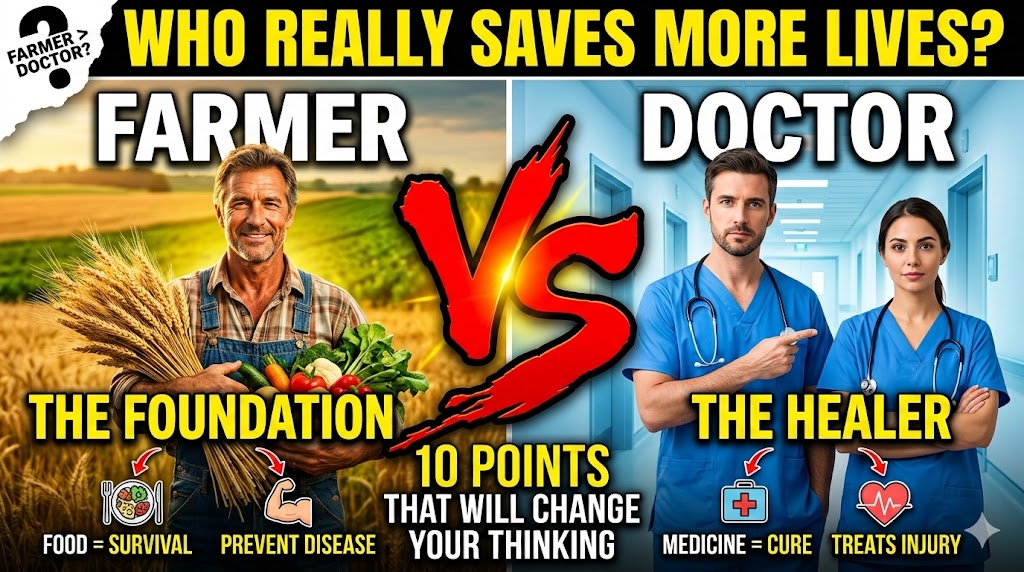
Debate on a Farmer Is Better Than a Doctor: 10 Debate Points That Will To Help You Win
The debate on a farmer is better than a doctor is one of the oldest philosophical arguments in human society, and it is far from settled. Most people instinctively side with the doctor. Doctors save lives, wear white coats, and command enormous respect. That is understandable. But here is the uncomfortable truth: a doctor cannot save a single life if the person arriving at the hospital is already dead from starvation. Food comes first. Always.
This article takes a clear stand. The farmer is, in the most foundational sense, more essential to human survival and societal existence than the doctor. That does not mean doctors are unimportant. It means we have been dramatically undervaluing the people who feed the world. Here are 10 powerful debate points to back that up.
1. No Food, No Life — The Farmer Addresses the First Human Need
Before medicine, before science, before civilization itself, humans needed food. That need has never changed.
A farmer produces the most basic requirement for human existence. Without food, the human body begins shutting down within days. The brain loses function. Organs fail. No doctor, no drug, and no surgery can reverse death by starvation. The farmer, therefore, operates at the very root of human survival.
Doctors treat conditions that arise in living bodies. But the farmer is responsible for keeping those bodies alive in the first place. The hierarchy is clear — food precedes medicine at every point in human history.
2. The Debate on a Farmer Is Better Than a Doctor Starts With Scale
A doctor might treat hundreds of patients in a year. A single farmer feeds thousands of people every single season.
Think about that scale. One rice farmer in Southeast Asia, one wheat grower on the plains of Kansas, one cassava cultivator in sub-Saharan Africa — each of them produces enough food to sustain entire communities. According to the Food and Agriculture Organization of the United Nations, the world’s farmers feed over 8 billion people daily. No medical system on earth touches that level of reach.
The farmer’s impact is not individual — it is civilizational. That scale of contribution alone deserves a higher place in our public conversation.
3. Farmers Prevent Disease Before Doctors Ever Need to Treat It
A well-nourished body is a defended body. Proper nutrition builds immunity, strengthens bones, supports brain development, and reduces the risk of chronic disease.
Malnutrition is one of the leading contributors to global disease burden. When people have access to diverse, nutrient-rich food — the kind farmers grow — they are less likely to need medical intervention in the first place. The farmer, in this way, is the world’s first line of preventive healthcare.
Doctors fix problems. Farmers stop many of those problems from ever starting. That is a powerful distinction. Prevention has always been more efficient than cure.
4. A Doctor Cannot Function Without a Farmer
This is a simple but decisive point. Doctors are human beings. They need to eat. They need energy, focus, and physical health to operate. Remove the farmer, and the doctor cannot do their job.
A surgeon operating on an empty stomach, weakened from lack of nutrition, is a danger to the patient on the table. Without the farmer, even the most brilliant medical mind in the world becomes useless. The dependency only flows one direction — doctors need farmers, but farmers do not strictly need doctors to grow crops.
This asymmetry of dependency is one of the strongest arguments in this debate.
5. In Rural Communities, Farmers Are the Only Safety Net
Millions of people around the world live far from any hospital, clinic, or pharmacy. For them, the nearest doctor might be a day’s journey away. But the farmer? The farmer is right there, in the field next door, growing the food that sustains the entire community.
In these contexts — which represent a significant portion of global humanity — the farmer is not just important, the farmer is everything. They provide the calories, the nutrition, and in traditional farming communities, often the medicinal herbs and natural remedies that keep people healthy without formal healthcare.
We cannot build a debate on the realities of wealthy, urban, well-resourced societies and pretend it represents the whole world.
6. The Global Food Crisis Proves the Farmer’s Irreplaceable Role
When food supply chains break down, the world notices immediately. War, drought, flooding, or economic collapse — any disruption to farming creates immediate, cascading human suffering on a mass scale.
According to the World Food Programme, hundreds of millions of people face acute food insecurity today. That crisis is not a medical crisis in its origins — it is an agricultural one. And the solution is not more doctors. It is more farmers, better farming, and stronger food systems.
The global food crisis is arguably the single greatest threat to human health on the planet. That makes the farmer, by extension, the single most important figure in addressing it.
7. Farming Is a Form of Environmental Medicine
This point often gets overlooked. Farmers who practice sustainable agriculture are not just growing food — they are maintaining the ecosystems that keep the planet alive.
Healthy soil absorbs carbon. Diverse crops support pollinators. Traditional farming methods protect watersheds and prevent desertification. A farmer who works in harmony with nature is, in a very real sense, healing the earth. The environmental health of the planet directly determines the physical health of every human being on it.
No doctor operates at that scale. No pharmaceutical company addresses that level of systemic health. The farmer’s role in environmental stewardship is a dimension of their contribution that rarely gets credited.
8. Emotional and Cultural Weight: The Farmer Feeds the Soul Too
Food is not just fuel. Food is culture, memory, identity, and love. The farmer who grows the grain used in a grandmother’s bread recipe, the fruit that marks a seasonal festival, the rice that ties a diaspora to its homeland — that farmer is contributing to something far deeper than caloric intake.
Human wellbeing is not purely physical. Psychologists and public health researchers have long understood that cultural connection, food security, and community cohesion are central to mental health. The farmer sits at the center of all three.
Doctors treat the body. But the farmer, in many ways, nourishes the whole person.
9. Society Would Collapse Without Farmers Far Faster Than Without Doctors
Let us run a simple thought experiment. Imagine all the doctors in the world disappeared tomorrow. It would be a catastrophe. Disease would spread. Surgeries would not happen. People with treatable conditions would suffer. Within months, mortality rates would rise sharply.
Now imagine all the farmers disappeared. Within weeks, the global food supply would begin running out. Within months, mass starvation would begin. Riots, social breakdown, and civilizational collapse would follow. Society cannot survive the absence of farmers for even a single growing season.
The speed and totality of collapse in a world without farmers versus a world without doctors is not even close. That reality should inform how we rank these two roles.
10. The Debate on a Farmer Is Better Than a Doctor Reflects a Question of Values
Ultimately, this debate is about what we value as a society. Doctors are admired. They are well-compensated, widely celebrated, and given enormous social status. Farmers, in most parts of the world, are underpaid, underappreciated, and increasingly struggling to survive economically.
Research from the International Labour Organization consistently shows that agricultural workers face some of the highest rates of poverty and occupational hardship of any workforce globally. We have built a world that cheers for the people who fix us while ignoring the people who feed us.
That imbalance is not just an economic injustice. It is a philosophical one. And it is exactly what the debate on a farmer is better than a doctor forces us to confront.
Conclusion
The argument here is not that doctors are dispensable. Of course they are not. A world without medicine would be brutal and short. But a world without farmers would not exist at all.
The debate on a farmer is better than a doctor ultimately comes down to one foundational truth: you cannot treat a body that has already stopped functioning from hunger. The farmer makes the doctor’s work possible. The farmer makes civilization possible. The farmer makes life possible.
We have spent centuries building institutions to honor and protect medical knowledge, and rightly so. Now it is time to extend that same reverence to the people in the fields. Because every heartbeat a doctor saves was first sustained by a meal a farmer grew.
Feed the world first. Heal it second. That is the natural order — and the farmer comes first.