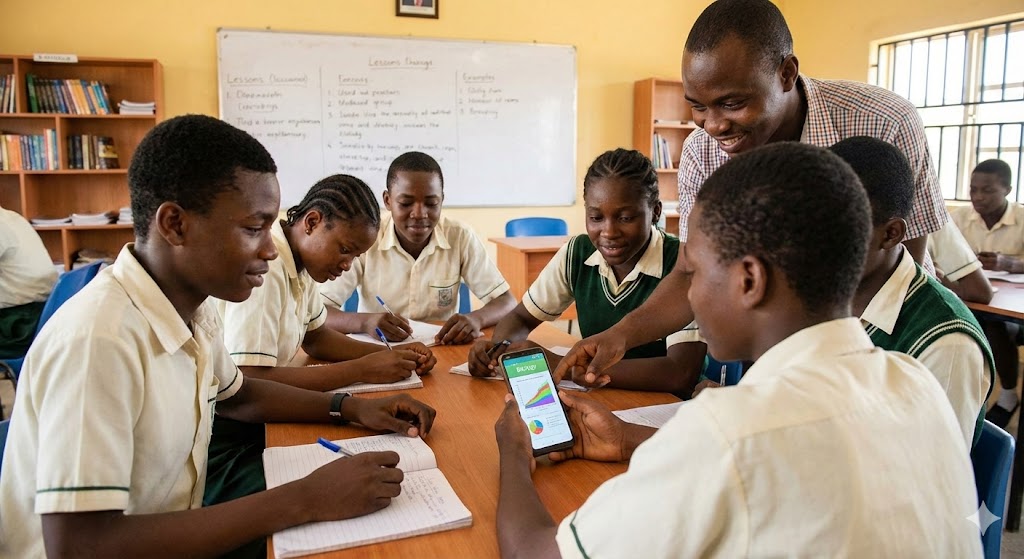
Debate: Mobile Phones Should Not Be Banned in Schools (7 Winning Points)
Debate: Mobile Phones Should Not Be Banned in Schools (7 Winning Points)
Good day, students! Looking for the winning points for your next debate? You’ve come to the right place.
Today, we are tackling a very hot topic that affects every single student in Nigeria. The motion is simple but controversial. We are here to argue that Mobile Phones Should Not Be Banned in Schools.
Before we dive into the script, let’s define our terms. When we say “mobile phones,” we aren’t just talking about devices for TikTok or chatting on WhatsApp. We are talking about powerful pocket computers that grant access to the world’s knowledge. And when we say they “should not be banned,” we mean they should be regulated and integrated, not completely forbidden.
There is a huge difference between “regulation” and a total “ban.” A ban is lazy; regulation is educational.
DISCLAIMER: This article provides debate points supporting one side of the motion for educational purposes. It does not dismiss the validity of opposing arguments or school regulations currently in place.

Winning Debate Points on Why Mobile Phones Should Not Be Banned in Schools
Here are 7 strong, persuasive arguments you can copy, adapt, and use to win your debate.
1. Safety and Emergency Communication
Mr. Chairman, panel of judges, let’s start with the most critical factor: Safety. We live in unpredictable times. In many parts of Nigeria, the security situation is a genuine concern for parents.
Imagine a student who closes from school late or faces a breakdown of their school bus. If mobile phones are banned and confiscated, how do they reach their parents? They can’t. They are stranded.
Mobile phones should not be banned in schools because they are a lifeline. They provide peace of mind to parents who need to know their children have arrived safely or can call for help in an emergency. Banning them cuts off this vital line of communication. It’s not just a phone; it’s a security tool.
2. Instant Access to Educational Resources
My second point is about information. We are in the information age, yet some people want to keep schools in the stone age.
Why should a student have to wait for a specific library period to look up the meaning of a word or a historical date? With a smartphone, the answer is seconds away. According to many educational experts, the ability to research quickly is a key skill for the future.
When we ban phones, we limit a student’s ability to be curious. We tell them, “Wait until you get home to learn that.” That is wrong. If we want students to be researchers and critical thinkers, we must give them the tools to access information instantly.
3. Preparation for the Real World (Digital Literacy)
Let’s be real for a second. When we leave school and enter the workforce, will our bosses tell us to put our phones away? No. They will expect us to use them to reply to emails, manage schedules, and coordinate teams.
Mobile phones should not be banned in schools because schools are meant to prepare us for the real world. The real world is digital. By banning phones, schools are missing a golden opportunity to teach digital literacy skills.
Instead of hiding the phones, teachers should be teaching us how to use them productively. We need to learn how to filter fake news, how to write professional emails, and how to use productivity apps. You can’t teach that if the device is locked away in a cupboard.
4. Cost-Effectiveness Over Heavy Textbooks
Have you checked the price of textbooks lately? It is alarming. Many parents struggle to buy the full list of required books every session.
This is where mobile phones become a glorious equalizer. A single smartphone can hold thousands of PDF textbooks, past questions, and novels. It is lighter to carry and much cheaper than buying physical copies of everything.
By embracing modern technology, we reduce the physical burden on students carrying heavy bags and the financial burden on parents. Why insist on paper when the screen offers the same knowledge for a fraction of the cost?
5. Supporting Different Learning Styles
We all know that not every student learns the same way. Some are visual learners; they need to see a video to understand how the human heart pumps blood. Others are auditory; they need to hear a podcast to understand Shakespeare.
A teacher at the front of the class talking for 45 minutes works for some, but not all. Mobile phones unlock interactive learning.
With educational apps like Khan Academy or even YouTube Edu, a student who didn’t understand the calculus lesson in class can watch a tutorial during break time. Banning phones denies these students the chance to learn in the way that suits them best. In fact, [according to UNESCO], mobile technology can significantly expand educational opportunities for students who might otherwise fall behind.
6. Classroom Engagement Tools
School doesn’t have to be boring. Teachers can use phones to make lessons exciting.
Imagine a class where, instead of a boring paper quiz, the teacher uses Kahoot! or Quizizz. Students use their phones to answer questions in real-time. The energy in the room goes up. Everyone is participating.
This isn’t a fantasy; it’s happening in modern schools globally. If we agree that mobile phones should not be banned in schools, we open the door to this kind of engagement. We turn passive listeners into active participants.
7. Regulation Teaches Responsibility
Finally, my opponents will argue that phones cause distractions or cyberbullying. They are right—phones can be distracting. But do we ban cars because they cause accidents? No. We teach people how to drive safely.
The solution is not prohibition; it is education. If schools ban phones, students will just sneak them in and use them secretly (and irresponsibly).
However, if schools allow them under strict rules—for example, “phones out only for research”—they teach students responsible usage. We learn self-discipline. We learn when to switch off and when to log on. That is a lesson that will serve us for the rest of our lives.
Frequently Asked Questions (FAQs)
What is the strongest argument against my points? The strongest argument against you is usually “distraction” or “cyberbullying.” To beat this, don’t deny it. Admit it’s a risk, but argue that supervision is better than a ban. Teachers should monitor usage, not eliminate it.
How do I start my debate speech? Start with a hook! Don’t just say “Good morning.” Say something like, “Raise your hand if you have a phone in your pocket or bag right now. Now, imagine if taking that out to learn something new was a crime.”
Can I use these points for a debate about ‘Gadgets’ generally? Yes, absolutely. These points apply to tablets, laptops, and smartphones. They are all tools for access to information.
Conclusion / Summary
To wrap up, the argument that Mobile Phones Should Not Be Banned in Schools is not about letting students play games all day. It is about safety, saving money, and preparing us for a digital future.
We established that:
-
Phones ensure safety during commutes.
-
They provide instant access to global knowledge.
-
They are cost-effective replacements for heavy textbooks.
-
Regulation teaches responsibility better than prohibition.
As we move forward, let’s stop fighting the future. Let’s bring our education system into the 21st century.
DISCLAIMER: This content is for educational purposes to help students structure their debates. Both sides of this argument have valid points, and school policies should always be respected.
What do you think? Are phones a distraction or a tool? Drop your opinions in the comments section below… Also, feel free to share this post with your coursemates or those in your debate team!