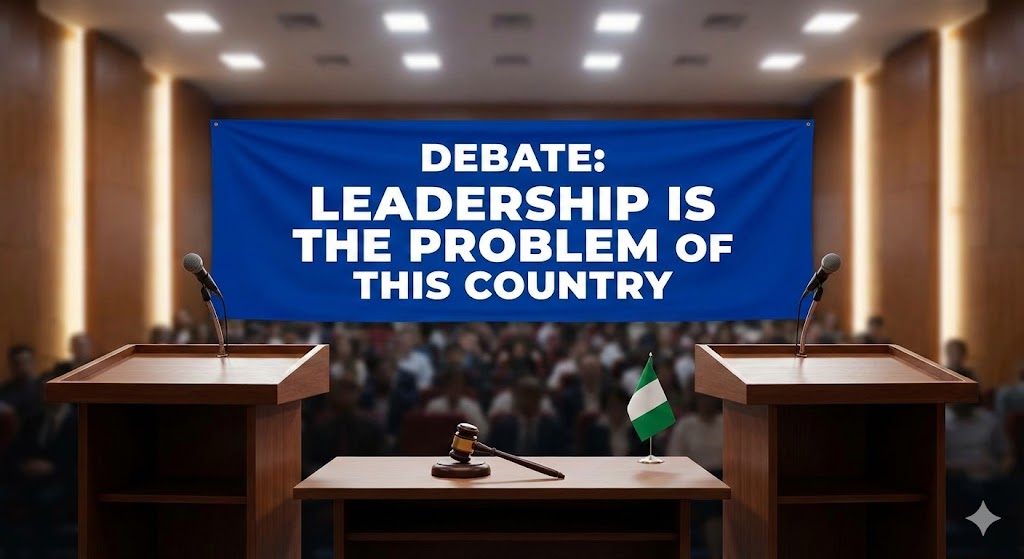
Debate: Leadership is the problem of this country (7 Winning Points)
Debate: Leadership is the problem of this country (7 Winning Points)
Good day, students!
Are you preparing for a heated debate session? Has your teacher or debate club coordinator given you the motion supporting that Leadership is the problem of this country? If yes, then you have landed on the right page.
We all know the saying, “Everything rises and falls on leadership.” It’s a popular quote by John C. Maxwell, and it fits our situation perfectly. When we look at the state of our nation today—from the economy to security—it is easy to get confused about who to blame. Is it the people? Is it the resources? Or is it the people at the top?
In this post, I will give you powerful points to argue that leadership is the problem of this country. Whether you are in secondary school or a higher institution, these points are crafted to help you win the judges over.
Definition of Terms: Before we dive in, let’s define our terms. Leadership here refers to the group of individuals (government officials, policymakers, heads of institutions) entrusted with the power to make decisions for the nation. The problem refers to the root cause of our underdevelopment, poverty, and struggles.
Disclaimer: This article provides debate points supporting the motion that leadership is the primary issue facing the country. This is strictly for educational purposes to help students build critical thinking and public speaking skills. It is not intended to incite hate or disregard the role of citizens.

Winning Debate Points on Why Leadership is the Problem of this country
Here are the winning arguments you need. Remember, when you get to the podium, speak with confidence. These are your lines:
1. The Head Determines the Direction of the Body
Mr. Chairman, panel of judges, and accurate timekeeper, my first point is simple logic. A fish starts rotting from the head. In any organization, family, or country, the direction is always set by the leader. If the driver of a bus is drunk or doesn’t know the map, it doesn’t matter how well-behaved the passengers are; that bus is going to crash.
Leadership is the problem of this country because the people at the top hold the steering wheel. The citizens (the passengers) can only complain or suggest, but the leaders take the actions. If the roads are bad, the citizens didn’t award the contract—the leaders did. If the schools are on strike, the students didn’t refuse to fund education—the leaders did. It starts and ends with them.
2. Mismanagement of Abundant Resources
Let’s be honest with ourselves. Our country is blessed. We have oil, we have fertile land, we have solid minerals, and we have a vibrant population. So, why are we still poor? The answer is the mismanagement of resources by those in power.
If a father earns millions of Naira every month but his children are starving and wearing rags, do we blame the children? No. We blame the father for wasting the money. That is exactly our situation. The issue isn’t a lack of wealth; it is the lack of visionary leaders to use that wealth properly. They prioritize their pockets over national development, and that is why we are where we are.
3. Lack of Accountability and Transparency
Another major reason why I insist that leadership is the problem of this country is the complete lack of accountability. When leaders make mistakes or when funds go missing, who asks them questions? In functioning societies, leaders resign when they fail. Here, they sit tight.
When there are no consequences for bad behavior at the top, it encourages more bad behavior. This culture of “anything goes” trickles down to the rest of society. If the people meant to enforce the law are the ones breaking it, how can the country move forward? It’s impossible.
4. Policy Inconsistency
Have you noticed how our laws and policies change every time a new government comes in? One leader starts a project, and the next one abandons it just to start their own. This lack of continuity is a failure of leadership.
A country needs a long-term plan that survives whoever is in the seat of power. But because our leaders are often driven by selfish interests rather than national interest, we end up running in circles. We take one step forward and two steps backward. That isn’t the fault of the common man; that is policy inconsistency caused by bad leadership.
5. Weak Institutions
My opponents might try to tell you that “the people” are the problem because they are corrupt too. But wait a minute. Who builds the institutions that check corruption? The leaders.
If the police, the judiciary, and the civil service are weak, it is because the leadership allows them to be weak to serve their own interests. Strong leaders build strong institutions that make it difficult for anyone (including themselves) to be corrupt. If the gatekeeper leaves the gate wide open, you cannot blame the goats for entering the farm. The gatekeeper is the problem.
6. The “Brain Drain” Effect
Look at what is happening today. Our best doctors, engineers, and teachers are leaving the country in droves—the “Japa” syndrome. Why? Because the environment created by our leaders is hostile to growth.
When leadership is the problem of this country, it kills the hope of the youth. When young people see that hard work doesn’t pay as much as political connections, they get discouraged. The government has failed to create an enabling environment for businesses and talents to thrive. So, we lose our best hands to other countries that have better leadership.
7. Leaders Influence Culture
Finally, let’s look at influence. Leaders are role models. What they do, the people copy. If a leader is ostentatious, greedy, and violent, the followers will adopt those traits to survive.
If we had leaders who were humble, honest, and hardworking, I guarantee you that the attitude of the citizens would change over time. You cannot plant a lemon tree and expect to harvest oranges. The leadership plants the seeds of the culture we see today.
Frequently Asked Questions (FAQs)
Q: What if my opponent says the citizens are also corrupt? A: You should agree that citizens can be corrupt, but remind them that leaders have the power to stop it. Use the “Driver and Passenger” analogy. If the driver (leader) insists on obeying traffic rules, the passengers (citizens) have no choice but to comply. The buck stops at the top.
Q: How do I end my speech powerfully? A: End with a strong summary. Remind them that a country without good leadership is like a ship without a captain. No matter how good the sailors are, the ship is lost without direction.
Q: Can I use these points for a debate about “Bad Governance”? A: Absolutely. “Leadership failure” and “Bad governance” are almost the same thing in this context. You can tweak these points slightly to fit that topic perfectly.
Conclusion / Summary
To wrap this up, the argument is clear. While citizens have a role to play, the bulk of the responsibility lies on the shoulders of those we have elected or appointed to lead. From the mismanagement of resources to the lack of a clear vision, the evidence is overwhelming that leadership is the problem of this country.
When the head is correct, the body will align. Until we fix the leadership question, every other solution is just a temporary bandage on a deep wound.
Disclaimer: Again, this article is designed to help students prepare for academic debates. It explores one side of the argument regarding national development and leadership. All roles in society—leaders and followers—are important for nation-building.
What do you think? Do you agree that the leaders are the main issue, or do the followers share the blame? Drop your opinions in the comments section below! Also, feel free to share this post with your coursemates or those in your debate team!