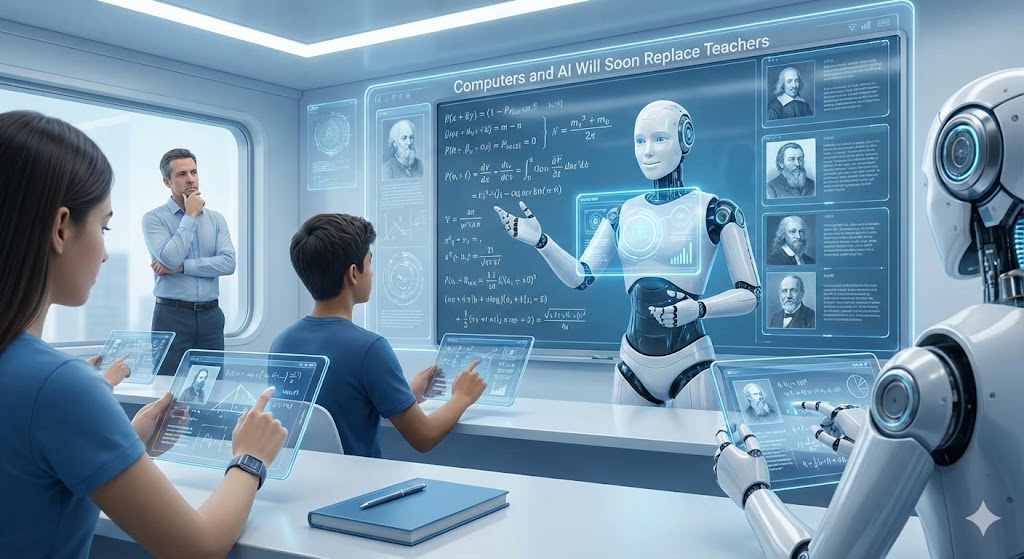
Debate: Computers and AI Will Soon Replace Teachers (7 Winning Points)
Debate: Computers and AI Will Soon Replace Teachers (7 Winning Points)
Good day, students!
Looking for the winning points for your next debate? You’ve come to the right place. Today, we are diving into one of the hottest topics in the world right now: the rise of Artificial Intelligence (AI) and how it’s reshaping our classrooms.
The motion before us is “Computers and AI Will Soon Replace Teachers.”
Before we get into the script, let’s break it down. When we say Computers and AI, we aren’t just talking about a calculator or a laptop. We are talking about smart systems that can think, learn, and teach—like the algorithms behind Google or ChatGPT. And when we say replace, we mean that these systems will eventually take over the primary role of instructing students because they can do it faster, cheaper, and more efficiently.
Below, I have crafted 7 solid points supporting this motion. These points are written in the first person, so you can pick the ones you like and deliver them straight to the judges.
Disclaimer: This article provides debate points supporting ONE side of the motion for educational purposes. It is not meant to diminish the value of human teachers, who play a vital role in society.
Winning Debate Points on Why Computers and AI Will Soon Replace Teachers
1. The “Personalized Learning” Advantage
My first point—and arguably the strongest—is personalization. Let’s be honest with ourselves: in a traditional classroom, one teacher has to teach 30, 40, or even 50 students at the same time. It is physically impossible for that teacher to cater to everyone’s learning speed. The fast learners get bored, and the slow learners get left behind.
AI solves this instantly. Computer-based adaptive learning systems can analyze exactly what a student understands and what they don’t. If I am struggling with algebra, the AI will slow down and give me more examples. If I am a genius at biology, it will move me to the next level immediately. No human teacher can do that for 50 students simultaneously.
2. Unlimited Knowledge Access (The “Walking Library”)
A human teacher, no matter how brilliant, has limits. They can forget facts, they might not know the latest scientific discovery from yesterday, and they certainly cannot speak every language in the world.
Computers, on the other hand, have access to the entire internet. An AI teacher is literally a “walking library” (or rather, a processing library) containing every book, article, and research paper ever written. Why should we limit a student’s education to the knowledge of one human being when an AI can give them the knowledge of the entire world in seconds? It’s simply a superior source of information.
3. 24/7 Availability (No Closing Time)
Think about this: Human teachers need to sleep. They need weekends off. They go on strike. They get sick. If I have a burning question at 9:00 PM while doing my homework, I can’t call my teacher. I have to wait until the next day, and by then, I might have lost interest.
AI and computers do not sleep. They don’t get tired, and they don’t go on holidays. An AI tutor is available 24 hours a day, 7 days a week. This means education stops running on “school time” and starts running on “my time.” This level of flexibility is the future of education, and it’s something humans simply cannot compete with.
4. Zero Bias and Favoritism
We all know the reality of the classroom. Some teachers have “favorites.” Some might be moody because they had a bad day. Some might subconsciously mark a student down because of their handwriting or their behavior in class, not their actual knowledge.
Computers are 100% objective. Automated grading removes bias completely. An AI evaluates you solely on your work—not your face, not your gender, and not how much you participated in class yesterday. This creates a fairer educational system where your grades reflect your actual ability, not the teacher’s opinion of you.
5. Infinite Patience
Have you ever been afraid to ask a question in class because you didn’t want to look “dumb”? Or maybe the teacher explained it twice and you still didn’t get it, but you were too scared to ask for a third time?
This is where computers win. An AI teacher has infinite patience. You can ask the same question 500 times, and the AI will explain it 500 times, without getting frustrated, raising its voice, or making you feel small. For students with learning difficulties or those who are just shy, this judgment-free environment is a game-changer.
6. Instant Feedback
In the current system, we write a test or submit an assignment, and then we wait. We wait days, sometimes weeks, to get our results. By the time the paper comes back, we’ve forgotten what we wrote!
With AI-driven education, feedback is instant. You submit an answer, and the computer tells you immediately if you were right or wrong—and exactly why. This allows students to correct their mistakes in real-time, which accelerates the learning process. As noted in research by organizations like the [World Economic Forum], this type of rapid feedback loop is essential for mastering new skills quickly.
7. Cost-Effectiveness and Accessibility
Finally, let’s talk about money. Building schools, maintaining classrooms, and paying salaries for thousands of teachers is incredibly expensive. In many developing nations, including parts of Nigeria, there simply aren’t enough qualified teachers to go around.
Computers and software are scalable. Once an AI education program is built, it can be distributed to millions of students for a fraction of the cost of hiring human teachers. For rural villages where good teachers refuse to go, a tablet with an AI tutor can provide a world-class education. It democratizes learning in a way that the traditional model never can.
Frequently Asked Questions (FAQs)
Q: Won’t students miss the emotional support of a human? A: This is the most common argument against AI. However, the motion says AI will replace teachers, not that it will replace all human contact. Counselors and mentors can still exist for emotional support, but the core job of teaching academic content is better handled by computers.
Q: Will schools disappear completely? A: Not necessarily. Schools might become social hubs where students go to play sports, socialize, and do group projects, but the actual “teaching” will be done by their personal AI devices.
Q: Is this technology actually ready? A: It’s closer than you think. With the explosion of Large Language Models (LLMs) and platforms like Khan Academy’s “Khanmigo,” we are already seeing the first generation of AI teachers.
Conclusion / Summary
To summarize, Computers and AI will soon replace teachers not because humans are bad, but because technology is simply more efficient at transferring knowledge. AI offers personalized learning, unlimited knowledge, 24/7 access, and total objectivity.
While we respect our human teachers, the future is digital. We cannot let nostalgia hold us back from a system that can teach every child, everywhere, perfectly.
Disclaimer: The views expressed in this debate script are for academic argumentation only. Teaching is a noble profession, and this content is designed to help students explore the potential benefits of technology in education.
What do you think? Are you ready for a robot teacher, or do you prefer the human touch? Drop your opinions in the comments section below… Also, feel free to share this post with your coursemates or those in your team!