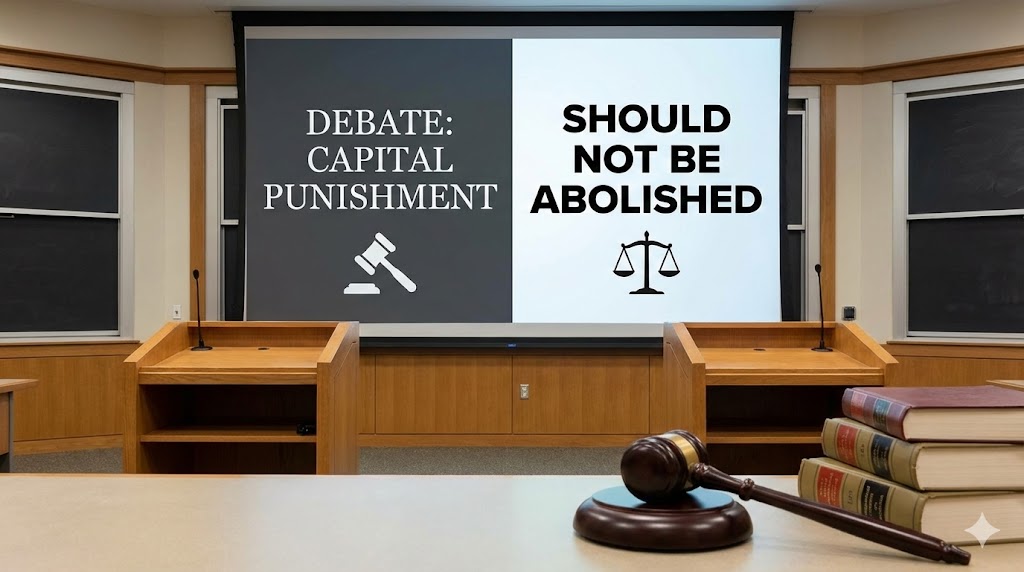
Debate: Capital Punishment Should Not Be Abolished (7 Winning Points)
Debate: Capital Punishment Should Not Be Abolished (7 Winning Points)
Good day, students!
Are you preparing to face the judges? If you are looking for the absolute strongest arguments to support the motion that Capital Punishment Should Not Be Abolished, you have definitely come to the right place.
Today, we are tackling a very serious and emotional topic. When we talk about capital punishment, also known as the death penalty, we are referring to the legal process where the state executes a criminal for committing a serious offense, usually murder or treason. My stance today is clear: to keep our society safe and just, this penalty must remain.
Disclaimer: This article provides a debate script supporting the proposition. It is designed for educational purposes and academic debates to help students build critical thinking skills. It is not meant to promote violence, but rather to explore the legal and moral arguments for retaining the death penalty.

Winning Debate Points on Why Capital Punishment Should Not Be Abolished
Here are 7 winning points you can use to silence your opposition. These are written as if you are already standing at the podium. Feel free to mix, match, or tweak them to fit your time limit.
1. The Principle of Retributive Justice
Mr. Chairman, Panel of Judges, let’s start with the most basic rule of fairness: the punishment must fit the crime. If a criminal steals a goat, they pay a fine or go to jail. But what if they steal a life?
When someone deliberately plans and brutally takes the life of an innocent person, a prison sentence is simply not enough. It is a mockery of justice to say that a murderer can keep their life after stealing someone else’s. Retributive justice is not about revenge; it is about balance. If you take a life, you forfeit your right to your own. It is the only punishment that truly matches the severity of the crime.
2. The Ultimate Deterrent to Crime
My opponent will try to tell you that the death penalty doesn’t scare criminals. I strongly disagree. Human beings fear death more than anything else.
Think about it. Why do armed robbers run when the police start shooting? Because they don’t want to die. If potential criminals know that the consequence of pulling that trigger is their own execution, they will think twice. By keeping the capital punishment should not be abolished debate alive and active in our laws, we send a loud message: Nigeria has zero tolerance for heinous crimes. Removing it tells criminals that the worst that can happen is free food and a bed in prison.
3. Permanent Incapacitation Ensures Safety
Here is a scary thought: What happens if a murderer escapes prison? Or what if they kill a prison guard while inside?
As long as a murderer is alive, they are a threat. We have seen cases where “lifers” organize crimes from behind bars or get released on parole only to kill again. The death penalty is the only 100% guaranteed method of incapacitation. It ensures that the monster who destroyed a family can never, ever do it again. It acts as a permanent shield for society.
4. Protecting the Taxpayer’s Hard-Earned Money
Let’s talk about economics. Why should the law-abiding citizens of this country work hard, pay taxes, and have that money used to feed, clothe, and provide medical care for a serial killer for 30 or 40 years?
It costs millions of Naira to keep a prisoner alive for a lifetime. That is money that could be spent on education, hospitals, or roads. It is unfair to ask the family of a victim to effectively “pay” for the survival of the person who killed their loved one. By keeping the death penalty, we ensure that resources are not wasted on those who have no value to add to our society.
5. Closure for the Victim’s Family
Imagine the pain of a mother who lost her child to a violent gang. Now, imagine her pain knowing that the killer is sitting in a cell, watching TV, eating three times a day, and breathing the air her child was denied.
For many families, there is no “moving on” until they know the killer is gone for good. [According to Britannica’s analysis of the death penalty], many victims’ families feel that execution provides the finality needed to close that dark chapter of their lives. Abolishing capital punishment denies them that justice and prolongs their trauma.
6. The “Heinous Crimes” Threshold
We are not saying people should be executed for stealing a phone. We are talking about the worst of the worst—terrorists, kidnappers who kill their hostages, and serial murderers.
In a world where terrorism is a real threat, we need the strongest tools available. If a terrorist blows up a market, killing dozens of innocent people, does he deserve a life sentence? No. Keeping capital punishment is necessary for these extreme cases. It preserves the sanctity of innocent life by showing that those who destroy it on a mass scale forfeit their right to exist.
7. It Is Constitutional and Legal
Finally, let’s look at the law. The Constitution of the Federal Republic of Nigeria, specifically Section 33, guarantees the Right to Life, but it includes a clear exception: “in execution of the sentence of a court in respect of a criminal offence of which he has been found guilty.”
Our laws were written by wise people who understood that some crimes are too great to be forgiven with just jail time. To abolish it would be to weaken our constitution and the rule of law. We must uphold the laws that protect the innocent, not change them to favor the guilty.
Frequently Asked Questions (FAQs)
Q: Isn’t the death penalty cruel and inhumane? A: My opponent might say that, but ask yourself: wasn’t the crime they committed cruel? The method of execution is usually quick and painless compared to the suffering the victim went through. Justice is not about being “nice” to murderers; it’s about doing what is right.
Q: What if an innocent person is killed? A: This is the strongest argument against us, but in the modern age, we have DNA testing and forensic science. The courts are extremely careful before handing down a death sentence. The risk of error has dropped significantly, and we shouldn’t scrap a necessary law just because of the possibility of error; instead, we fix the justice system.
Q: How do I conclude the speech effectively? A: You need to be firm. End with a statement that puts the focus back on the victims. For example: “Let us save our sympathy for the innocent victims, not the guilty murderers.”
Conclusion / Summary
To wrap up, the motion that capital punishment should not be abolished debate points is supported by logic, justice, and the need for public safety.
We have discussed how it serves as a deterrent, provides closure to families, saves taxpayer money, and ensures that dangerous criminals can never harm anyone again.
Disclaimer: Once again, this article is a guide for academic debate. It reflects one side of a complex legal and moral argument. All life is valuable, but the justice system must prioritize the safety of the innocent.
What do you think? Do you have a killer point I missed? Drop your opinions in the comments section below… Also, feel free to share this post with your coursemates or those in your team!