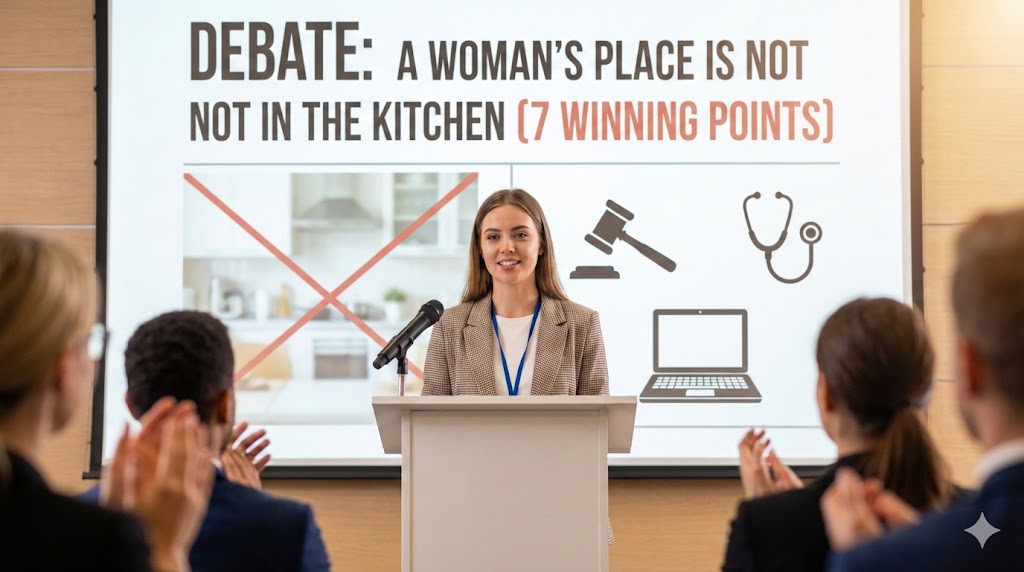
Debate: A Woman’s Place is Not in the Kitchen (7 Winning Points)
Debate: A Woman’s Place is Not in the Kitchen (7 Winning Points)
Good day, students!
Are you preparing to take the podium? If you are looking for the absolute strongest arguments to support the motion that Debate: A Woman’s Place is Not in the Kitchen (7 Winning Points), you have definitely come to the right place.
Today, we are tackling a topic that touches on culture, economics, and basic human rights. When people say a woman’s place is “in the kitchen,” they are using a metaphor to limit her role to domestic chores and household management. But when we say her place is not in the kitchen, we aren’t saying she shouldn’t cook. We are saying her potential shouldn’t be limited to just that room.
Disclaimer: This article provides a debate script supporting the proposition. It is designed for educational purposes and academic debates to help students build critical thinking skills. It is not meant to disrespect anyone who chooses to be a homemaker, which is also a noble and difficult job.

Winning Debate Points on Why A Woman’s Place is Not in the Kitchen
Here are 7 winning points you can use to crush your opponent. These are written as if you are already speaking to the judges. Feel free to mix, match, or tweak them to fit your time limit.
1. The Waste of Human Potential (Economic Argument)
Mr. Chairman, Panel of Judges, consider this. The brain has no gender. Intelligence does not check if you are male or female before it solves a math problem or cures a disease.
When we restrict a woman to the kitchen, we are essentially telling half of the population that their ideas, their inventions, and their leadership do not matter. Imagine if Ngozi Okonjo-Iweala had been told her place was only in the kitchen. The world would have lost a brilliant economist and the Director-General of the World Trade Organization. A nation that locks women in the kitchen is a nation that is fighting with one hand tied behind its back. We cannot afford to waste that kind of talent.
2. Women Are Drivers of Economic Growth
Let’s talk about money. The reality of our modern economy is that single-income households are struggling. It is no longer feasible for only the man to provide while the woman stays back.
When a woman works, the family income doubles. The standard of living rises. Children get better education. It’s a ripple effect. [According to a report by UN Women], investing in women’s economic empowerment sets a direct path towards gender equality, poverty eradication, and inclusive economic growth. If a woman is confined to the kitchen, who helps pay the bills when the economy gets tough? Her place is in the boardroom, the marketplace, and the office, helping to build the family’s wealth.
3. Leadership and Governance
My opponent might try to tell you that women are too “emotional” for leadership. That is a tired myth. History has shown us time and time again that women make exceptional leaders.
Look at countries like New Zealand or Germany under Angela Merkel. These nations thrived because they didn’t care about gender; they cared about competence. A woman’s place is in the Senate, in the House of Assembly, and in the Presidency. Restricting her to domestic duties deprives society of compassionate, detailed, and highly effective leadership.
4. Education Invalidates the “Kitchen” Argument
Why do we send the girl child to school? Think about it. We spend millions of Naira on school fees, WAEC, JAMB, and university tuition for our daughters.
If her only destiny is to cook and clean, then why bother with Physics, Chemistry, or Literature? The very fact that we educate women is proof that their place is not meant to be static. Education expands the mind. It prepares you for the world, not just the stove. To say a woman’s place is in the kitchen is to say that her education is a waste of time. And we all know that education is never a waste.
5. Biological Function is Not Destiny
The opposing side will likely bring up biology. They will say, “Women are the nurturers, so they belong at home.” Please, don’t fall for that trap.
Yes, women give birth. But does giving birth stop you from thinking? Does breastfeeding stop you from coding a website or performing surgery? Absolutely not. Men have muscles, but that doesn’t mean their only place is on a construction site. Biology gives us functions, but it does not dictate our destiny. A woman can be a mother and a CEO. She can cook dinner and run a country. It is not an “either/or” situation.
6. The Changing Dynamics of Modern Society
We are no longer in the 1800s. The days when physical strength was the only measure of work are gone. We are in the digital age.
Today, work is about mental capacity, creativity, and digital skills. A woman can run a multi-million Naira business from her laptop. The “kitchen” argument is an outdated relic of a past that no longer exists. Society has evolved. Culture evolves. Holding onto this belief is like refusing to use a smartphone because your ancestors used smoke signals. We must move with the times.
7. National Development Depends on It
Finally, let’s look at the giants of the world. The most developed nations—the USA, China, the UK—are countries where women are active participants in the workforce.
Now, look at the poorest nations. They are often places where women are restricted, oppressed, and kept “in the kitchen.” There is a direct link between how a country treats its women and how developed that country is. If we want Nigeria to be great, we need our women in laboratories, in engineering firms, and in courts of law. As the saying goes, “Train a woman, and you train a nation.” You cannot train a nation from the kitchen.
Frequently Asked Questions (FAQs)
Q: Does this mean women shouldn’t cook at all? A: Not at all! This debate isn’t about banning cooking. It’s about limitation. A man can cook, and a woman can cook. The point is that a woman’s entire existence shouldn’t be defined by or limited to that role.
Q: What is the strongest counter-argument I might face? A: The opposition will likely talk about the “breakdown of the family unit” or “neglected children.” You can counter this by saying that quality parenting comes from both the father and the mother, and a fulfilled, educated mother raises smarter, more ambitious children.
Q: How do I close my speech? A: End with a punchy, memorable line. Something like: “Mr. Chairman, let us not clip the wings of our daughters and then complain that they cannot fly.”
Conclusion / Summary
To wrap up, the motion that Debate: A Woman’s Place is Not in the Kitchen (7 Winning Points) is supported by logic, economics, and the reality of our modern world.
We have discussed how limiting women wastes human potential, how women are crucial for economic growth, and why education proves that women are meant for more than just domestic chores.
Disclaimer: Once again, this article is a guide for academic debate. Every role in society, including homemaking, is valuable. The goal here is to advocate for equal opportunity and the freedom to choose.
What do you think? Do you have a killer point I missed? Drop your opinions in the comments section below… Also, feel free to share this post with your coursemates or those in your team!