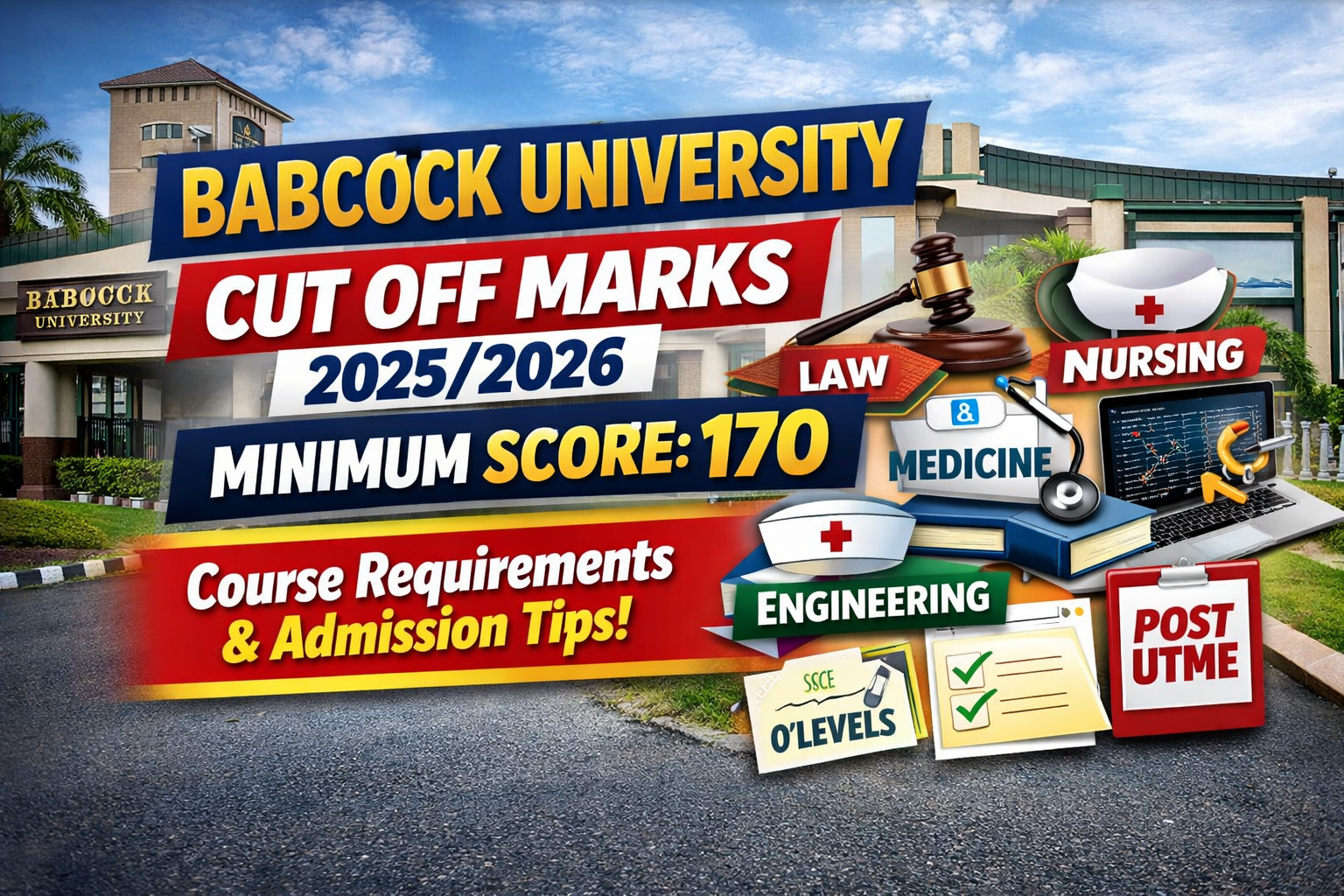
Babcock University Cut Off Mark for All Courses in 2026
If you are searching for the babcock university cut off mark for all courses, the clearest official answer is this: Babcock University’s current undergraduate admission requirements for 2026 state that candidates need a UTME aggregate score not lower than 170. The same page also says applicants must have five relevant O’Level credits, Medicine requires one sitting, and candidates must be at least 16 years old.
That sounds simple, but this is where many students get confused. A lot of websites publish long departmental cutoff tables as if every course has a different official JAMB score. What Babcock’s own admissions materials show is a little different. The university clearly publishes a general minimum score, then breaks programmes down mainly by subject requirements, screening rules, and special programme conditions. So the real question is not only “What is the cutoff?” but also “What does my course require beyond the cutoff?”
Table of Contents
ToggleWhat Is the Babcock University Cut Off Mark for All Courses?
Based on Babcock’s official admission page and current prospectus, the published undergraduate minimum is 170. That is the figure the university itself uses for 2025/2026 admission into first degree programmes.
The important part is how to read that number. It is best understood as the general entry threshold, not a promise of admission into every department. After that, Babcock checks whether your O’Level subjects fit the course, whether your entry route is UTME or Direct Entry, and whether your programme has an extra screening or test requirement. That is why two students with the same UTME score may not have the same admission outcome.
Does Babcock Publish a Different Cut Off Mark for Every Course?
From the official 2025/2026 materials reviewed, Babcock does not present a neat department-by-department JAMB cutoff chart beside every undergraduate course. Instead, the school publishes the 170 university-wide minimum and then lists course-specific academic requirements by school or programme. That is a major distinction, and it explains why many unofficial pages can be misleading.
So when students search for “cut off mark for all courses,” the most accurate answer is this: the official baseline is 170 across undergraduate programmes, but the actual admission requirements differ by course. For some courses, the difference shows up in the required subjects. For others, it shows up in one-sitting rules, screening exercises, or extra internal tests.
Babcock University Cut Off Mark for All Courses by Broad Study Area
Here is the most useful way to think about it.
Education and Humanities
The prospectus lists programmes such as History and International Studies, English Studies, French and Foreign Studies, Christian Theology, Business Education, Economics Education, Educational Management, Guidance and Counseling, and English Education under this broad area. These programmes still sit under the general 170 minimum, but their O’Level requirements differ depending on the exact course. For example, English-related programmes expect Literature in English, while History and Political fields look for Government or History.
Law and Security Studies
For Law, Babcock’s requirement is more specific than a raw UTME number. The university says LL.B applicants need five credits including English Language, Mathematics, and Literature in English, plus an acceptable level of performance in the admission examinations and screening. In practice, that makes Law more than a “170 and go” course.
Management and Social Sciences
Accounting, Finance, Business Administration, Marketing, Economics, Mass Communication, Political Science, Public Administration, Peace Studies, and Social Work all fall into this broad area. Accounting, for instance, requires English Language, Mathematics, and relevant commercial subjects. Mass Communication requires English, Mathematics, Literature in English, and two other subjects. So even if two applicants both score above 170, the one with the right subject mix is in the stronger position.
Science, Computing, and Technology
Babcock’s science and computing routes include programmes such as Mathematics, Chemistry, Biology, Microbiology, Agriculture-related courses, Computer Science, Information Systems, Information Technology, Cyber Security, and Software Engineering. These courses generally require strong science subjects, especially English, Mathematics, and Physics, with Biology and Chemistry depending on the programme. Computer Science and Software Engineering both clearly show this science-heavy pattern.
Medicine, Nursing, and Allied Health
This is where applicants need to slow down and read the fine print. Medicine, Human Anatomy, Physiology, Biochemistry, Human Nutrition and Dietetics, Public Health, Medical Laboratory Science, and Nursing all require strong science credits. Medicine is especially strict because Babcock says candidates must have credits in English, Mathematics, Biology, Physics, and Chemistry in one sitting, and the programme page also says candidates must pass the Babcock University Medical School Admission Test. Nursing and allied health programmes also require the core sciences at O’Level.
Engineering and Environmental Sciences
Engineering programmes listed in the current prospectus include Computer Engineering, Civil Engineering, Mechanical Engineering, and Electrical & Electronics Engineering. These require English, Mathematics, Physics, Chemistry, and another acceptable science subject. For Environmental Sciences, Babcock lists Architecture and Estate Management, each with its own subject pattern. Architecture, for example, expects English, Mathematics, Physics, and two relevant supporting subjects.
Course Examples Applicants Usually Ask About
Law
Law is not treated like a general social science course. Babcock explicitly asks for English Language, Mathematics, and Literature in English, then adds acceptable performance in admission examinations and screening. That means a student can meet the general UTME minimum and still be weak on core law requirements.
Accounting
Accounting requires English Language, Mathematics, and three relevant commercial subjects such as Principles of Accounting, Commerce, or Economics. This is one of the clearest examples of why the published minimum score is only one part of the admission picture.
Computer Science and Software Engineering
Computer Science requires English Language, Mathematics, Physics, and other relevant science subjects. Software Engineering also requires English, Mathematics, Physics, Chemistry, and another science subject. So for applicants moving into tech courses, subject strength matters almost as much as the UTME number itself.
Nursing
The current prospectus says Nursing requires five credits in English Language, Mathematics, Biology, Physics, and Chemistry at not more than two sittings, plus acceptable UTME performance. That puts Nursing among the courses where meeting 170 is only the starting point.
Medicine
Medicine is stricter. The official programme page and prospectus both say applicants need the five core science credits, and the Medicine page adds that those credits must be in one sitting and that candidates must pass BUMSAT. In real terms, Medicine is one of the least forgiving programmes to apply for with a borderline profile.
Architecture and Estate Management
Architecture needs English, Mathematics, Physics, and two relevant subjects drawn from options such as Chemistry, Biology, Technical Drawing, Fine Arts, Geography, Economics, Building Construction, and Land Surveying. Estate Management has its own subject mix built around English, Mathematics, Economics, and approved supporting subjects. These are good examples of courses where applicants often focus too much on cutoff talk and miss the actual subject rule.
Other Admission Requirements You Must Not Ignore
Babcock’s admission page says undergraduate admission is through UTME or JAMB Direct Entry, and candidates who did not initially choose Babcock as first choice can still apply, but must change Babcock to first choice at an accredited JAMB CBT centre before completing the process. That is a practical detail many students miss.
The school also states that candidates must be 16 years and above for the 2025/2026 cycle. For Medicine, the one-sitting O’Level rule is clearly stated.
Another important detail appears on the admission portal: it says results must be obtained before registration and explicitly states “No awaiting results.” The same portal also mentions that there will be an entrance examination and that the mode is computer-based.
There is one area where applicants should be especially careful: Law, Medicine, and Nursing entry mode information is not perfectly consistent across Babcock pages. The admission portal includes a line saying students who want to study Law, Medicine, and Nursing can only come through UTME, but the current prospectus and programme pages still show Direct Entry information for Medicine and Nursing, and the law school page also includes Direct Entry admission details. The safest move is to confirm the current position directly from the admissions office before relying on any one page.
Common Mistakes Students Make
The first mistake is treating 170 as automatic admission. It is not. It is the published minimum score, but Babcock also checks whether your subject combination actually matches the programme you want.
The second mistake is using unofficial cutoff tables without checking the school’s own prospectus or programme pages. That is how applicants end up mixing general minimum scores with rumours about departmental cutoffs. Babcock’s official documents place much more emphasis on programme-specific requirements than on a long public departmental score chart.
The third mistake is ignoring special rules. Medicine has a one-sitting rule and a separate admission test. Law requires Literature in English. Nursing is built around the core sciences. Architecture has a more specific subject spread than many students expect. Missing those details can be more damaging than having a modest UTME score.
A Smart Next Step Before You Apply
Use the 170 score as your first checkpoint, not your final conclusion. After that, verify four things: whether your O’Level subjects fit the course, whether the course has extra screening, whether Babcock must be your first choice at that stage, and whether your programme has special conditions like one sitting or an internal test. That is the difference between being merely eligible and being realistically prepared.
If you are applying to a competitive programme, a higher score is simply safer. Babcock’s official materials publish the minimum, but they do not suggest that every applicant above that line has the same admission strength. A careful applicant reads the course bulletin, not just the headline cutoff.
FAQ Section
What is Babcock University cut off mark for all courses?
The official undergraduate minimum published by Babcock University for 2025/2026 is 170 in UTME.
Is 170 enough for every course in Babcock University?
It is the official minimum entry score, but it is not the only requirement. Your O’Level subjects, screening performance, and course-specific rules still matter.
Does Babcock University have separate departmental cut off marks?
In the official materials reviewed, Babcock clearly publishes a general minimum score of 170, then gives course-by-course academic requirements. The university does not present a simple official departmental JAMB cutoff chart for every course in the same way many third-party sites do.
Can I study Nursing in Babcock with 170?
You may meet the published minimum with 170, but Nursing also requires credits in English Language, Mathematics, Biology, Physics, and Chemistry, plus other programme conditions. So 170 alone does not settle the question.
Does Medicine have extra requirements apart from the cutoff mark?
Yes. Medicine requires the five core science credits in one sitting, and the official programme page also says candidates must pass the Babcock University Medical School Admission Test.
Can I apply if I did not choose Babcock as first choice in JAMB?
Yes, but Babcock says you must change the institution to first choice at an accredited JAMB CBT centre to complete the admission process.
Does Babcock accept awaiting result?
The admission portal says results must be obtained before registration and states “No awaiting results.”
Can I use Direct Entry for Law, Medicine, or Nursing?
You should verify this directly with Babcock before applying because the university’s pages are not fully consistent. One page says those courses come only through UTME, while other official pages still show Direct Entry information for Medicine, Nursing, and Law.
Conclusion
The most reliable answer to the babcock university cut off mark for all courses is that Babcock currently publishes 170 as the general undergraduate UTME minimum for 2026. What changes from course to course is not mainly the headline cutoff, but the subject requirements, screening conditions, one-sitting rules, and special programme checks. Applicants who want the strongest chance should use 170 as the starting line, then match their result carefully against the exact course bulletin before applying.





4 Comments