Debate: Teachers Are Responsible for Students’ Failure (7 Winning Points)
Debate: Teachers Are Responsible for Students’ Failure (7 Winning Points)
Good day, fellow students, debaters, and friends!
Are you preparing for a tough debate session? Does the motion seem a bit controversial? You are in the right place. Today, we are tackling a very hot topic that always sparks a lot of emotion in the hall.
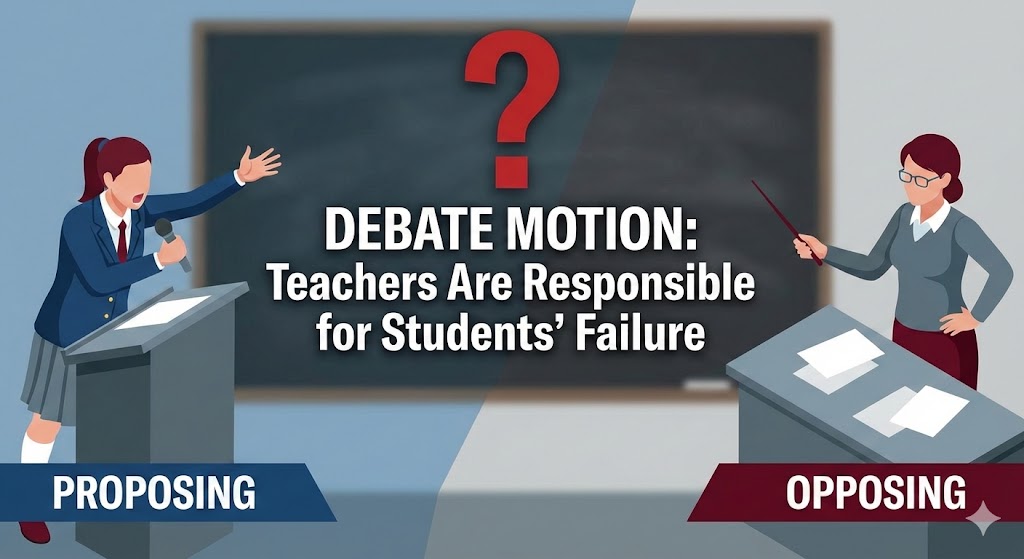
We are supporting the motion that Teachers are responsible for students failure.
Now, before we dive into the script, let’s define what we are talking about. When we say a student has “failed,” we usually mean a drop in academic performance or an inability to pass exams. And when we say teachers are “responsible,” we mean they hold the primary duty to ensure learning happens.
If learning doesn’t happen, who is to blame?
IMPORTANT DISCLAIMER: This article provides a debate script supporting the motion that teachers are responsible for failure. This is strictly for educational and debating purposes. We respect teachers and acknowledge that many work hard. However, in a debate, you must argue your specific side passionately. This script is designed to help you win that specific argument.
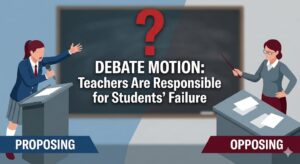
Winning Debate Points on Why Teachers Are Responsible for Students’ Failure
Here are the winning arguments you need. These are written exactly as you should speak them on stage.
1. The Captain of the Ship Analogy
Mr. Chairman, panel of judges, and accurate timekeeper.
My first point is simple logic. Imagine a ship sinks in the ocean. Who do we blame? Do we blame the passengers? No. We blame the captain. Why? Because the captain is the professional in charge of navigation.
In the classroom, the teacher is the captain. They are the trained professionals paid to guide us. If a student—who is the passenger—fails to reach the destination of knowledge, it is because the navigation was poor. You cannot blame a learner for not learning if the teaching method was flawed from the start. It is the professional’s job to ensure the service is delivered correctly.
2. Poor Teaching Methods Kill Interest
Let’s be honest with ourselves. We have all had that one teacher. The one who comes into the class, opens a textbook, reads it word-for-word, and then leaves. Is that teaching? No, that is reading.
When teachers refuse to adapt their lesson delivery to suit modern students, failure is guaranteed. You cannot use 1990s methods for 2025 students and expect distinction results. If a teacher fails to make a subject interesting or understandable, the student switches off. When the brain switches off, failure sets in. The spark for learning must come from the teacher. If there is no spark, there is no fire.
3. Lack of Motivation and Mentorship
Here is the hard truth. Students look up to teachers. We spend more time with them than with our parents during the week.
Psychology tells us that motivation is the fuel for success. A great teacher doesn’t just teach math or English; they teach belief. But what happens when a teacher tells a student, “You are a dullard” or “You will never know this”? They kill the student’s confidence.
According to [educational studies regarding student psychology], negative reinforcement from authority figures leads to a direct drop in performance. When a teacher fails to offer mentorship or encouragement, they are actively contributing to the student’s failure. They are crushing the very spirit needed to pass.
4. Poor Classroom Management
Have you ever tried to study in a market? It’s impossible, right?
Well, a noisy, disorganized class is just like a market. And whose job is it to control the class? The teacher’s. If a teacher has poor classroom management skills and allows bullying, noise, or chaos to take over, learning stops.
I have seen brilliant students fail simply because the learning environment was toxic, and the teacher did nothing to fix it. If the teacher cannot control the environment, they are responsible for the academic crash that follows. It’s that simple.
5. Ignoring Individual Differences
We are not robots. We are humans. Some of us learn fast, some learn slow. Some need pictures to understand, others need notes.
A lazy teacher treats everyone the same. They teach to the top 10% of the class and ignore the rest. This is professional negligence. If a doctor gave the same medicine to every patient regardless of their sickness, and the patients died, the doctor would be jailed.
So, when a teacher uses a “one size fits all” approach and the slower students fail, why do we try to blame the students? The teacher failed to diagnose the problem and provide the right support.
6. Lack of Preparation and Mastery
Mr. Chairman, you cannot give what you do not have.
It is a sad reality, but some teachers simply do not master their subjects. I have sat in classes where the student corrected the teacher. How can a student pass an exam when the person teaching them is confused?
If the source of information is polluted, the river will be dirty. If the teacher’s knowledge is shaky or they come to class unprepared, the students are doomed to fail before they even pick up a pen. Teachers are responsible for students failure in this case because they failed to prepare. And as the saying goes, “He who fails to prepare, prepares to fail.”
7. The Curriculum vs. The Delivery
My opponents might argue that the syllabus is too wide or the government is to blame. But who delivers the curriculum? The teacher.
A good teacher can take a bad syllabus and make it make sense. A bad teacher can take a perfect syllabus and make it confusing. The teacher is the bridge between the book and the brain. If the bridge is broken, the goods cannot cross over. The responsibility always lies with the builder of the bridge.
Frequently Asked Questions (FAQs)
What is the strongest argument for the opposing side? Usually, the opposition will blame “student laziness” or “bad parenting.” They will say teachers can’t force a horse to drink water. To counter this, use the “Doctor Analogy”—a doctor can’t force a patient to get well, but they must provide the best possible treatment first.
Can I use these points for a debate about university lecturers too? Yes, absolutely. The principles of academic performance and mentorship apply to primary, secondary, and university levels equally. The logic remains the same.
How do I conclude this speech powerfully? End with a rhetorical question that leaves the judges thinking. Something like, “If the student is always the problem, why do we need teachers at all?”
Conclusion / Summary
To wrap this up, the argument is clear. While students have a role to play, the professional burden lies with the educator. From poor teaching methods to a lack of classroom control, the factors that lead to failure are often in the hands of the teacher.
We have discussed how:
-
Teachers are the captains of the ship.
-
Boring methods kill interest.
-
Lack of motivation destroys confidence.
-
Poor management creates chaos.
Disclaimer: Once again, this post supports the motion that teachers are responsible for students failure for the sake of academic debate. In reality, education is a partnership between teachers, students, and parents. We value our teachers and the hard work many of them put in daily.
What do you think? Do you agree with these points? Or do you think students should take more blame? Drop your opinions in the comments section below! Also, feel free to share this post with your coursemates or those in your debate team!