Debate: Hard Work is More Important Than Talent (6 Winning Points)
Debate: Hard Work is More Important Than Talent (6 Winning Points)
Good day, students! Looking for the winning points for your next debate? You’ve come to the right place.
Preparing for a debate can be stressful, especially when you are up against a tough team. But don’t worry, I’ve done the heavy lifting for you. Today, we are tackling one of the most popular topics in Nigerian schools: the battle between natural ability and hustle.
If you are supporting the motion that Hard Work is More Important Than Talent, you need arguments that strike a nerve. You need to prove that while talent is a nice bonus, it is the sweat and tears that actually get the job done.
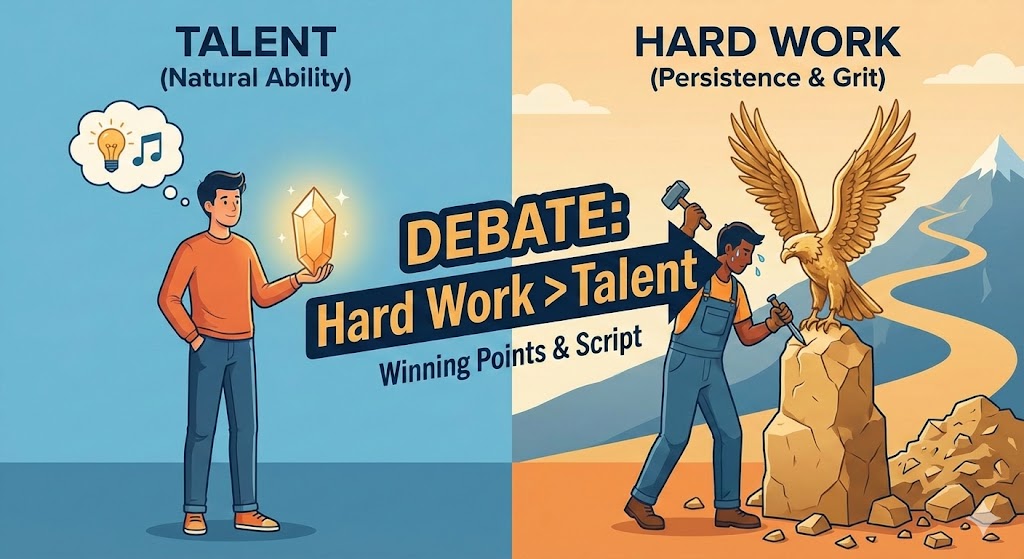
Before we dive into the script, let’s define our terms. Talent is simply a natural aptitude or skill you are born with. Hard work, on the other hand, is the consistent effort, discipline, and “grit” applied to achieve a goal.
Disclaimer: This article provides debate points supporting the motion that hard work supersedes talent. This is for educational and debating purposes only and is not meant to diminish the value of natural gifts.
Winning Debate Points on Why Hard Work is More Important Than Talent
Here are 6 solid points you can copy, adapt, and use to win your debate.
1. Talent is Useless Without Discipline
My first point strikes at the heart of the matter: talent is merely potential. It is not a guarantee of success. You can be the most naturally gifted singer, footballer, or mathematician in the world, but if you don’t practice, that talent rots.
Think about it. We all know that one student in class who is naturally smart but never reads. Eventually, they fall behind. Why? Because hard work is more important than talent when talent refuses to work. As the famous saying goes, “Hard work beats talent when talent doesn’t work hard.” I put it to you, judges, that a disciplined worker will always overtake a lazy genius.
2. Hard Work Builds Character and Resilience (Grit)
Talent is often a safety net. Talented individuals are used to things coming easily to them. But what happens when they hit a wall? They crumble. They don’t know how to struggle.
On the other hand, those of us who rely on hard work have built something psychologists call “grit.” We are used to failing, learning, and trying again. This resilience is key to long-term success. [According to research by psychologist Angela Duckworth], grit—the power of passion and perseverance—is actually a better predictor of success than IQ or talent. This proves that the ability to stick with it matters far more than starting with an advantage.
3. Hard Work Beats “Natural Aptitude” in the Long Run
Let’s talk about consistency. Talent is like a sprint; hard work is a marathon. You might start faster because you are gifted, but can you keep it up?
Panel of judges, history is filled with “average” people who became legends through sheer consistency. Look at the story of the Tortoise and the Hare. It’s not just a fable; it’s a life lesson. The Hare had the talent (speed), but the Tortoise had the hard work (consistency). In the real world, the person who shows up every single day, puts in the hours, and refuses to quit will eventually surpass the person who relies solely on a lucky genetic lottery.
4. Hard Work Allows You to Acquire New Skills
Here is a harsh truth for my opponents: Talent is fixed. You usually can’t “create” more natural talent. If you aren’t born with a great singing voice, does that mean you can never be a musician? No!
Through hard work, you can acquire skills you weren’t born with. This is the essence of a growth mindset. Hard work is the great equalizer. It allows a poor student to become a scholar. It allows a clumsy kid to become a karate champion. If we say talent is more important, we are telling people that their destiny is fixed at birth. But if we accept that hard work is more important than talent, we give everyone the power to change their own stars.
5. Innovation Comes from Perspiration, Not Just Inspiration
My opponents might argue that geniuses like Einstein or Mozart were just “talented.” But that is a lie. Thomas Edison, one of the greatest inventors in history, famously said that “Genius is 1% inspiration and 99% perspiration.”
What does this mean? It means the great inventions, the cure for diseases, and the masterpieces of art didn’t just poof into existence because someone was talented. They happened because someone stayed up late, failed a thousand times, and kept working. The lightbulb wasn’t an accident of talent; it was the result of thousands of hours of hard work.
6. The Real World Rewards Results, Not Potential
Finally, let’s look at the real world. Employers, universities, and the society at large do not pay you for your “potential.” They pay you for what you can deliver.
You cannot walk into a job interview and say, “I am naturally smart, so hire me,” if you have no portfolio to show for it. The world respects the grind. It respects the person who built a business from scratch more than the person who inherited it. In the grand scheme of things, hard work is more important than talent because hard work produces tangible, undeniable results, whereas talent is just a promise that hasn’t been kept yet.
Frequently Asked Questions (FAQs)
Q: Can hard work beat pure genius? A: Yes, absolutely. While a genius has a head start, they often lack the discipline to finish complex projects. A hard worker who improves 1% every day will eventually overtake a genius who stands still.
Q: Isn’t a combination of both the best? A: Ideally, yes. But in a debate where you must choose one, hard work is the safer bet. Hard work without talent can still lead to a decent life. Talent without hard work leads to wasted potential and regret.
Q: How do I end my speech powerfully? A: End with a strong quote or a direct challenge to the audience. Remind them that they have control over how hard they work, but no control over how much talent they were born with.
Conclusion / Summary
To wrap this up, while talent is a wonderful gift, it is widely overrated. We have seen that without discipline, resilience, and consistency, talent is wasted.
From the research on “grit” to the real-life examples of inventors like Edison, the evidence is clear: Hard work is more important than talent. It is the engine that drives success, while talent is merely the paint on the car. So, if you ever feel like you aren’t “gifted” enough, remember that your effort counts for double.
Disclaimer: All professions, skills, and natural abilities are valuable. This article supports one side of a specific debate motion for educational purposes.
What do you think? Drop your opinions in the comments section below… Also, feel free to share this post with your coursemates or those in your team!