Debate: Vocational Education is Better Than Formal Education (6 Winning Points)
Debate: Vocational Education is Better Than Formal Education (6 Winning Points)
Good day, students!
Looking for the winning points for your next debate? You’ve come to the right place. Today, we are settling a very tough argument: Vocational Education is Better Than Formal Education.
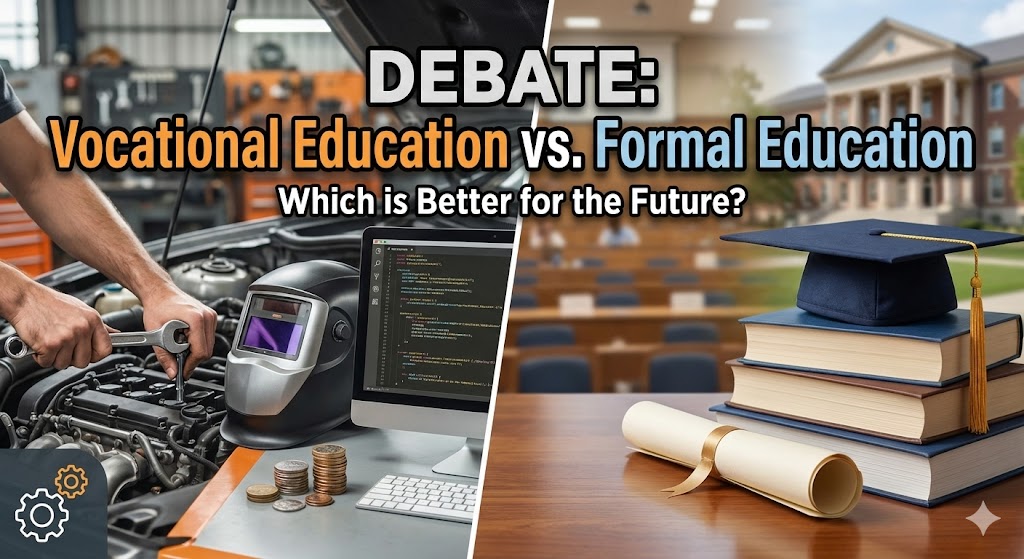
If you are supporting this motion, you are on the realistic side of history. In Nigeria today, the certificate is not enough. We need hands. But first, let’s define our terms. Formal education is the traditional classroom learning—primary, secondary, and university—that focuses heavily on theory and certificates. Vocational education (or TVET) focuses on specific hands-on skills like tailoring, coding, mechanics, and carpentry.
Disclaimer: This article provides points supporting the motion that vocational education is better than formal education for educational debate purposes. It is designed to help students build a persuasive argument. We recognize that both forms of education are essential for a balanced society.
Winning Debate Points on Why Vocational Education is Better Than Formal Education
Here is your script. These points are written in the first person. You can copy them, adapt them, and read them directly as if they are your own thoughts.
1. Skills Pay the Bills Immediately
My first point is simple: practical skills put food on the table faster than big grammar.
Think about it. When a vocational student finishes learning how to fix cars or sew clothes, they can start making money that same day. They don’t need to print a CV or beg for an interview. But look at the university graduate. After four or five years of studying big theories, they often come out confused because they have “knowledge” but no marketable skill. In this economy, vocational education is better than formal education because it gives you a direct ticket to earnings. You don’t wait for luck; you create your own luck.
2. Solving the Unemployment Crisis
We have a serious problem in this country. We have millions of graduates with degrees but no jobs. Why? because formal education trains people to be employees, waiting for an office that doesn’t exist.
Vocational education is the cure for this disease. It trains you to be an employer. A carpenter doesn’t look for a vacancy; he looks for wood. A programmer doesn’t look for an office; she looks for a laptop. [According to the International Labour Organization (ILO)], bridging the “skills gap” through technical training is the fastest way to reduce youth unemployment. We need creators, not just job seekers.
3. Cost-Effectiveness and Time
Let’s talk about money. Formal education is incredibly expensive. Between tuition fees, textbooks, accommodation, and the endless “handouts” in our universities, parents spend millions. And for what result?
Vocational training is often shorter and cheaper. You can master a trade in 6 months to 2 years without breaking the bank. For the average Nigerian family, this is a lifesaver. Why spend five years and millions of Naira to study a course you might never use, when you can spend two years learning a tech skill that pays in dollars? It’s just common sense.
4. Practicality Over Theory
Have you ever met a graduate of Electrical Engineering who cannot change a light bulb? It sounds funny, but it is true. Formal education often traps students in a world of theory. We cram definitions, pass exams, and forget everything the next day.
Vocational education is different. It is 100% practical. You learn by doing, not just by reading. When you learn how to bake, you actually bake a cake. When you learn welding, you actually join metals. This hands-on experience builds confidence that no textbook can give. The world is built by people who do things, not just people who write about them.
5. Economic Stability and Independence
Formal education relies heavily on the government or big companies to provide jobs. When the economy crashes (like it often does), the formal sector fires people first.
But the person with a vocation? They are solid. Even in a recession, people still need to fix their cars, cut their hair, and repair their plumbing. Vocational skills are “recession-proof.” By focusing on skills acquisition, we build a generation that is self-reliant and independent. This is true freedom.
6. It Drives Industrialization
Finally, let’s look at the developed nations like China and Germany. How did they become powerful? They didn’t do it by just writing essays. They did it through manufacturing and technology.
They prioritized vocational and technical education. They built factories and produced goods. If we want Nigeria to grow, we need more technicians, machinists, and fashion designers, not just more Philosophy graduates. Vocational education is better than formal education for our national growth because it turns us from a country of consumers into a country of producers.
Frequently Asked Questions (FAQs)
What if the opposition says formal education teaches critical thinking? You can agree, but add a “but.” Say: “Yes, formal education teaches thinking, but vocational education teaches problem-solving. Thinking about a broken engine doesn’t fix it; knowing how to use the tools does.”
Is vocational education only for those who aren’t ‘smart’? Absolutely not. This is an old stigma. Today, some of the smartest and richest people are those with technical skills (software developers, top chefs, fashion moguls).
How do I close my argument? Remind the audience that the certificate is just paper, but the skill is power. End with a strong statement about self-reliance.
Conclusion / Summary
To wrap this up, we are not saying school is bad. But we are saying that in the real world—the world of bills, rent, and development—vocational education is better than formal education.
It creates jobs, it saves money, and it builds a nation of producers. It is time we stop looking down on the mechanic and the tailor, because they are the ones holding the economy together.
Disclaimer: The views expressed in this debate script are for educational and competition purposes only. We acknowledge the importance of formal education in sectors like medicine, law, and research.
What do you think? Is the university degree still the golden ticket, or has the world changed? Drop your opinions in the comments section below! Also, feel free to share this post with your coursemates or those in your debate team!