
Debate: Internet is a Curse (7 Winning Points)
Good day, fellow students! Are you preparing to take the stage and argue that the web is doing more harm than good? You have come to the right place.
The motion on the ground is strong: “Internet is a Curse.”
If you are on this side of the debate, your job is to prove that despite the “flashy” benefits, the internet has brought more destruction, moral decay, and danger to our society than solutions. When we say “Internet is a Curse,” we mean it is a source of misery and trouble. We aren’t saying it doesn’t have uses, but like a poisoned chalice, the harm outweighs the good.
Important Note: This article provides a debate script supporting the motion that the internet is a curse. This is strictly for educational purposes to help you build a strong argument for your school debate.
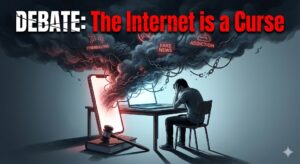
Winning Debate Points on Why the Internet is a Curse
Here are 7 solid points you can use to silence your opponents. Read them, understand them, and deliver them with passion.
1. The Explosion of Cybercrime (The “Yahoo” Menace)
Let’s tell ourselves the truth. My first point focuses on crime. Before the internet, if a thief wanted to steal your money, they had to physically come to your house. Today? They can empty your parents’ bank account from the comfort of their bedroom.
The internet has given birth to a new generation of criminals. In Nigeria, we see the devastating effects of cybercrime every day. Young people who should be in school are chasing “fast money” online. It has ruined the reputation of our country and destroyed the future of many youths. [According to a report by the EFCC], cybercrime is one of the biggest challenges facing our youth today. The internet gave them the tool to commit these crimes. If that isn’t a curse, what is?
2. Moral Decay and Exposure to Harmful Content
Imagine leaving a child in a room full of explicit, violent, and dangerous materials. That is exactly what the internet does.
My second point is about our morals. The internet has no filter. A student searching for homework help can easily stumble upon pornography or violent videos with just one wrong click. It exposes young minds to things they are not ready for.
This unrestricted access is eroding our cultural values. We see children disrespecting elders because of a “trend” they saw online. We see decency being thrown out the window for “likes” and “views.” The internet has opened a door to moral corruption that we are struggling to close.
3. The Death of Genuine Human Connection
We are more connected than ever, yet we are lonelier than ever. Is that not a tragedy?
The internet has replaced real conversations with emojis. Families sit in the same living room, but everyone is glued to their screens, chatting with strangers while ignoring the people right next to them. This is social isolation.
We are forgetting how to talk to each other. We are forgetting empathy. When we hide behind screens, we lose the human touch that makes society work. A tool that divides families and makes us lonely zombies is definitely a curse.
4. The Plague of Fake News and Misinformation
Information is power, but false information is a weapon.
The internet allows lies to travel faster than the truth. During health crises or national emergencies, we see how fake news spreads panic. People drink salt water to cure diseases because “they saw it on WhatsApp.”
This misinformation leads to chaos, violence, and wrong decisions. Unverified blogs and rumors destroy people’s reputations in minutes. The internet has become a factory for lies, and it is tearing the fabric of our society apart.
5. Addiction and Distraction for Students
Ask yourself this: How many times have you picked up your phone to study, only to end up on TikTok for three hours?
The internet is designed to be addictive. It is a massive distraction. As students, our grades are suffering because we cannot focus. The constant “ping” of notifications breaks our concentration. Internet addiction is real, and it is stealing our time.
Instead of reading our books or learning a trade, we are busy watching skits or arguing in comment sections. It is making us lazy. A tool that stops the leaders of tomorrow from learning today is a curse to our future.
6. Cyberbullying and Mental Health Crisis
The internet has given bullies a megaphone.
In the past, if you were bullied at school, you could go home to be safe. Now, the bullying follows you home on your phone. Cyberbullying is silent but deadly. People hide behind anonymous accounts to tear others down.
We see depression and anxiety rates rising among teenagers because of online harassment. Students are harming themselves because of nasty comments or leaked photos. The internet has created a battleground where mental health is the first casualty. [Research by the World Health Organization (WHO)] highlights how online harassment significantly impacts adolescent mental health.
7. Health Issues (The Physical Toll)
Finally, let’s look at our bodies. The internet makes us sedentary.
Because everything is “a click away,” we don’t move. We sit for hours gaming, chatting, or watching movies. This leads to obesity, eye strain, and bad posture. We are trading our physical health for digital entertainment.
We are raising a generation that has neck pain at age 15 because they are always looking down at a screen. If something damages your health and makes you physically weak, you have to call it what it is—a curse.
Frequently Asked Questions (FAQs)
Q: Can’t we say the internet is a tool and not a curse? A: You can argue that, but in a debate, you look at the net impact. If a tool causes crime, depression, moral decay, and addiction, the negative impact (the curse) is undeniable, regardless of the few benefits.
Q: How do I conclude this speech powerfully? A: End with a strong summary. Remind the judges that while the internet connects computers, it disconnects hearts. Tell them that a world with less privacy, more crime, and more hate is a cursed world.
Q: What if my opponent mentions online education? A: Counter it immediately. Admit that education exists, but ask at what cost? Ask if the distraction and access to exam malpractice sites don’t undermine that same education.
Conclusion
To wrap up, the evidence is clear. The Internet is a Curse because it has fueled cybercrime, destroyed our privacy, ruined our focus, and damaged our mental health.
We cannot ignore the tears of cyberbullying victims or the future of youths lost to internet fraud just because Google helps us do homework. The price we are paying is too high.
Disclaimer: This article offers points supporting one side of a debate for educational purposes. The internet is a complex tool with both positives and negatives, and this content is crafted to help students win a specific academic argument.
What do you think? Drop your opinions in the comments section below… Also, feel free to share this post with your coursemates or those in your team!