
Debate on mobile phones should not be allowed in school is not really about whether phones are evil. It is about whether unrestricted phone access helps or harms learning, discipline, safety, and fairness inside a school environment.
That distinction matters. A weak debate treats the issue as if the only choice is “phones are good” or “phones are bad.” A strong debate recognizes that phones are useful tools in some settings but disruptive in others. School is one of those places where purpose, timing, and control matter more than convenience.
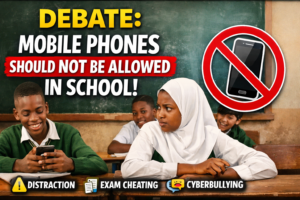
For students in Nigeria, this topic is especially practical. It shows up in classroom debates, essay questions, speech writing, and civic discussion because it touches real school concerns: concentration in class, examination malpractice, cyberbullying, teacher authority, and the wider pressure that smartphones bring into student life.
Across the world, governments and school systems are tightening restrictions. UNESCO reported in March 2026 that 114 education systems had national bans on mobile phones in schools, showing how quickly this policy debate has grown.
So the real question is not whether phones exist. They do. The real question is whether students should have open access to them during school life.
What the motion really means
When people hear the motion, they often assume it means students should never touch a phone again. That is not the smartest reading.
In most debate settings, “mobile phones should not be allowed in school” usually means students should not be free to carry and use phones during normal school activities, especially in classrooms, tests, assemblies, and other supervised spaces. It is mainly a question of school control.
That matters because the strongest version of the argument is not blind hostility to technology. It is this: a school should be a place for learning first, and any device that regularly interrupts learning should be restricted.
That position is easier to defend because it is practical, not extreme.
Why schools are tightening phone rules
The first reason is distraction. OECD findings from PISA 2022 show that around 30% of students across OECD countries said they get distracted by digital devices in most or every mathematics lesson, while about 25% said they are distracted by other students using those devices. Students who reported frequent distraction in math lessons also scored lower in mathematics on average.
The second reason is that distraction is not the only issue. UNESCO says governments increasingly see smartphones as a source of classroom distraction and a potential threat to students’ well-being, which helps explain why restrictions have spread so quickly.
The third reason is safety. UNICEF’s guidance for families stresses clear rules, privacy, digital footprints, and the need to protect children from harmful online experiences rather than assuming they can manage everything on their own.
Nigeria’s own digital policy conversation reflects the same caution. The Federal Ministry of Education notes in its National Digital Learning Policy that more digital learning can challenge children’s well-being and development if it is not well managed, and can raise risks around cybersecurity, safety, privacy, and data ownership.
So this debate is not based on fear alone. It grows out of real concerns that schools, parents, and policymakers are already dealing with.
Strong arguments for saying mobile phones should not be allowed in school
Phones divide attention and weaken concentration
A student cannot fully listen to a teacher and fully track a buzzing phone at the same time. Even when the phone is silent, the temptation remains. A quick glance at a message can become five minutes of lost attention. A classroom works best when attention is shared. The teacher explains, students follow, and the lesson moves forward together.
Phones break that flow.
This is one of the strongest debate points because it is easy to observe. A student may open a phone to check the time and end up on WhatsApp, TikTok, Instagram, football updates, or a gaming app. That shift happens fast. Once attention leaves the lesson, learning becomes weaker.
This is also why the issue is bigger than the individual user. One student using a phone can distract nearby students, interrupt the teacher, and change the mood of the class. A phone problem rarely stays private for long.
They can damage discipline and teacher authority
School discipline depends on structure. Students are expected to follow instructions, face the front, complete tasks, and respect timing. Phones create a second authority inside the classroom. Instead of the teacher controlling attention, the device begins to compete for it.
That competition affects discipline in quiet but serious ways. A student may pretend to listen while texting under the desk. Another may refuse to hand over a device when told. Others may record teachers secretly, post clips online, or use phones to mock classmates. Once that culture grows, school rules become harder to enforce.
The problem is not only disobedience. It is divided loyalty. If students treat the phone as more urgent than the lesson, respect for the classroom weakens.
They increase the risk of exam malpractice
In the Nigeria context, this argument is powerful. Mobile phones can be used to store notes, search for answers, share questions, take pictures of test papers, or receive outside help during examinations. Even when a student does not cheat, the mere presence of phones can create suspicion and tension.
A good school system should protect honest students, not place them in an environment where unfair advantage is easy.
This point is especially effective in debate because it links phone use to fairness. Once phones enter the exam setting, they do not just distract; they undermine trust. And when trust goes, the value of assessment falls with it.
They can fuel cyberbullying, secret recording, and conflict
A school argument about phones is no longer just about calling and texting. Smartphones carry cameras, social media, group chats, screen-recording tools, and instant sharing. That changes the risk.
A student can film a fight, embarrass a classmate, share a teacher’s image without permission, spread rumors in a group chat, or turn a small school conflict into a public online drama before the school day even ends.
UNICEF warns that children need guidance about digital footprints, privacy, who they communicate with, and what they post, because harmful online behavior can escalate quickly and stay online long after the moment has passed. The Nigerian Communications Commission also provides child online protection resources and localized safety materials for children, teachers, and families, which shows that online risk is not a distant theory but a live issue.
A school should reduce predictable harm, not make it easier.
They increase theft, loss, and unhealthy comparison
This point is often ignored, but it matters. Phones are expensive items. When students bring them to school, they create new problems: theft, damage, arguments over missing devices, and pressure to own fashionable models.
In mixed economic settings, a smartphone can become a status symbol. One student has a basic device, another has an expensive iPhone, and another has nothing at all. That can deepen feelings of inferiority, pride, envy, or unnecessary competition.
School should reduce social pressure where possible. It should not turn the classroom into a showroom for gadgets.
The emergency argument is often overstated
One of the most common defenses of phones is emergency communication. At first, it sounds decisive: what if a parent needs to reach a child?
But schools already have communication channels. Parents can contact the school office. Schools can reach parents. In a real emergency, organized communication through the school is usually safer and clearer than dozens of students calling home at once and spreading confusion.
That does not mean emergencies are fake. It means they are not a strong enough reason to allow unrestricted phone use throughout the school day.
The strongest counterarguments
A good debate does not hide the other side. It faces it.
Phones can support research and learning
This is the best counterargument. Phones can help students search definitions, access e-books, watch educational explanations, use calculators, translate language, and join learning platforms.
And that point is not empty. OECD data suggest that moderate use of digital devices for learning in school can be linked with better performance, while excessive or misdirected use becomes a problem. UNICEF Innocenti also argues that children need opportunities to build digital skills and that simple restriction alone may weaken those opportunities.
So the opposition has a real case: the issue is not technology itself, but uncontrolled use.
Parents want direct communication
Many parents feel safer when their child has a phone. They want to check in after school, coordinate transport, or respond quickly if plans change.
That concern is understandable. In some cases, especially for older students who travel long distances, a phone can be practical.
Students need digital skills, not total isolation
This is also true. The modern world requires digital literacy. Students should know how to search responsibly, protect privacy, recognize online risk, and use technology for learning rather than only entertainment. A school that bans every digital tool without teaching digital responsibility may solve one problem while creating another.
A smarter position than a simple yes or no
This is where the strongest article and the strongest debate usually land.
The motion says mobile phones should not be allowed in school, but the most defensible interpretation is not absolute hatred of phones. It is controlled restriction.
That means:
- no free student phone use during lessons
- no phones in examinations
- no unsupervised use in assemblies or formal school activities
- limited or no use during school hours unless a teacher authorizes it for learning
- clear consequences for misuse
- communication through school channels when necessary
This position is stronger than either extreme.
It is stronger than “allow phones everywhere,” because that ignores distraction, cheating, cyberbullying, and discipline.
It is stronger than “ban all technology completely,” because that ignores the value of digital skills and supervised educational use.
UNESCO’s broader message on technology in education supports this more careful approach: digital tools should serve learning clearly and not simply be present because they are modern.
How to argue this topic well in a Nigerian school debate
A winning debate on this motion usually does three things.
First, it defines the issue properly. Do not argue as if the topic is about adults, office workers, or life outside school. Keep the focus on students, classrooms, exams, discipline, and safety.
Second, it distinguishes between supervised educational technology and personal smartphone freedom. That distinction makes your argument look mature. A classroom tablet used by instruction is not the same thing as a student scrolling social media during English lesson.
Third, it stays practical. Judges and teachers often prefer arguments that sound realistic. Saying “phones have destroyed education” sounds exaggerated. Saying “phones weaken concentration, create room for cheating, and make classroom rules harder to enforce” sounds grounded.
Some weak arguments to avoid:
- claiming phones have no educational value at all
- pretending every student with a phone is irresponsible
- ignoring emergency communication concerns
- treating restriction and total prohibition as the same thing
A better debate voice sounds measured. It admits that phones can help in some cases but insists that school is a structured environment, not a free-use digital space.
The most convincing position
After weighing both sides, the stronger side of the motion is still the proposition.
Mobile phones should not be allowed in school as freely accessible personal devices during normal school activity, because the risks are immediate and practical: distraction, weaker discipline, exam malpractice, cyberbullying, privacy breaches, theft, and social pressure.
The opposition is right that digital skills matter. But that does not require open smartphone use all day. Schools can teach digital literacy through supervised computer labs, guided research tasks, monitored devices, or teacher-directed digital activities. They do not need unrestricted personal phones to do that well.
That is the key distinction many weak articles miss.
The smartest school policy is not anti-technology. It is pro-learning.
FAQ Section
1. Why should mobile phones not be allowed in school?
Because unrestricted phone use can distract students, weaken concentration, encourage cheating, increase cyberbullying, and make classroom discipline harder to maintain.
2. Are mobile phones completely useless in education?
No. Phones can support research, communication, and digital learning. The issue is uncontrolled personal use during school hours, not the existence of technology itself.
3. Should schools ban phones completely or only restrict them?
The stronger practical position is restriction during school hours, especially in class and during exams, while allowing limited supervised educational use where necessary.
4. What is the strongest argument in favor of banning phones in school?
The strongest argument is that phones divide attention and disrupt learning. Once attention is broken, teaching becomes less effective for the whole class, not just one student.
5. What is the strongest counterargument?
The strongest counterargument is that phones can help students learn, research information quickly, and build digital skills needed in modern life.
6. How can students answer this debate topic well?
Define the motion clearly, focus on classroom realities, give balanced points, acknowledge the best opposing argument, and show why controlled restriction is more sensible than unrestricted access.
7. Are emergency reasons enough to allow phones in school?
Usually not. Schools can handle emergencies through official communication channels. Emergency concerns are real, but they do not justify constant unrestricted phone access.
Conclusion
Debate on mobile phones should not be allowed in school is strongest when argued with balance, not exaggeration. Phones are useful tools, but school is a place where attention, fairness, order, and safety come first. When students have unrestricted access to phones, the costs are usually immediate: distraction, discipline problems, cheating opportunities, online conflict, and unnecessary pressure.
That does not mean schools should reject technology. It means they should control it. The sensible position for most Nigerian schools is simple: restrict personal mobile phone use during school hours, allow supervised educational use where it genuinely supports learning, and teach students digital responsibility in a structured way.
That is a sharper argument, a more realistic policy, and a better final answer to the motion.