The motion “Debate computers and ai will soon replace teachers” sounds dramatic, but that is exactly why it appears so often in school debates. It gives students a chance to talk about technology, jobs, education, and the future all at once. The problem is that many students answer it with lazy extremes. One side says AI can do everything. The other side says AI can do nothing. Neither side is persuasive for long.
A better answer starts with a distinction. Computers and AI are already changing teaching. They can help with lesson planning, tutoring, translation, quizzes, and feedback. UNESCO’s recent work on AI in education even describes today’s reality as a “teacher-AI-student” dynamic, while its guidance stresses that education must stay human-centred.
That means the real debate is not whether AI matters. It clearly does. The real debate is whether those tools will replace teachers themselves or mostly replace parts of teachers’ work. If you understand that difference, your speech will already sound sharper than most.
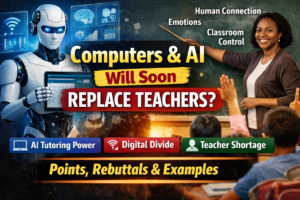
Debate computers and ai will soon replace teachers: what the motion really means
Before you give points, define the motion properly. In debate, definitions are not decoration. They decide the battlefield.
“Computers and AI” can include learning apps, intelligent tutoring systems, chatbots, virtual classrooms, automated marking tools, lesson generators, and adaptive platforms that adjust to a student’s level. So the topic is not only about robots standing in front of a class. It includes software that teaches, guides, tests, and responds.
“Replace teachers” is the heavier part of the motion. It does not simply mean “assist teachers” or “make teachers faster.” It suggests that the teacher’s core role could disappear or become unnecessary.
That is where the argument becomes interesting. If teaching only meant delivering information, then the proposition side would have a strong path. A machine can already explain grammar rules, solve equations, translate text, and generate practice questions in seconds. But if teaching also means judgment, discipline, encouragement, safeguarding, ethics, emotional support, and social development, the claim becomes much harder to prove.
So a smart student should define teaching broadly. That lets you analyze the motion more honestly.
Why this debate matters in Nigeria
This topic feels even more relevant in Nigeria because the country is trying to expand digital learning while still dealing with major infrastructure gaps. Nigeria’s Federal Ministry of Education says in its National Digital Learning Policy that AI and digital tools can improve the effectiveness, efficiency, and inclusivity of learning when used responsibly and ethically.
At the same time, access is uneven. UNICEF’s 2024 situation analysis says only 24 percent of households in Nigeria have internet access, and in rural areas the figure falls to 15 percent. The same report points to low digital literacy and limited electricity as major barriers.
That Nigerian reality matters in a debate. It means students should avoid copying foreign arguments blindly. In some countries, the question is how far AI can go. In Nigeria, the question is also whether schools and households have the connectivity, devices, and support needed for AI-heavy education in the first place.
That local angle makes your argument stronger because it shows you understand the topic beyond slogans.
Strong arguments supporting the motion
AI can deliver personalized tutoring at scale
This is the strongest argument for the proposition side.
A human teacher in a crowded classroom cannot give every learner one-to-one attention all the time. AI systems can respond instantly, explain again, adjust difficulty, and keep going without getting tired. That matters because students do not all learn at the same pace.
There is real evidence behind this idea. A World Bank study and follow-up analysis from Edo State, Nigeria, found that students in an AI-supported after-school programme outperformed the control group by about 0.3 standard deviation overall after six weeks, with gains in English as well. The World Bank described this as roughly 1.5 to 2 years of typical learning progress in similar settings.
That is a powerful debate point. You can say: AI may replace teachers because it can provide individualized tutoring at a scale human systems often cannot match.
Computers can give instant feedback and constant availability
Teachers need sleep, breaks, transport, and time. Computers do not.
An AI tutor can answer questions late at night, generate extra practice instantly, and respond again when a student is confused. For revision-heavy subjects such as English grammar, objective mathematics steps, spelling, vocabulary, and multiple-choice preparation, that kind of constant access can be very useful.
This is one reason many students already turn to digital tools before they ask a teacher. They value speed, privacy, and convenience. A shy student may ask AI ten questions without embarrassment. In a classroom, that same student may stay silent.
That does not prove complete replacement by itself, but it gives the proposition side a practical line: if students can learn, practice, and get feedback without waiting for a teacher, the teacher’s central role may shrink over time.
AI can automate repetitive teaching tasks
Some parts of teaching are repetitive. Marking objective tests. Preparing drill questions. Rewriting notes at different levels. Generating examples. Translating explanations. Summarizing passages. Producing worksheets.
OECD says AI can assist with grading and other teaching functions, although it also stresses that human judgment remains crucial for creative, subjective, and motivational aspects of education. That nuance actually helps the debate. It suggests that even where full replacement is unlikely, partial replacement of tasks is already happening.
So the proposition can argue that teachers may not disappear overnight, but their job may become so reduced that one teacher plus AI can do what several teachers used to do.
Teacher shortages may push schools toward AI-supported instruction
There is a global teacher shortage, and that matters here.
UNESCO says the world needs 44 million additional primary and secondary teachers by 2030. Sub-Saharan Africa is especially affected.
The proposition can use that fact in a strategic way: if education systems cannot recruit enough teachers, they may increasingly rely on computers and AI to fill the gap. Even if policymakers do not want full replacement in theory, economic pressure and staffing shortages may push schools in that direction.
That is one of the more realistic pro-AI arguments. Replacement may happen not only because AI is brilliant, but because human systems are under strain.
Digital platforms can widen access beyond the classroom
A teacher standing in one room can only reach the students physically present. A digital platform can reach students far beyond the school compound.
Nigeria’s digital learning policy is built on that idea. It frames digital learning as a way to make the system more resilient, inclusive, and capable of reaching learners across different locations.
For debate, this gives you a strong modern line: technology scales; human presence does not. If a country wants broader access, especially for revision, distance learning, or catch-up support, AI-enabled systems may become more central than individual teachers.
Strong arguments opposing the motion
Teaching is a human relationship, not just content delivery
This is the strongest argument for the opposition side.
Teaching is not only about passing information from one brain to another. It is also about noticing fear, confusion, boredom, trauma, dishonesty, withdrawal, and talent. A good teacher reads a room. A good teacher knows when a child is struggling emotionally, not just academically.
UNESCO puts this directly: education is a fundamentally human process, and AI can be a powerful assistant but cannot replace the social and emotional skills of educators. UNESCO’s later campaign goes further, saying teachers build human connections no device can replicate and help learners develop critical thinking, ethical reasoning, emotional intelligence, and social belonging.
That is difficult for the proposition to escape. A machine can explain a concept. It cannot truly care in the human sense.
AI cannot fully replace judgment, care, and classroom leadership
Even where AI works well, someone still has to decide what should be taught, what good work looks like, when a student is overconfident, when a response is shallow, and when discipline or encouragement is needed.
OECD says human judgment remains crucial, especially for creative or subjective work and for motivational purposes. It also notes that schools need to understand how AI systems operate, how they generate feedback, and where they may fail.
That matters in real classrooms. A teacher does not only answer questions. A teacher sets norms, builds trust, manages conflict, encourages reluctant learners, and protects standards. Those are leadership functions, not just information functions.
You can sum it up like this in a debate: AI can instruct, but teachers also lead.
AI makes mistakes and can reinforce bias
Many students talk about AI as if it is always correct. That is a weak argument. AI systems can produce false information, shallow explanations, biased outputs, and confident nonsense.
UNESCO’s global guidance on generative AI warns that many countries still lack regulatory frameworks and that educational institutions are often unprepared to validate these tools properly. OECD also warns that AI can amplify bad educational practice, reinforce bias, and create unfair outcomes if used carelessly.
The World Bank’s Nigeria pilot is useful here too. Even in a promising AI tutoring programme, teachers played a direct role in helping students spot AI “hallucinations,” keep on task, and avoid over-reliance.
That is an excellent opposition point. If AI still needs human supervision to stay accurate and safe, then it is not ready to replace teachers.
Nigeria’s digital divide makes full replacement unrealistic
This point is especially important for Nigerian students.
If only 24 percent of households have internet access nationally, and only 15 percent in rural areas, then any argument about full AI replacement must face a practical question: replace teachers for whom?
A replacement model that excludes huge numbers of learners is not a serious education solution. It may work for some urban, connected, device-rich schools. It does not automatically work for the whole country.
So the opposition can argue that even if AI becomes more useful, Nigeria still needs teachers not less, but more, especially where infrastructure is weak.
Practical, moral, and social parts of teaching still need humans
Schools are not only places for academic transactions. They are also places where children learn cooperation, patience, character, boundaries, respect, and social responsibility.
A teacher mediates conflict, notices bullying, mentors students, handles moral grey areas, and helps shape behaviour. UNESCO’s teacher-focused AI work keeps returning to human agency and teacher rights for a reason: once teaching is treated as a technical process alone, something essential is lost.
This is where the opposition often wins. Even if computers become extraordinary tutors, tutoring is not the whole job.
The strongest rebuttals for each side
Rebuttals for the proposition
If you support the motion, the opposition will say AI has no emotions, cannot control a classroom, and will deepen inequality.
Your best reply is not to deny those weaknesses. Your best reply is to say that many parts of teaching are already shifting from human labour to intelligent systems. Marking, revision support, drill practice, translation, tutoring, and content delivery can increasingly be automated. Once enough teaching tasks move to AI, the number of teachers needed may fall sharply even if some adults remain in supervisory roles.
You can also argue that major shifts often begin unevenly. The fact that rural Nigeria still faces infrastructure gaps does not prove the replacement trend is false. It may only mean the replacement happens faster in well-connected environments first.
Rebuttals for the opposition
If you oppose the motion, the proposition will point to AI tutoring gains and personalized learning.
Your best answer is to use the evidence carefully. The World Bank’s Nigeria pilot did show learning gains, but it was teacher-guided. Teachers introduced topics, shaped prompts, monitored use, and corrected hallucinations. That is evidence for AI-assisted teaching, not proof that teachers are becoming unnecessary.
You can also argue that the proposition keeps confusing helping teachers with replacing teachers. Those are not the same claim.
Common mistakes students make in this debate
The first mistake is going to extremes. Saying AI will do everything sounds careless. Saying AI will never change teaching sounds outdated.
The second mistake is ignoring Nigeria. A debate answer that sounds imported from Silicon Valley will feel detached in a Nigerian classroom where electricity, internet access, devices, school funding, and teacher availability are uneven realities.
The third mistake is confusing information delivery with teaching. Teaching includes explanation, yes, but also judgment, trust, discipline, protection, feedback, and emotional support.
The fourth mistake is using technology examples without asking whether they actually prove replacement. A chatbot helping with homework is not the same as a teacher being unnecessary.
A short sample debate closing statement
Here is a closing statement you can adapt:
Computers and AI are changing education fast, and they will continue to take over many teaching tasks such as tutoring, revision, feedback, and content delivery. But teaching is not only the transfer of information. It is also leadership, judgment, motivation, discipline, ethics, and human connection. So while AI may replace parts of a teacher’s work, it is far less convincing to say it will soon replace teachers themselves.
FAQ Section
1. Will computers and AI completely replace teachers soon?
The strongest evidence does not support a full replacement claim. UNESCO explicitly argues that education is fundamentally human and that AI cannot replace the social and emotional skills of educators.
2. Can I support the motion in a school debate?
Yes. You can argue that AI may replace many teaching tasks through personalized tutoring, instant feedback, automation, and scalability. The key is to argue carefully and avoid claiming that every human part of teaching disappears.
3. What is the best argument against AI replacing teachers?
The best argument is that teaching is more than content delivery. It includes emotional support, classroom management, ethical judgment, safeguarding, and motivation, which AI still cannot fully provide. UNESCO and OECD both support that broader view.
4. Is there any Nigerian example I can use in this debate?
Yes. The World Bank’s Edo State pilot on AI-supported tutoring is a strong example. It showed meaningful learning gains, but teachers still guided the sessions and helped manage AI errors. That makes it a useful example for both sides.
5. Why is Nigeria-specific context important in this debate?
Because technology debates can sound unrealistic if they ignore local conditions. UNICEF’s 2024 analysis shows major internet access gaps in Nigeria, especially in rural areas. That affects how quickly AI-based education can spread.
6. What is the difference between AI replacing teachers and AI assisting teachers?
AI assisting teachers means technology helps with tasks such as planning, tutoring, practice, and assessment while the teacher remains central. AI replacing teachers means the teacher’s core role becomes unnecessary. Most current evidence supports assistance far more strongly than full replacement.
7. Which side is stronger in this debate?
For most classrooms, the opposition side is slightly stronger because it aligns better with current evidence. AI is becoming powerful in education, but the most convincing research and policy guidance still describe it as a tool that supports teachers rather than eliminates them.
Conclusion
The motion “Debate computers and ai will soon replace teachers” works best when you treat it seriously instead of dramatically. Yes, AI is already changing education. It can personalize learning, offer instant feedback, reduce routine work, and expand access in ways that matter. In Nigeria, official policy also shows clear interest in using digital tools and AI to improve learning.
But the stronger overall conclusion is more careful than the motion itself. Computers and AI will likely replace some teaching tasks and reshape the profession in major ways. They may even reduce demand for certain routine roles. Still, the evidence from UNESCO, OECD, and real-world education pilots points in the same direction: the future is more likely to be teacher plus AI than AI instead of teacher.
For a debate, that gives you a smart final line: technology will transform teachers’ work, but replacing teachers completely is a much bigger claim than today’s evidence can fully support.