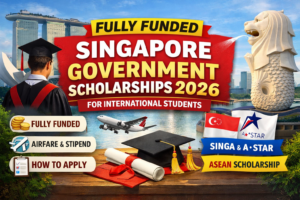
The search phrase fully funded singapore government scholarships 2026 for international students sounds like it should lead to a long, simple list. It usually does not. Once you strip away recycled scholarship roundups and look at the official sources, the real picture is more specific: the strongest verified options in 2026 are mostly tied to A*STAR research funding and MOE’s ASEAN Scholarship, and each one targets a different kind of applicant.
That matters because plenty of students waste time applying for scholarships that do not match their level, nationality, or academic background. This guide focuses on the options I could verify from official or institution-backed sources and explains who each scholarship is actually for, what it covers, and how to approach the application intelligently.
Quick Summary of the Best Official Options
If you want the short version, here it is.
-
SINGA is the clearest broad-access route for international students aiming for a research PhD or EngD in Singapore, especially in science, engineering, computing, and related research areas across A*STAR and partner universities.
-
A*STAR Graduate Scholarship (AGS) is fully funded, but for non-Singaporeans it is much narrower than many articles suggest. A*STAR states that non-Singaporean applicants must already have completed or be completing a degree in a Singapore autonomous university, and non-Singaporean awardees have a three-year service commitment in Singapore-based companies.
-
MOE ASEAN Scholarship is a strong official option for students from selected ASEAN countries, but it is for secondary and pre-university study in Singapore, not for general bachelor’s or master’s degrees. It covers allowance, hostel accommodation, settling-in support, transport, school fees, exam fees, and accident insurance.
What Counts as a Singapore Government Scholarship in 2026?
This is where many articles get sloppy. Some pages label every scholarship in Singapore as a “government scholarship,” even when the funding is really university-based. A cleaner way to handle this keyword is to focus on scholarships administered by the Singapore government or by government-linked research bodies.
That puts ASTAR and the Ministry of Education at the center of the conversation. ASTAR’s international-student pathways include SINGA, SIPGA and ARAP, while MOE runs the ASEAN Scholarship. A*STAR also lists AGS as a graduate scholarship, but its international eligibility is more limited than the phrase “for international students” suggests.
Best Fully Funded Singapore Government Scholarships 2026 for International Students
1) Singapore International Graduate Award (SINGA)
SINGA is the best-known Singapore government-linked scholarship for international students who want a fully funded doctoral pathway. ASTAR describes it as a collaboration with NTU, NUS, SUTD and SMU, built for international students in a research environment. Current ASTAR project pages show active supervisor and project listings across A*STAR, NTU, NUS, SUTD and SMU, which is exactly what serious applicants need to review before applying.
Institution-backed pages also show the practical funding structure: full tuition coverage, an initial monthly stipend for international students, plus one-time settling-in and airfare support. NTU’s graduate scholarship page describes SINGA as covering tuition fees, an initial monthly stipend of S$2,000 that rises after the qualifying examinations, and one-time settling-in and airfare grants.
Who should care most about SINGA? International graduates who want a PhD or EngD in research-heavy fields and who are comfortable building an application around research fit, supervisors, and referees rather than just grades. It is a much better fit for STEM and advanced research applicants than for students looking for a general taught master’s scholarship.
The one tricky part is timing. ASTAR’s search-accessible pages currently show the scholarship ecosystem and application portal, but not a clean, consolidated 2026 deadline page in the text available here. Multiple scholarship trackers recorded 1 June 2025 for the January 2026 intake and 1 December 2025 for the August 2026 intake. Treat those dates as useful reference points, but verify the next live intake on the official ASTAR portal before you submit anything.
Click to apply through the official A*STAR scholarship portalhttps://www.a-star.edu.sg/scholarships/home/scholarships/astar-international-fellowship
2) A*STAR Graduate Scholarship (AGS)
AGS is fully funded and generous, but the fine print matters. A*STAR says successful applicants receive up to four years of support, including full tuition fees, a monthly sustenance allowance, book allowance, computer allowance, conference allowance, thesis allowance, and support for up to 12 months of overseas attachment.
This is where many readers get caught out: AGS is not a broad open-call scholarship for any international student overseas. For non-Singaporeans, A*STAR says applicants must have completed or be on track to complete at least a Second-Class Upper Honours degree in a Singapore autonomous university. In other words, it is mainly relevant if you are already studying in Singapore. For non-Singaporean awardees without permanent residency, there is also a three-year service commitment in Singapore-based companies after graduation.
Timing is clearer here. A*STAR’s pages show one cycle that closed on 15 February 2026 and another running from 1 May 2026 to 1 August 2026, with interview and outcome windows also listed.
So who is AGS really for? Not the average overseas applicant searching from scratch. It is strongest for international students already inside Singapore’s university system who want a funded PhD or EngD and are comfortable with the service commitment.
Click to submit your application through the official A*STAR AGS portal.
3) MOE ASEAN Scholarship
The ASEAN Scholarship is official, valuable, and sometimes overlooked because many scholarship blogs focus only on university applicants. MOE states that this scholarship is for students from ASEAN countries to study in Singapore, and the country pages show that the available tracks are mainly for secondary and pre-university entry, not broad postgraduate study.
The benefits are substantial. MOE country pages list annual allowance with hostel accommodation, settling-in allowance, return economy airfare or transport allowance, school fees, examination fees, and subsidised medical benefits with accident insurance. For many families, that is the difference between “good opportunity” and “actually realistic.”
As of March 2026, MOE says applications for Malaysia are open, Cambodia, Lao PDR and Myanmar will open in April 2026, and applications for Brunei, Indonesia, the Philippines, Thailand and Vietnam are closed. The country pages also show different timelines. For example, Thailand runs from 5 January to 9 March 2026, while Malaysia’s Secondary 1 and 3 window runs from 5 January to 23 March 2026.
This scholarship is best for younger ASEAN students planning a school or junior-college pathway in Singapore, not for graduate applicants.
Click to apply through your official MOE country page and submit your application online.
Eligibility Requirements and Documents You Will Likely Need
The exact document list depends on the scholarship, but a consistent pattern shows up across the verified pages and institution-backed SINGA guidance:
You should expect to prepare your academic transcripts, degree certificates or current-study proof, passport, referee reports, and any required language or test documentation. SINGA-linked institution pages also emphasize academic referees, English ability, and research readiness. AGS requires eligibility for admission to a PhD programme in a Singapore autonomous university.
For research scholarships, your documents are only half the story. Research fit matters just as much. A*STAR’s SINGA project pages encourage applicants to review supervisors and projects across research councils and university units, including interdisciplinary areas. That is a strong signal that vague, generic applications will underperform.
How to Choose the Right Scholarship
Start with level of study, not funding size.
If you are an international graduate aiming for a doctorate in science, engineering, AI, computing, or adjacent research areas, SINGA is usually the first scholarship to investigate.
If you are already studying in Singapore and want an A*STAR-funded PhD or EngD, AGS may fit better, but only if you meet the in-country eligibility rules and are comfortable with the service commitment.
If you are from an ASEAN country and still at secondary or pre-university stage, the ASEAN Scholarship is the more relevant route.
That sounds obvious, but it solves the main search-intent problem behind this keyword: people often search broadly, while the scholarships are actually narrow.
Step-by-Step Application Process
First, identify the scholarship that matches your level and nationality. Do not begin with the application form.
Second, read the eligibility rules line by line. For AGS, the foreign-applicant restriction is crucial. For ASEAN Scholarship, country-specific pages matter. For SINGA, research field and supervisor fit matter most.
Third, prepare your documents early. Referee reports and transcripts often slow applicants down more than the form itself.
Fourth, review research projects before writing your statement. A*STAR explicitly provides supervisor and project pages for SINGA applicants, and serious applications should use them.
Fifth, submit only through the official portal or country page. That sounds basic, but scholarship scams and stale aggregator links are common around high-demand opportunities.
Common Mistakes to Avoid
One mistake is assuming every “Singapore government scholarship” is open to all international students. It is not.
Another is applying for AGS from overseas without noticing that the foreign-applicant rule is tied to having studied in a Singapore autonomous university.
A third is treating SINGA like a generic scholarship essay competition. It is a research scholarship. Project fit, field alignment, and referees matter.
The last big mistake is waiting too long. Even when a scholarship is officially open, documents, references, test records, and research matching take longer than most applicants expect.
Important 2026 Notes and Deadline Strategy
For 2026 planning, the safest strategy is to work backward from the likely intake rather than waiting for the final week.
A*STAR’s AGS timeline already shows two cycles around 2026. MOE’s ASEAN Scholarship is clearly country-specific and can open or close at different times depending on the country. SINGA timing appears to follow intake-based cycles that close well before the programme start date, so early preparation is not optional.
The practical takeaway is simple: shortlist the right scholarship first, gather your documents next, and use only the official portal or official country page when you are ready to apply.
FAQ Section
1. Which is the best Singapore government scholarship for international PhD students in 2026?
For most international PhD applicants, SINGA is the strongest broad-access option among the verified official routes because it is designed for international research candidates and links A*STAR with major Singapore partner universities.
2. Is SINGA fully funded?
Institution-backed pages describe SINGA as covering tuition fees, an initial monthly stipend, and one-time settling-in and airfare grants.
3. Can any international student apply for A*STAR Graduate Scholarship?
No. A*STAR says non-Singaporean applicants for AGS must have completed or be completing a degree in a Singapore autonomous university, so it is not a general overseas scholarship for every international applicant.
4. Does AGS have a bond or service commitment?
Yes, for non-Singaporeans without Singapore permanent residency. A*STAR states there is a three-year service commitment in Singapore-based companies.
5. Is the MOE ASEAN Scholarship for university students?
Usually no. The official MOE pages show it is targeted at secondary and pre-university entry, depending on the country.
6. What documents are commonly required for Singapore research scholarships?
You will usually need academic transcripts, degree certificates or current-study proof, passport details, referee reports, and sometimes English or other test scores, depending on the scholarship and institution.
7. Are there many fully funded Singapore government scholarships for international bachelor’s or master’s students?
Among the official options I could verify here, the clearest routes lean more toward PhD research funding and ASEAN school/pre-university scholarships than toward broad government-funded bachelor’s or taught master’s scholarships for all international students.
Conclusion
If you are searching for fully funded singapore government scholarships 2026 for international students, the smartest move is to ignore inflated roundup lists and focus on the official pathways that actually match your profile. For most international research applicants, that means starting with SINGA. For foreign students already studying in Singapore, AGS may be the better fit. For younger ASEAN students, the MOE ASEAN Scholarship is the key route. Use the official portal, prepare your documents early, and click to apply only when you have confirmed that the scholarship truly fits your study level, nationality, and timeline.