7 Proven Ways on How to Use Past Questions to Predict JAMB Questions (Stop Guessing)
Let’s keep it real. Every year, over 1.5 million students sit for JAMB, and every year, the story is the same. Some come out smiling, while others start blaming “village people” or the CBT center’s mouse for their low scores.
But here is the secret most high-scorers won’t tell you: JAMB isn’t inventive. They aren’t sitting down every year to create brand new, never-before-seen questions from scratch. They have a question bank.
If you are wondering how to use past questions to predict JAMB questions, you are asking the single most important question for your admission. Most students use past questions to test themselves. That’s okay. But the smart ones? They use them to predict the future.
I’m going to show you exactly how to do that.

The “Recycling” Secret: Understanding How JAMB Sets Questions
Think about it. The laws of Physics haven’t changed since Newton. The rules of Concord in English are the same. Biology diagrams are standard.
JAMB has been conducting exams since 1978. Do you honestly think they generate 100% fresh questions every year? No. They recycle.
But—and this is a big “but”—they don’t just copy and paste the exact question word-for-word (well, sometimes they do). They tweak it. They change the figures. They rephrase the sentence.
If you understand the pattern, the exam hall becomes a playground. You will read a question and smile because you’ve seen it before, just wearing a different shirt.
Step 1: Thematic Sorting (Don’t Solve by Year, Solve by Topic)
This is where 90% of students get it wrong. You probably pick up a past question booklet, open to “2019,” and try to solve numbers 1 to 40.
That’s a waste of time if you want to predict questions.
Do this instead:
Pick a topic from the Official JAMB Syllabus. Let’s say “Sound Waves” in Physics. Now, go through your past questions from 2010 to 2023 and pick out only the questions on Sound Waves.
You will notice something shocking.
You’ll see that they ask the same 3 things repeatedly:
-
Calculation of echo.
-
Characteristics of sound (Pitch/Frequency).
-
Resonance in tubes.
Once you solve 15 questions on just Sound Waves back-to-back, you will own that topic. You won’t just know the answers; you’ll know exactly how they set the trap.
Step 2: The “Wrong Option” Strategy (The Hidden Goldmine)
This is my favorite trick. It works like magic.
When you answer a question, don’t just mark option A and move on. Look at options B, C, and D. Why are they there?
Often, JAMB takes the wrong options from a 2018 question and turns them into the question for 2024.
Imagine this scenario:
2018 Question: Which of these is a vector quantity?
A) Mass
B) Distance
C) Velocity (Correct)
D) Time
In 2024, the question might be: “Time, Mass, and Distance are examples of what type of quantity?”
If you had studied the “wrong” options back then, you’d already know the definitions of Scalar quantities. Don’t just hunt for the right answer. Study the distractors. They are usually future questions in waiting.
Step 3: Spotting the “Twist” (Same Question, Different Values)
Maths, Physics, and Chemistry students, gather round.
I’ve seen students cry because they crammed the answer “50J” for a specific work-done question. Then they get into the exam hall, see the same question, tick “50J,” and fail.
Why?
Because JAMB changed the force from 10N to 20N.
Predicting questions doesn’t mean predicting the answers. It means predicting the method. When you practice, focus on the formula used, not the final figure. If you know the formula for potential energy ($mgh$), it doesn’t matter if they change the mass or the height. You will still get it right.
Top universities like UNILAG and UI are extremely competitive. The difference between a merit list admission and “supplementary list” begging often comes down to these small details in calculation subjects.
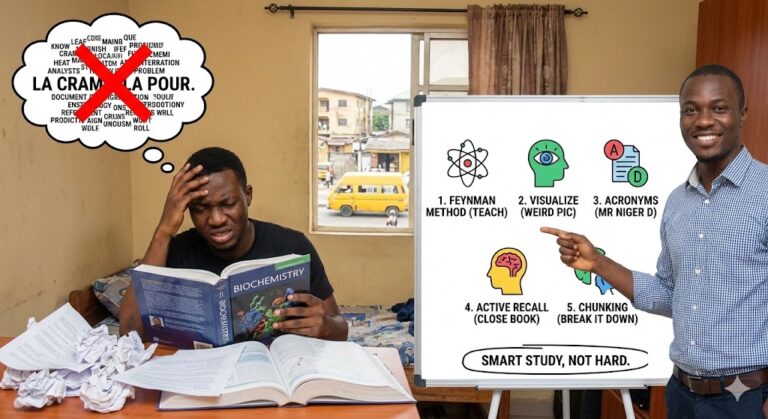
Common Mistakes: Why “La Cram, La Pour” Will Fail You
We need to talk about the “Expo” mentality.
Some apps and booklets have answer keys that are plain wrong. I’ve seen students memorize wrong answers because they trust the booklet more than their textbooks.
Also, JAMB shuffles options. In your past question book, the answer might be A. In the actual CBT exam, that same answer might be moved to C.
If you go in there with a crammed head saying, “Question on Osmosis is always Option A,” you are setting yourself up for premium tears.
Recommended Tools & Resources
You don’t need expensive tutorials to do this. You just need discipline.
-
JAMB CAPS: Keep an eye on the official portal for updates.
-
CBT Practice Software: Use apps that allow you to sort questions by topic.
-
Educational News Sites: Platforms like The Punch often interview high scorers who share similar strategies.
Final Verdict: It’s About Strategy, Not Magic
Predicting JAMB questions isn’t juju. It’s pattern recognition.
If you start studying themes instead of years, and if you start analyzing the wrong options, you will walk into that exam hall feeling like you have the marking scheme in your pocket.
Don’t wait until two weeks to the exam. Start this method today. Grab your past question pack, rip it apart (mentally), and start connecting the dots.
Your admission letter is waiting. Go get it.