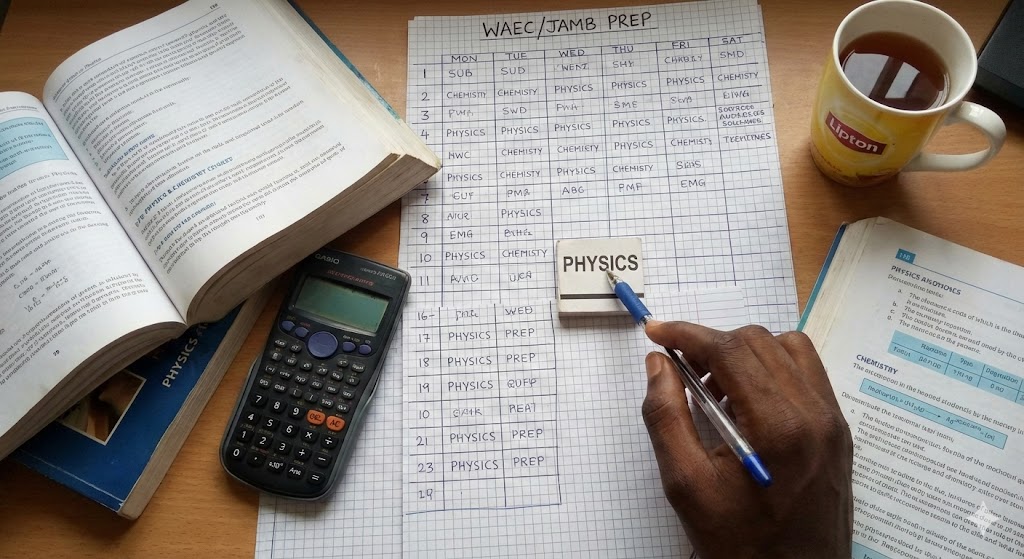
7 Proven Steps to Build a Killer Study Timetable for Science Students in Nigeria (And Stop Failing)
Let’s be honest: being a science student in Nigeria is not beans.
You’re not just reading stories; you’re juggling Physics calculations that look like hieroglyphics, Organic Chemistry chains that refuse to stick, and Biology diagrams that need to be labeled perfectly. It’s a lot.
And here is the mistake most students make. They wake up, pick up a textbook, and just start reading without a plan. They call it “jacking.” I call it a waste of time.
If you are preparing for WAEC, NECO, or trying to crush that JAMB score to get into a school like UNILAG or UI, you don’t need to read harder. You need to read smarter. A study timetable isn’t just a piece of paper; it’s the only thing standing between you and that “admission not given” cap on the JAMB portal.
Here is how to build a study timetable that actually works for a Nigerian science student.

1. Audit Your Current Lifestyle (The “Honest” Truth)
Before you draw any table, look at your life. Seriously.
Most students create a timetable that says “Wake up 4 AM, Read till 7 AM.” But be real—do you actually wake up at 4 AM? Or do you snooze the alarm until your mom bangs on the door?
If you build a timetable based on who you want to be, rather than who you are, you will fail by Day 3.
Grab a piece of paper. Write down exactly what takes up your time. School hours. Lesson. House chores (because we know Nigerian parents won’t let you rest just because you have exams). Sleeping. TikTok scrolling.
Once you see the “free” hours you actually have, you can stop deceiving yourself.
2. Prioritize Your “Problem” Subjects
Science subjects are jealous. If you leave Physics alone for one week, the formulas will leave you.
But not all subjects are equal. You might be a wizard at Biology but struggle with Further Math. A common mistake I see is students spending all their time reading the subjects they love because it makes them feel smart.
That’s a trap.
Your timetable needs to be heavy on your weak points. If Chemistry is your headache, it needs to appear on your timetable during your “peak hours”—that time of day when your brain is sharpest. For most people, that’s not 11 PM when you are dozing off.
Check the JAMB Brochure to confirm exactly which subject combinations carry the most weight for your desired course, and give them the respect they deserve.
3. The “Block” Method vs. The Marathon (Stop Burning Out)
You might think studying for 8 hours straight makes you a serious student. Honestly? It just makes you tired.
Your brain isn’t designed to focus on Stoichiometry for four hours without a break. This is why you find yourself reading the same paragraph five times.
Use the Block Method (or Pomodoro).
-
Study for 50 minutes.
-
Rest for 10 minutes.
During that rest, stand up. Walk around. Don’t pick up your phone to check WhatsApp statuses, or you’ll lose 30 minutes instantly.
Mixing subjects helps too. Don’t do calculation subjects back-to-back. If you just finished a heavy Physics block, switch to English or Biology next. It gives the “math part” of your brain a break.
4. Integrating WAEC & JAMB Past Questions
If your timetable only says “Read Textbook,” tear it up.
You can know the definition of everything in the textbook and still fail because you don’t know how the questions are set. The West African Examinations Council (WAEC) has a specific way they ask questions. The same goes for JAMB.
Dedicate at least two slots a week specifically for solving questions. Not reading them. Solving them.
Treat it like a mock exam. Time yourself. If you get it wrong, go back to your textbook to find out why. This is active recall, and it beats “la cram, la pour” every single time.
5. Factor in “Nigerian Realities”
This is the part nobody talks about online.
You live in Nigeria. The light will go off (UP NEPA). Your younger siblings will make noise. Your data might finish.
If your timetable is too rigid, one power outage will ruin your mood.
-
Have a Plan B: If there’s no light, do you have a rechargeable lamp? Or can you switch to a topic that doesn’t require solving calculations so you can read with a candle?
-
Chores: Don’t schedule study time when you know you have to wash plates or fetch water. You’ll just get frustrated when you’re interrupted. Schedule around the chores.
6. The Sample Timetable (A Template You Can Use)
This is a rough guide. Tweak it to fit your reality.
| Time | Activity | Notes |
| 5:00 AM – 6:30 AM | Hard Subject (e.g., Physics) | Brain is fresh. Tackle the calculations now. |
| 7:00 AM – 4:00 PM | School / Lesson / Chores | The daily grind. |
| 4:00 PM – 5:00 PM | Rest / Sleep | Do not skip this. You need to reset. |
| 5:00 PM – 6:30 PM | Medium Subject (e.g., Chem) | Focus on organic or physical chemistry. |
| 7:00 PM – 8:00 PM | Past Questions (Speed Run) | Pick a year and solve 40 questions. |
| 8:00 PM – 9:00 PM | Dinner / Relax | Eat. Gist with family. |
| 9:00 PM – 10:00 PM | Light Subject (e.g., Biology/Agric) | Reading and memorization. No heavy math. |
Note: On weekends, extend these blocks. But keep the breaks!
7. The Weekend Review Rule
Sunday evening is not for reading. It’s for auditing.
Look at your week. Did you actually follow the plan? Did you realize you spent too much time on English and zero time on Physics?
Be your own boss. If you slacked off, don’t beat yourself up—just adjust the plan for the next week. According to reports from The Guardian Nigeria, consistent review is often the difference between average students and top scorers.
Final Thoughts: Consistency Over Intensity
Don’t try to be Superman.
I’ve seen students start with 10 hours a day and quit after a week because they crashed. It is better to study for 3 hours every single day than to study for 15 hours once a week.
Stick to the plan, respect the rest breaks, and don’t let a bad grade in a mock exam discourage you. You’ve got this. Now, go draft that table.