7 Proven Hacks on How to Focus on Studies in a Noisy Environment (Stop Failing Today)
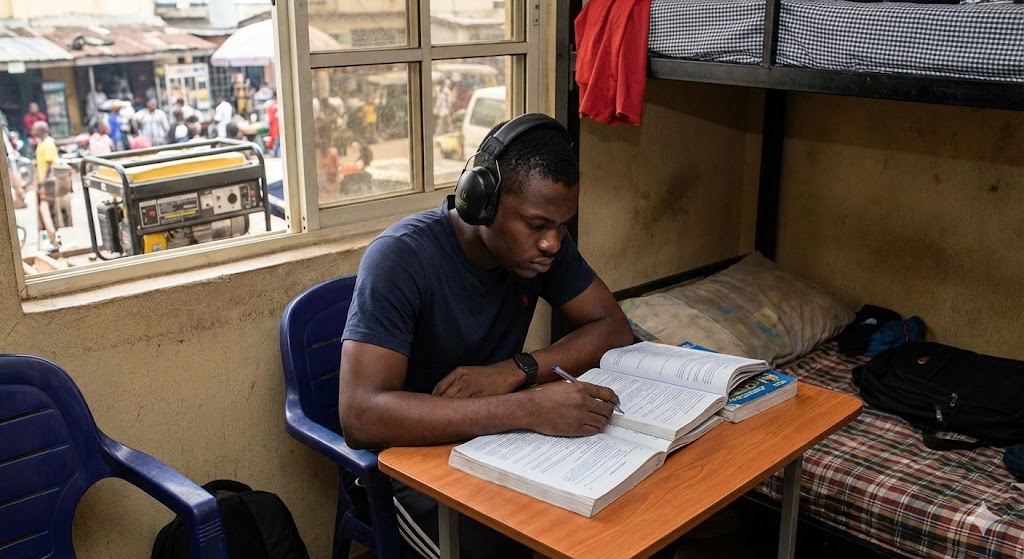
Picture this: You have a Chemistry exam tomorrow. You’ve opened your textbook to “Stoichiometry,” ready to crack the code. But just as you start reading, your neighbor’s generator roars to life like a helicopter taking off.
To make matters worse, the guys at the gate are arguing about who is the GOAT between Messi and Ronaldo, and crying babies are providing the backup vocals.
It is frustrating.
If you are a student in Nigeria, silence is a luxury. Whether you live in a noisy hostel in Akoka or a “face-me-i-face-you” in Ibadan, finding a quiet place to read is harder than finding original fuel. But here is the bitter truth: WAEC and JAMB don’t care about your environment. They only care about your answers.
So, how do you survive? Here is exactly how to focus on studies in a noisy environment without losing your mind (or your grades).
1. The “Masking” Technique (Fight Noise with Noise)
Silence is impossible? Fine. Create your own noise.
This might sound crazy, but trying to force silence when it doesn’t exist will only make you angry. Instead, use “White Noise.” This is a consistent, steady sound that drowns out the random, distracting noises (like people shouting or horns honking).
You don’t need expensive gear.
-
Download a “Rain Sound” app.
-
Play “Lo-Fi Beats” or instrumental music on YouTube.
The goal isn’t to listen to the music; it’s to create a sound barrier. I used to play the sound of a fan on my phone just to block out my roommates’ gisting. It works like magic because your brain eventually ignores the steady sound and focuses on the book.
2. Change Your Timeline (The 3 AM Advantage)
If you can’t beat them, don’t join them—just avoid them.
Most noise makers have a weakness: they eventually sleep. The hours between 1:00 AM and 4:00 AM are usually the “Golden Hours” for Nigerian students. The generator has likely been switched off, the neighbors are asleep, and the road is quiet.
I know, waking up that early is painful. But if you are serious about hitting that cut-off mark for University of Lagos (UNILAG), you might need to adjust your sleep schedule. Sleep when the noise is loud (maybe 7 PM to 12 AM) and wake up to read when the world is quiet.
3. Go “Active” Instead of “Passive”
Here is a mistake I see all the time. Students try to read novels or heavy theory notes when the environment is chaotic. That’s a recipe for disaster.
When the noise level is high, switch to Active Study.
-
Don’t just read; solve calculations (Maths, Physics, Accounting).
-
Don’t just stare at the page; write out notes furiously.
-
Read out loud to yourself.
When you are writing or solving, your brain is more engaged. It enters a “flow state” faster than when you are passively reading lines of text. According to study tips often shared by the West African Examinations Council (WAEC), active engagement with study materials improves retention significantly, even in less-than-ideal conditions.
4. The Library Escape (Or Finding Your “Ghost” Spot)
Sometimes, your house is just a war zone. You need to evacuate.
Don’t be stubborn. If the noise is affecting your mental health, pack your bag.
-
Does your school have a library?
-
Is there a religious center (Mosque or Church) nearby that is quiet during the day?
-
Can you crash at a serious friend’s place?
I remember leaving my hostel to read in an empty classroom block because my roommates were having a birthday party. It wasn’t comfortable, but I passed that semester. Comfort doesn’t bring results; focus does.
5. Low-Budget Earplugs
You might think you need N150,000 noise-canceling headphones to study. You don’t.
Go to a pharmacy and buy foam earplugs. They are cheap. Or, in a worst-case scenario, use cotton wool. It won’t block everything, but it muffles the sharp sounds that usually break your concentration.
Combine this with the “Masking” technique (Tip #1), and you are practically in a soundproof booth.
6. Negotiate Like a Diplomat
This is tricky, so tread carefully.
If the noise is coming from a specific person (like a roommate playing loud music), ask them nicely. Don’t fight. Just say, “Abeg, I get serious exam tomorrow, help me reduce the volume small.”
Most times, people don’t even know they are disturbing you. However, if the noise is coming from a generator or a religious building, you can’t really negotiate that. Refer to Tip #2 or #4 instead.
7. Train for the Chaos
Here is a perspective shift that might help.
The exam hall won’t be perfectly silent.
-
An invigilator might be talking.
-
A student nearby might be coughing.
-
A desk might be squeaking.
If you only learn to study in perfect silence, you will panic when the exam hall is noisy. See your noisy environment as a training ground. If you can solve a complex Calculus problem while your neighbor is shouting, the JAMB exam will feel like a walk in the park.
Final Words: Your Grades Don’t Care About the Noise
It’s tough. I won’t lie to you and say it’s easy to ignore a loud environment.
But successful students don’t wait for perfect conditions. They adapt. Whether it’s waking up at 3 AM or stuffing cotton wool in your ears, do what you have to do.
Reports from The Guardian Nigeria often highlight that resilience is the number one trait of top-performing students in the country. Be resilient. Block out the noise, and get that admission.